Tithonus’ Drone: Myth, Loss and Memory in Phoenix Springs
This is a feature story from Unwinnable Monthly #195. If you like what you see, grab the magazine for less than ten dollars, or subscribe and get all future magazines for half price.
———
The grasshopper plucks a harp.
The player is cradled within a frame narrative, witnessing Phoenix Springs protagonist Iris’ memories as she reminisces on a train headed to the game’s titular location. She is looking for her brother.
Iris, a technology reporter, appears to be in her 30s, perhaps 40s. She narrates her investigation with a level of detachment, speaking in a low register, her voice marked by a slight rasp. The player navigates by point-and-click, collecting a web of ideas stored in a menu used to make connections that push Iris forward. This menu of leads is centered on her brother’s name: Leo Dormer.
Phoenix Springs’ looping narrative makes Iris resemble not a grasshopper, but another insect mentioned in passing in the game – a cicada. In a facsimile of its life cycle, she unearths herself from her memories, emerges into a desert oasis and repeats her song to each individual she encounters. At her journey’s end, she returns underground and is reborn, reemerging to enact the cycle again.
This is the night she finds him. Leo Dormer. Her little brother.
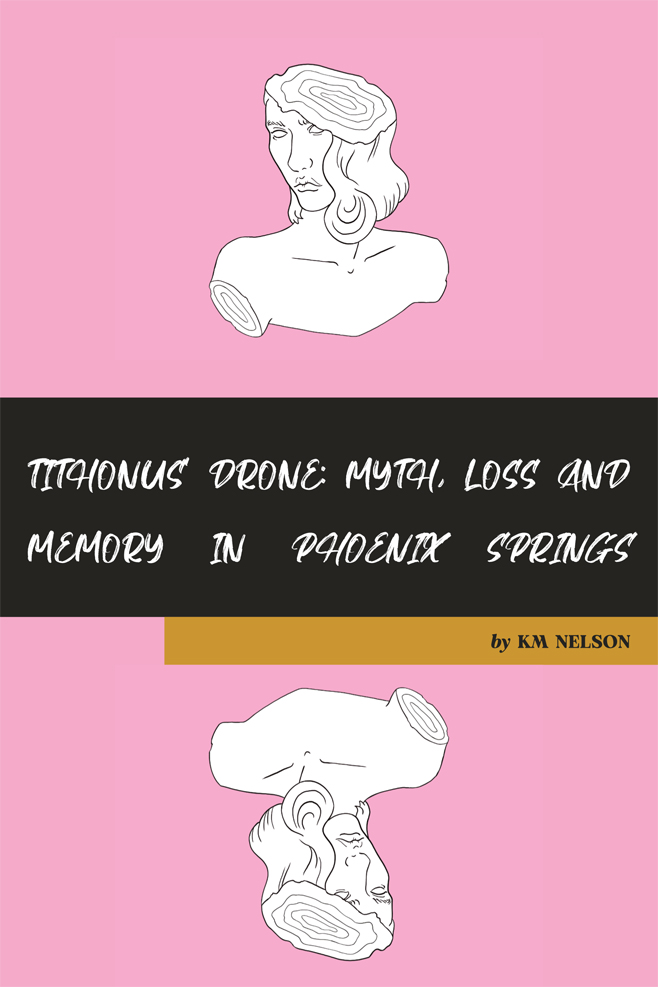
She first sees the image of the grasshopper illustrated on a poster – a proposed statue to be placed in front of the university where Leo worked, never to be built. She later finds it in Leo’s home, part of a network of clues that will get her through a locked door. A small sculpture sits on a credenza, golden with red eyes and mosaic wings, a harp nestled between its forelimbs. Once she is in possession of the grasshopper’s name, Tithonus, she can find his story within a book authored by her bioethicist sibling. “Cursed lover of Eos, Goddess of the Dawn,” the volume reads. “Begged the Gods to grant him eternal life, yet forgot to ask for his eternal youth. Often represented as a cicada or grasshopper.”
Armed with an answer that will open the aforementioned door, Iris crosses its threshold. There she finds her younger brother, an elderly man who says with his dying breath, “Don’t go to Phoenix Springs.”
In Ancient Greek pottery, Tithonus is depicted holding a lyre. The Tithonus myth has several variations. In the version that most closely aligns with the description in Phoenix Springs, he requests immortality for himself then later begs Eos for respite from his ongoing deterioration. Though Eos is unable to grant him death, she transforms him into a singing insect, either a cicada or grasshopper. From this combination the statue’s iconography is drawn: Tithonus, now transformed, still playing a harp despite his insect-form’s ability to stridulate. However, in the Homeric Hymn to Aphrodite, it is Eos who makes the mistake, requesting from Zeus immortality for her lover but not agelessness. As Tithonus withers over time, she hides him from view. Per Martin L. West’s translation, “And when repulsive old age pressed fully upon him, and he could not move or lift any of his limbs, this is what she decided was the best course: she laid him away in a chamber, and shut its shining doors. His voice still runs on unceasing, but there is none of the strength that there used to be in his bent limbs” (Homeric Hymns. Homeric Apocrypha. Lives of Homer, 177).
The loop of Iris’ remembrances closes; she is back on the train. When she disembarks, she meets a boy in a desert. She asks him about Leo Dormer (she asks everyone about Leo Dormer). He reacts dismissively. Iris narrates: “That name again, he sighs. Wherever I stand, he says, no matter what I do. There’s forever a Crying One asking about Leo Dormer.”
Like the cicada nymph, she has emerged. Within Phoenix Springs’ oasis she moves in circles, navigating perplexing conversations with its enigmatic residents.
“Those trees by the river: they weren’t there yesterday.”
“There is a binary between mind and body.”
“What happens when you place a mirror in front of another mirror?”
With each person, she repeats her call (Leo Dormer, Leo Dormer) droning on like the cicada’s song in summer.
The residents of Phoenix Springs are distorted, degraded. Some are more lucid than others; none will give Iris straight answers. A writer fills handmade paper with undecipherable symbols. A woman rocks herself, humming a melody. A naked man carefully monitors his pulse. “I anticipate an anomaly in the data,” he explains. “This heart never stutters.”
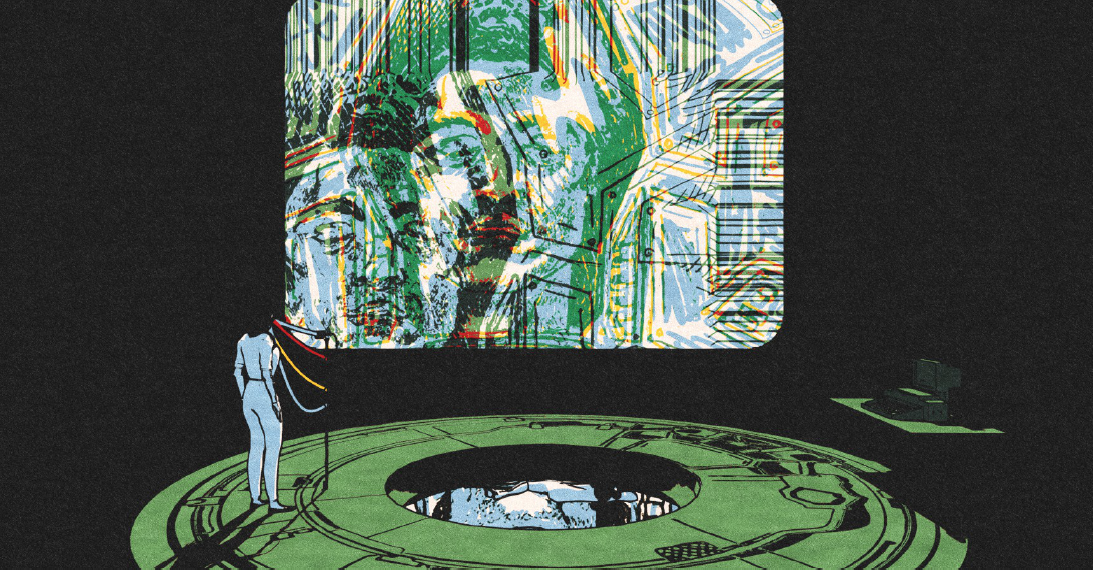
Iris isn’t only disconnected from the people around her – connections to the outside world seem to have also been severed. There is an antique radio perched on a cliff in the desert, which can only receive signals, not transmit. When she turns the dial, she hears static. Later she’ll find it smashed, presumably pushed off the edge. A second radio waits on an island at the end of her journey, thick cables snaking from its rear to couple with towers adorned with dishes and antennae. She cannot use it, however, as a man is occupied with the device (“Distress call,” he mutters, waving her away). Whatever the nature of the broadcast, it is unavailable to her.
Phoenix Springs feels incomplete, most noticeably in its oasis ecosystem. The soundscape includes a smattering of birdsong, chirps and warbles intermingling with a gentle breeze that massages the tree canopy. One intermittent, eerie cry sounds somewhere between a human wail and a creaking door. However, no birds are seen. The only nonhuman creatures Iris encounters are paired with rot. Flies buzz around buckets of decaying fruit, and maggots writhe in the flesh of a yellow citrus she lifts from the ground. This lack extends beyond the place’s natural characteristics. For all the futuristic equipment the player sees in Iris’ memories – a mirror that swaps out reflective glass for a video feed, a gate that verifies identity via a DNA scan, a stasis pod – Phoenix Springs is comparatively rustic. Its wooden cabins are largely filled with handicrafts. A notable exception is an instrument that lies within the High Cabin. “Snake-haired machine,” Iris remarks. “Clinical imaging device. Repurposed to produce sounds.”
This incompleteness conveys the location’s illusory nature. Phoenix Springs is a simulacrum, a false utopia. Stumps regenerate into trees overnight. Birdsong is piped in. Its inhabitants are frozen, stultified, warping more and more over time. It is an empty world, and its occupants are slowly emptying themselves out. Like data on a discarded hard drive, they are subject to bitrot.
The Crying Girl sobs alone in a cabin. She wails, “I’m going under soon . . . and I can’t remember my own name.” Iris adjusts her inquiry, deviating from her repeated chorus of “Leo Dormer, Leo Dormer” to uncover the Crying Girl’s memories. Her identity restored, the girl – now called Mason – enacts a ritual. Mason is far from the first to go under; bathed in the heat of a bonfire, Iris confesses to having seen this scene “a hundred times.”
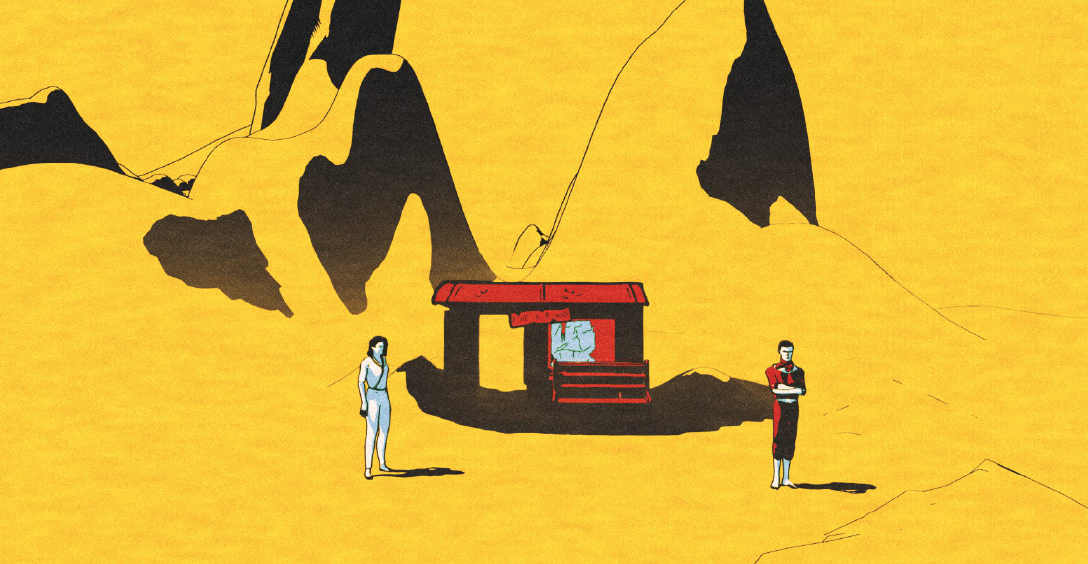
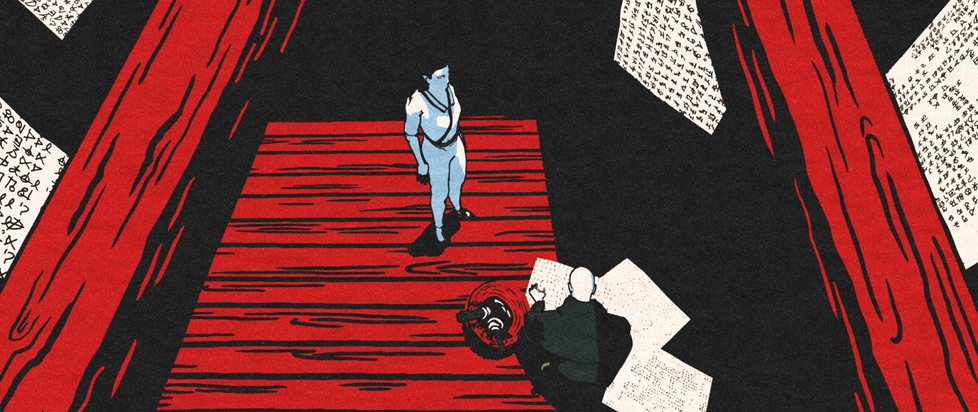
Now begins another circuitous loop (through memory, through the oasis), after which Iris delves underground to uncover the truth of it all. Here lies Phoenix Springs’ missing technology. Empty stasis pods are scattered in the space, “discarded like bullet casings.” A circular platform sits in front of a screen. In its center lies a pool of viscous liquid into which a descending tube drops bodies, individuals whose memories Iris can access via an imaging device similar to the High Cabin’s instrument. She communes with Mason – “two souls crammed into one skull” – who is unrecognizable, skin sheared away from her face, black spheres congealed on her head and torso. Between Mason and one more tortured soul, the Architect, she unearths a narrative. There was an accident. A procedure, called Rebirth. A surgeon. A reporter.
Iris enters that black pool herself and relives her memory of Leo a third time. Like Tithonus, she sought immortality. Leo saw the truth of it: “I’m afraid eternity would distort me eternally,” he told her. He refused to join her, and begged her not to go.
“The words ring like a curse.”
Not every answer is spelled out, though. In the game’s climactic reveal, Iris does not divulge the exact nature of her eternal existence. And why would she? What may be unclear to the outsider hitching a ride on her consciousness, buoyed only by her narration, she knows intimately. However long she has repeated this cycle (“Years, decades, millennia?”), however many memories she has jettisoned (or that have become distorted by repeated remembrance – Leo’s address is supposedly 341 Belvedere Heights, but is later displayed as 413), Iris always returns to confront that pivotal, traumatic loss. Again and again, she relives the death of her sibling, the precursor to her greatest mistake: choosing to pursue the promise of life unending.
Still, the pieces are there for those who seek them. There’s a stasis pod in Leo’s home. “End-of-life technology,” Iris narrates. In the High Cabin she speaks to a Tall Woman, who says, “Fifty pods per floor…maximum occupancy. The fire escape was a monstrous spiral staircase.” On another visit to that location, the Musician describes the audio of Phoenix Springs, saying, “It sounds like a bomb or eruption. Then liquid.” (This is heard at key moments in the game, a deep rumbling accompanied by a pulsating noise similar to a heartbeat heard on an ultrasound.) Overwhelmed by Mason’s ritual, words spill from Iris: “The acoustics in the sanctum are excellent. It must be wired for sound. The smoke is anesthetic. It stings the eyes and relaxes. The water has an oily quality. It rises and smells faintly of roses.” And during Iris’ communion with Mason, various images briefly cohere on the display: three medical professionals as seen from the point-of-view of a patient on an operating table, what appears to be a microscopic device breaching the wall of a human cell, and a person entombed in a pod.
More images bubble to the surface: The Reporter conversing, questioning, crying.
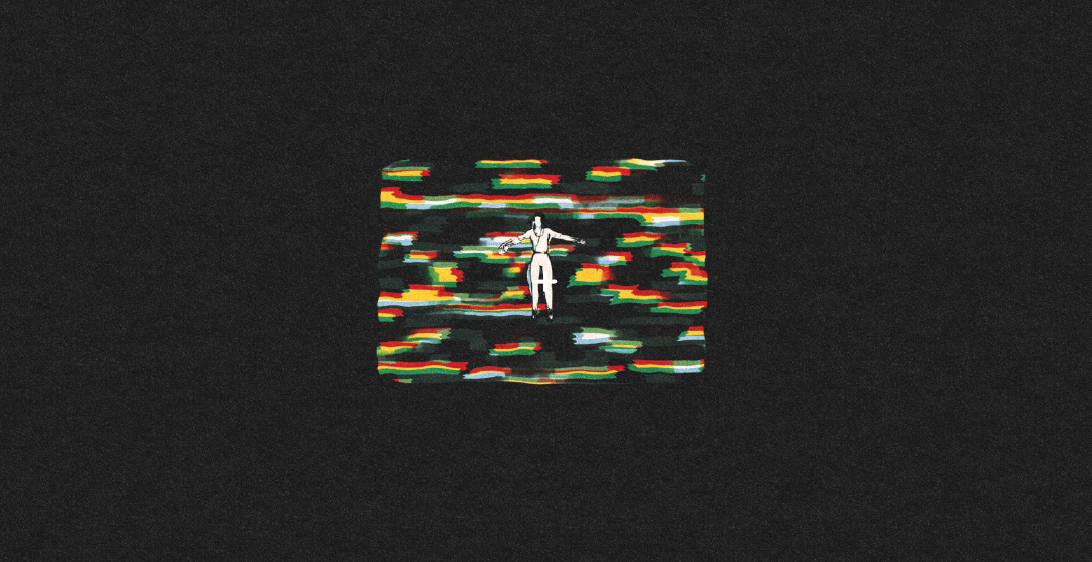
“Something happens to me here. I become broken. An engine that only produces one question,” Iris laments, “But it is me. The reason his name lives on. I ask about Leo. Endlessly.” But what of it? She continuously projects an image of her dead brother, glitching and prismatic, fragmented by her own incremental dissolution. Her cicada song – a meaningless drone to her equally eroded compatriots – cannot be heard beyond the border of Phoenix Springs.
What is the point of a memorial to the dead if there is no one to receive it?
Iris is also ensconced in the sanctum of a stasis pod. While her cycle of rebirth within the simulacrum resembles the biological processes of the cicada, she is not the Tithonus transformed by Eos, but the Crying One shut behind a set of shining doors: endlessly babbling, endlessly degrading. She is forever cocooned, with no promise of escape or respite, disconnected from both the world at large and the others interred alongside her.
Cast upon a rocky shore, sitting among a symbolic representation of what amounts to her and Leo’s combined history, she muses, “Maybe I should have left when I still had the chance.”
That chance is long gone. There remains only one thing for Iris to do: repeat the lamentation of her loss, and sing her brother’s name regardless of whether anyone will listen.
———
KM Nelson is a writer and editor from Texas. She is the Managing Editor for startmenu and Editor for Deleted Saves, and edited, provided quality assurance for and performed in Radiant Array’s debut visual novel Interstate 35. You can follow her on Bluesky.