Grad School is the Scariest Part: On Re-Animator
This is a feature excerpt from Unwinnable Monthly #195. If you like what you see, grab the magazine for less than ten dollars, or subscribe and get all future magazines for half price.
———
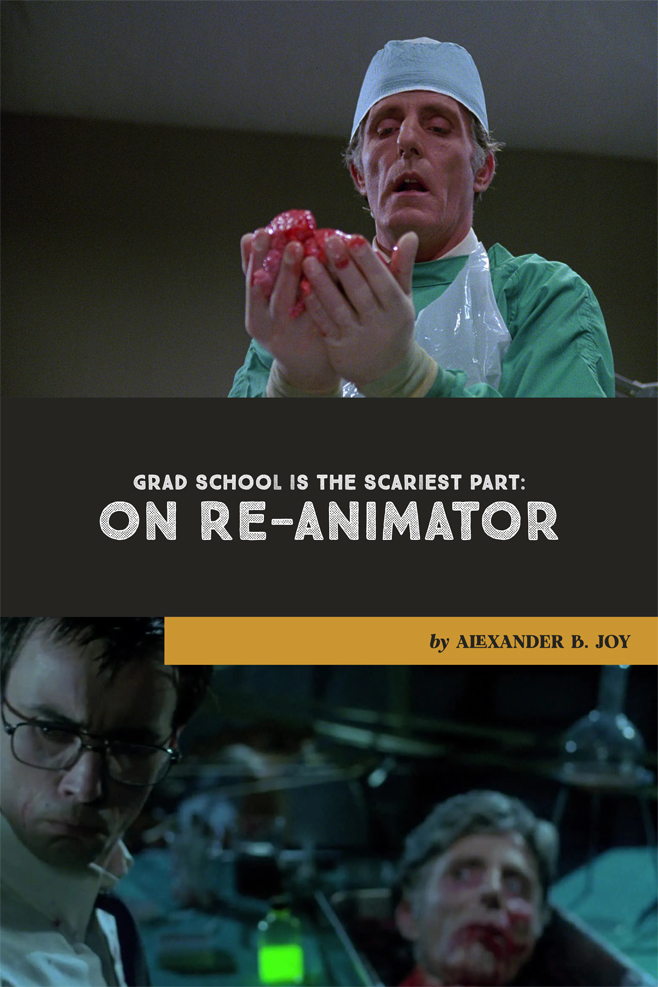
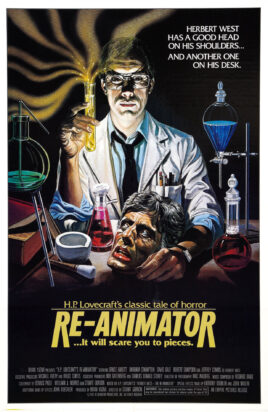
Re-Animator is a loose cinematic adaptation of the H.P. Lovecraft story, “Herbert West—Reanimator” (1921–1922), covering the life and times of a brilliant but misguided scientist who develops a serum capable of restoring life to dead matter. The film opts for a modern setting where West becomes a twenty- or thirty-something medical student who struggles to garner resources and legitimacy for his disconcerting research, while the remaining cast are refashioned as university administrators, faculty and students to suit.
But unlike typical dark academia, Re-Animator finds no romance in the university, recognizing that it’s another workplace at best, and a far more hostile environment in its usual mode. In Re-Animator, as in real life, departmental politics, professorial caprice and administrative incompetence conspire to produce even scarier outcomes than Herbert West’s corpse-revitalizing reagent.
Observing what the characters in the film find frightening soon reveals academic life itself as the central locus of Re-Animator’s horror. Few people greet the violent, shambling beings that West recalls from death with an appropriate level of terror, more often responding with surprise or scientific curiosity. Threats to research or academic careers, however, come across as infinitely more horrible. Take, for instance, protagonist Dan Cain, West’s housemate and later assistant. Handsome but otherwise nondescript, Cain’s visual coding brands him a creature of convention, the kind of person content to follow the rules because they often benefit him and his like. Accordingly, although he’s alarmed by seeing resurrected housecats and vivified morgue bodies, the real source of his distress is seldom the creatures themselves, nor the ethics of creating such abominations; it’s the trouble his overseers might cause after they learn what he and West have been attempting.

For Cain, the question is never “What have we done,” but rather, “What will my advisors do?” He’s not wrong to worry. Cain can only attend Miskatonic Medical because of a student loan the university has extended. His entire future is therefore at the mercy of his professors, whose opinions alone determine whether that line of credit remains open. For those in his position, seniority is not strength. The issue goes beyond sunk costs. The closer he comes to completing his degree, the more he has to lose – and the more power that faculty and administrators wield over him. Dan’s is the plight of every grad student: being forced to stomach a soul-crushing cocktail of financial vulnerability, enforced mediocrity and paranoid anxiety disguised as a program of professionalization.
Re-Animator offers up a thorough cross-section of the professional caste that upholds this deleterious, dispiriting milieu, starting with the Dean of Mistaktonic Medical, Alan Halsey. We’re first introduced to Halsey via someone noting his respectable title, but the more we learn about him, the less impressive he becomes. Halsey’s daughter Meg (Cain’s girlfriend and would-be fiancée) calls her father “the last living Puritan,” and although she delivers the line affectionately, her remarks furnish a concise summation of his personal and intellectual failings. Though a nominal scholar and man of medicine, Halsey is disinclined to follow the science in any given situation, more often basing decisions on his own dogmas and caprices. When Cain asks him to consider supporting West’s research, Halsey not only deems it ludicrous without further investigation, but expels West and rescinds Cain’s vital student loan before the conversation finishes. It doesn’t matter that West and Cain have a viable proof of concept – Halsey’s fossilized understanding of the world cannot admit new horizons. In a similar vein, during a disagreement with Meg, Halsey brooks no argument, shutting down her perspective with a peremptory, “You are my daughter and you’ll do as you’re told!” His outdated notions of gendered and familial hierarchies render Meg’s concerns immaterial to him, even though she is a capable adult deserving some measure of autonomy.
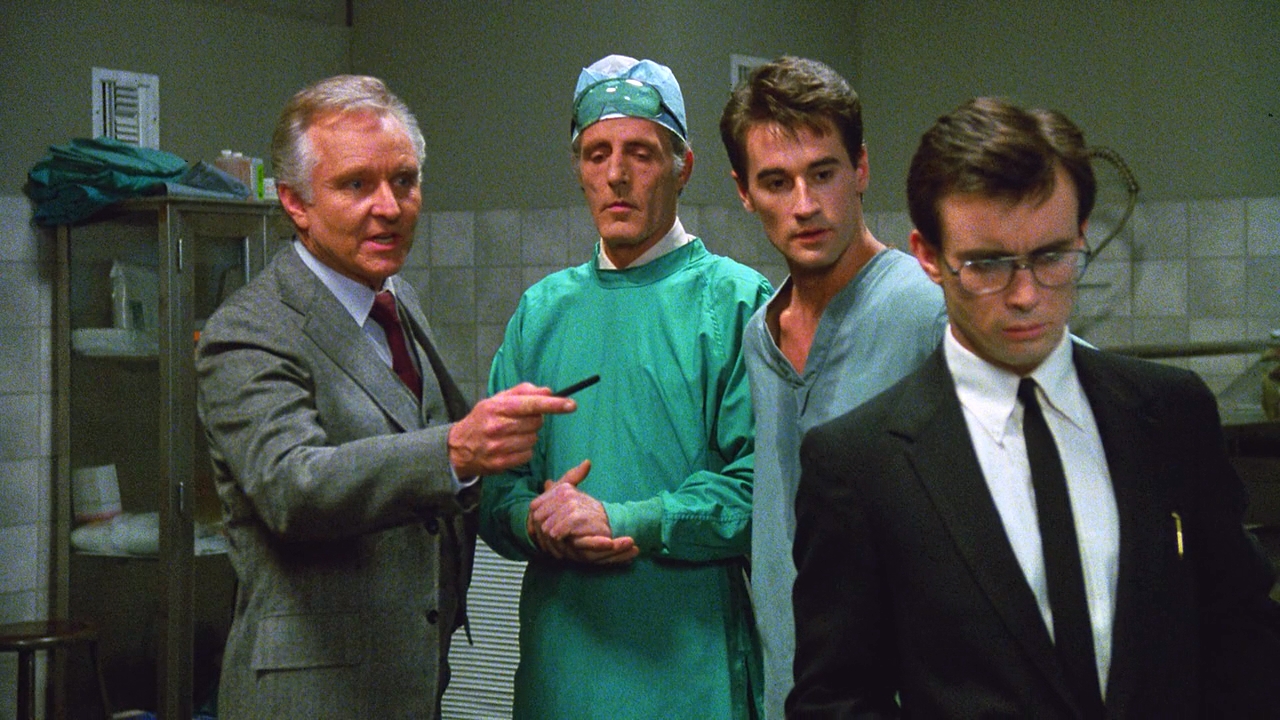
Compounding the insult of Halsey’s petty, unfair dealings, he’s also shown not to have his finger on the pulse of anything current. An early scene directs him to the hospital morgue, where a colleague observes that he hasn’t been there in ages. At first it lands as a long time no see-style greeting, but its critical subtext signals that Halsey is deeply out of touch – with the day-to-day practice of medicine, with the latest science and, above all, with the times. That Halsey has risen to the rank of Dean is both an illustration of the Peter Principle, and a symbol of how the administrative classes who decide academic departments’ fortunes are temperamentally unfit to be vested with such capacities.
Yet this is not to say that administrators alone are the source of Re-Animator’s graduate nightmares. Faculty, too, represent another species of bogeyman, personified via the antagonistic Dr. Carl Hill. With his hostility toward West’s research (despite finding the work of West’s late mentor compelling enough to plagiarize), Hill proves every bit as dismissive and closed-minded as Halsey. Yet he’s arguably worse: While Halsey amounts to a reactive, silencing force who aims for nothing but the preservation of his own narrow concept of order, Hill pursues an agenda both base and self-serving. Lecherous and predatory, Hill’s academic veneer disguises a creature of appetite, who hungers without cease (including after death!) for renown and sexual gratification.
In this respect, Hill is no different from common university sex pests like Larry Summers, who abuse imbalances in power and prestige to exploit those in less secure circumstances. Watching Meg squirm when the much older Hill hits on her during a dinner party feels more uncomfortable than their infamous “head going down on that babe” scene later on, because the former does not strain the imagination; there’s nothing fanciful about some well-connected lech subjecting a woman to unwelcome sexual microaggressions. (Along those lines, Hill’s secret file on Meg, stuffed with newspaper and yearbook clippings interspersed with locks of her blonde hair, may well be Re-Animator’s single creepiest sight.) Preying on fear, Hill is less persuasive than coercive. He has an altogether preternatural knack for detecting weakness, and always strikes when people are vulnerable and afraid – such as when he convinces Meg to grant him full control over her father’s surgical regimen after his first death, or when he threatens to tar West as a murderer unless the brilliant young student surrenders his research. And that’s merely Hill the man!
Hill the professor is a different kind of predator, eager to steal other people’s best ideas and pass them off as his own. He’s happy to pretend West’s revolutionary serum is his own discovery, and has built his reputation off of work that’s effectively copied from West’s onetime mentor, Dr. Gruber. What is perhaps most frustrating about Hill is that none of his antics are done in service of a greater good or to advance cutting-edge research; they’re only to slake his (unquenchable) thirsts and feed his immense ego. Whether Hill’s transgressions are known to administrators like Halsey – that is, people with the power to stop him – is unclear. But it’s also unlikely that they would do anything to hinder him: Miskatonic Medical celebrates Hill for being, in Halsey’s words, a “grant machine.”
Halsey and Hill may be the most monstrous university presences – literally and figuratively – but the film suggests that they are not uniquely antagonistic; they’re simply the academy figures who see the most screentime. Re-Animator hints that poisonous attitudes and outlooks suffuse the university, of which Halsey and Hill are more likely symptoms than causes. Dr. Harrod, a minor character who exists mostly as a cameo vehicle for the director’s wife, affords us a glimpse into this pernicious mood and mindset. She says little, but what few sentiments she voices are telling. She’s there beside Cain when we first meet him, trying and failing to resuscitate a flatlining patient; but while Cain works himself into a lather administering CPR, Harrod insists he stop, convinced there’s nothing more to be done. Later, when Halsey storms into the hospital to eject the recently-expelled West and Cain, Meg chases after him, begging him to reconsider. Harrod politely detains Meg at the front desk, suggesting that she hold back and talk things over with her father afterward. Thus, although Harrod is presumably “one of the good ones,” she has no advice to offer besides “give up” and “submit to authority.” No wonder the Halseys and Hills of the world thrive in academic environments. They crawl with enablers like Harrod, who position themselves as reasonable voices despite only ever empowering a department’s worst elements.
———
Alexander B. Joy is a writer from New Hampshire. He is the author of Legend of the River Kingand the editor of Flaxman Low: Occult Detective. Find him on Bluesky at @aeneas-nin.bsky.social, and see more of his work at alexanderbjoy.com.
You’ve been reading an excerpt from Unwinnable Monthly Issue 195.
To read the article in its entirety, please purchase the issue from the shop or sign up for a subscription to Unwinnable Monthly!