THAT’S WHAT THE BLOG IS FOR! Mad Men S1E5–S1E6
You feel compelled to support great writing…

S1E5 5G
Twice in this episode, someone observes that Don looks like a different person sometimes. The first is Midge, during a nooner:
“I like that you come in here acting like someone else…. But then you always – shift gears.”
“I don’t even think about it.” Don replies.
Who is Don when he arrives at Midge’s, and who does he become when he’s with her? Is that the real Don? Or is Dick? Or is there another, unnamed version of himself in the mix? How many people are inside this one man? We don’t know, and neither does Don because he cannot afford to be introspective enough to consider how fractured he might be.
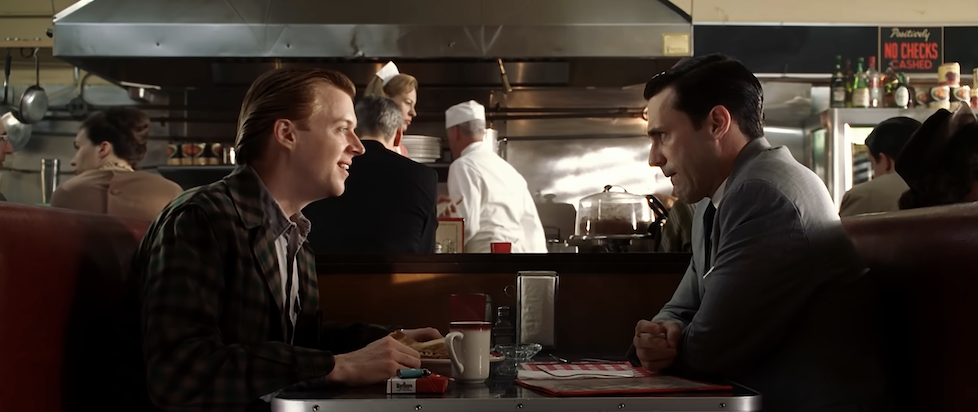
One person he is sure he is not anymore is Dick Whitman. He’s done with that. When his younger half-brother Adam finds him, after seeing a picture of him winning an award in the paper, Don repeatedly denies it. This is terror, yes, (we have not yet ever seen him flop sweat at a pitch as much as he does when Peggy tells him who is waiting for him in reception), but it is also his belligerent way of trying to get Adam to understand. He is not Dick Whitman any more. He’s shifted gears, and he doesn’t even think about it.
Is he being honest with himself? Maybe not. When he goes to see Adam later, prepared and not taken by surprise Adam says:
“Look at you. You look more like you now.”
He shifted gears. It might be he didn’t even think about it, but it is also possible that he went back and found Dick Whitman again, and let himself be that person again briefly, to be with his little brother one last time. It’s hard to say how much of this he’s in control of.
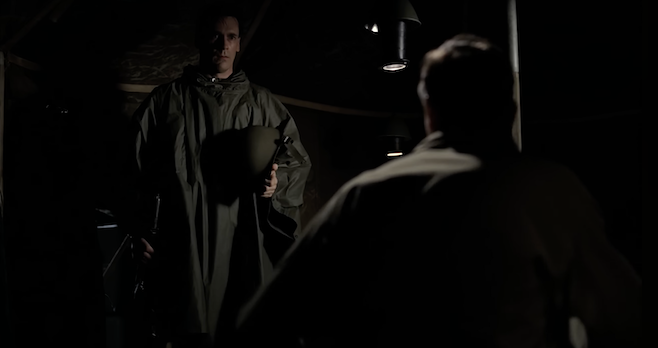
The only joy Don gets from this encounter is learning that Adam’s mother and someone named Uncle Mack are dead, (Good, he says like a cold motherfucker). It relaxes him to know this link to the past is gone, and he clearly doesn’t like them very much. Don did not run from his past casually, and he did not only run from poverty. There was no love there.
Except for maybe from this little boy who is now a man. Adam convinces Don to pay him one last visit by mailing him a photograph of the two of them together – Adam a child still and Don looking handsome in a military uniform. Don’s arm is slung around the boy and he looks happier than we’ve seen him yet. He burns the photo, but he decides that he owes something to this brother. Here’s another gear shift: at home, pulling out all of his cash savings from a desk drawer, Don has the fraught, hesitant expression of someone who knows he’s about to do something hurtful, but by the time he’s reached Adam he’s convinced himself that helping his brother to start over the same way that he has is a gift (aided by a very substantial wad of money). Don is not a psychopath the way that Tony Soprano is. He understands people very well, and he understands that what he is doing is upsetting, but he does it anyway because he’s terrified and selfish. Adam doesn’t want it. He would rather have his brother back, but Don is adamant that isn’t possible, save for maybe one moment as they hug. And then it shifts and he steps away.
More Thoughts:
Five episodes is a long time to get to a substantial, twisty piece of the protagonist’s identity, but Mad Men avoids the Surf Dracula problem because while this is an important thing to know about Don, it’s not really what the show is about. It’s a driver of Don’s action, and Mad Men is very good about having the things they introduce reverberate throughout the run of the show, but structurally the show is not a thriller about a guy trying to hide his identity.
Peggy overhears Midge on the phone with Don and then panics the next day when Betty shows up at the office, assuming he’s with his mistress again. She makes the mistake of telling Joan who, like the absolute queen she is, is relieved to know this is why Don always ignored her. It’s an awkward day for Peggy, who learns something about her boss and about her job, but as an audience we learn more about Joan. In the first few episodes she plays it like this job is a little beneath her, and she’s only there to create ideal circumstances for husband hunting. Here though, when she tells Peggy that this job is the best, I believe her. She might be biding her time but she’s enjoying the hell out of it while she’s there. Also: we get the first glimpse of Joan’s low vocal register, when she tells Peggy that she should have kept Don’s secret even from her. That always means business.
Peggy says that Don comes back from his afternoon delight “all greasy and calm” which is both hilarious and a specific and observant bit of language. Hope that comes in handy for her!
Speaking of a gift with language: Ken Cosgrove has a story published in the Atlantic and everyone hates him for it since the entire agency is filled with people who fancy themselves as artists. No one has ever looked as sad as Pete saying it’s a national magazine. Pete is very difficult to root for in this episode, as he tries to pimp out his wife to her ex-boyfriend to get his own short story published. Kinsey tries to apologize for his jealous behavior, but Ken is too annoyed and at ease with himself to accept it. “You lost”.
Hungover Betty in her jewelry from the night before is aspirational to me as a parent. “Mommy has a headache.”
Trudy’s taste in decor is much more modern than how she dresses. Pete’s suits are also always a little more modern than his co-workers, so I wonder if this is something they bond over. I have some pieces of their Stanglware Amber Glo dish set.
S1E6 Babylon
I come from a family of New York Jews that is very different from Rachel Menken’s family which is why, if you are trying to get a handle on the Jewish people so as to sell them things, it’s best to consult more than one (Don does not know more than one). Rachel tells Don that she is not very Jewish. I was raised without God, but I was not raised to see myself that way. She tells Don her life is in New York which, same. But she also tells him that Israel is a place that simply must be, and that is where I shrug my shoulders, feh. I was not raised with any emotional connection to Israel.
My mother’s family is more observant than my father’s, but the religious practice was about history, community, and social values. Israel was simply not a part of the storytelling. We never said next year in Israel, we said next year still in New York City. For my mother and uncle especially, who had fled the Midwest to return to the place their parents had met, we were already in the promised land. Utopia, Don interprets Rachel’s statement. And she tells him that the word means two things: The Good Place/The Place that Can Not Be.
The tension between these two Utopias is desire, which both animates this episode and advertising as a compromised art. Don, who knows this well, spends the episode bouncing around between his wife, his girlfriend, and the woman he wants to be his next girlfriend, but what makes this one of my favorite early episodes of Mad Men is the attention paid to the women themselves. Don’s lovers but also the ones who support his professional life. Somewhere between this episode and the next one is the halfway point of the season, and this is the most of an ensemble this show has been so far, connected by the distance between the good place they find themselves in and the unreality that undermines it.
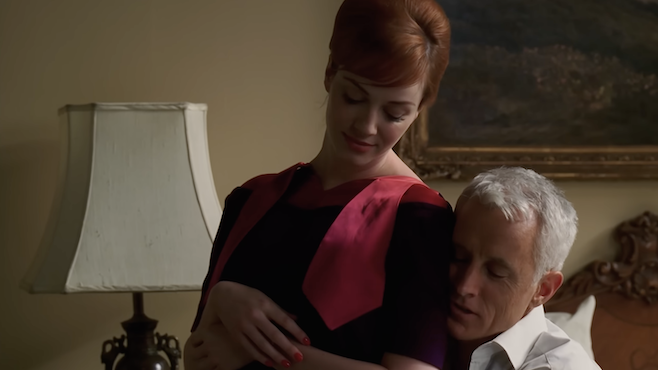
Joan has it pretty good, in her first real plotline. She’s having an affair with a married man, but she’s under no pretense about what that means, and she won’t indulge in his desire to pretend either. She likes Roger, she’s comfortable with him, and she likes the jewelry he gives her, but she’s not going to give up her roommate or her single-gal lifestyle to make him feel special. She still wants to get married, and until that happens she’s willing to have an affair but won’t be a mistress. Until then, she’ll keep the gifts and enjoy the privilege of telling her boss when he’s a spoiled baby. Drawing the line here allows her to still feel confident when his wife and daughter (clearly in awe of Joan) come into the office.
Where she begins to feel shaky is when the natural order of her office world is threatened by Peggy, a tutee who emerges as an unexpected threat. Peggy was never going to compete with Joan in the areas she expects to find rivals. She’s never going to be prettier, more graceful under pressure, or more adept at managing people. But while Joan is busy having fun undermining the research-German during product testing, Peggy is observing the other girls because she didn’t get the lipstick she wanted, and had no desire to settle. Her ability to express this internal surety, along with a sweet turn of phrase, (basket of kisses), impresses the copywriters – impresses Don – upending the office hierarchy by playing with the boys. Of course, Peggy’s good new thing is unreal in its own way too: She is not getting paid for her new work, and she may not even be recognized for it.
More Thoughts
Betty, of course, desires Don, and cannot have him because he’s hiding most of himself from her. Her lusty, sad monologue is one of my favorites in the show (I make a grocery list, I cook butterscotch pudding. I never let my hands idle. Brushing my hair, drinking my milk… It’s all in a kind of fog because I can’t stop thinking about this), and he responds by trying to hook up with a woman who already rejected him for being married, and when rejected again, goes off to be ignored by his mistress when another of her lovers shows up. More things that cannot be.
The stuff at the Gaslight is very harharhar which makes it easy to take Don’s side against Midge’s theater collective boyfriend. Not the last time, or the best time, the show goes to this well. The Gaslight, incidentally, is full of Jews if Don wanted to poll them all on what Israel means to them (he does not).
Sally trying on her mother’s dress and lipstick at the end is a lovely button that ties Betty and Peggy together. Peggy can see the framework around the narrative she’s been given, and that gives her somewhere to climb out. All Joan and Betty can do right now is try to be the fairest of them all.
First episode with Freddie Rumsen. It takes a lot in this environment to get labeled the office alcoholic!
———
Natasha Ochshorn is a PhD Candidate in English at CUNY, writing on fantasy texts and environmental grief. She’s lived in Brooklyn her whole life and makes music as Bunny Petite. Follow her on Instagram and Bluesky.