Cartography of the Cold

This column is a reprint from Unwinnable Monthly #194. If you like what you see, grab the magazine for less than ten dollars, or subscribe and get all future magazines for half price.
———
Architecture and games.
———
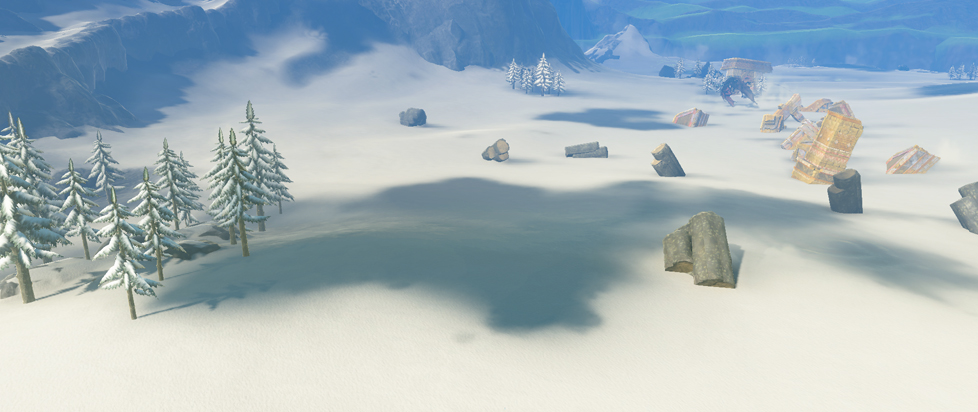
Take a walk through the northern regions of the game world in The Legend of Zelda: Tears of the Kingdom and you’ll find yourself quite literally freezing, bitten by the bitter nip of the blowing breeze. You’ll need to pack warm because Tabantha Tundra in particular is hostile to outsiders, and even most newcomers.
Tabantha Tundra in Tears of the Kingdom is really just a rehearsal for the wind. This would be a place where the defining characteristic is motion, great gusts pulling the sky into strips and snow skimming across the mountainsides like sliding sand, along with seemingly random currents pulling you upwards at the drop of a paraglider. The game invites you to experience the bleakness of this landscape as a vertical ecosystem, where the horizon is only half the story.
When seen from ground level, Tabantha Tundra maintains the austere beauty which is peculiar to such lofty plateaus. The region is in other words filled with sharp ridgelines, winding gullies and broad plains covered with sparse vegetation, frequently frozen into fragile tangles. Tears of the Kingdom however layers the landscape with a somewhat different system than previous entries in the series, featuring suspended landmasses and islands held up on high. These fragments of terrain catch the light, throwing it back at you like mirrors. They seem like slowly migrating constellations, drifting overhead while hiding the invisible path of the wind.
You’re likely to come across a couple of Rito soaring above the steppe on your travels throughout the region. They keep their weathered nests of beaten brushwood on the various cliff faces, representing an interesting form of architecture in themselves, presumably prototypical of this aeolian society. These are somewhat more than mere platforms, creating a choreography of ascent and descent which makes traversal seem like you’re learning to dance, initially stumbling or stiff, then strangely supple.
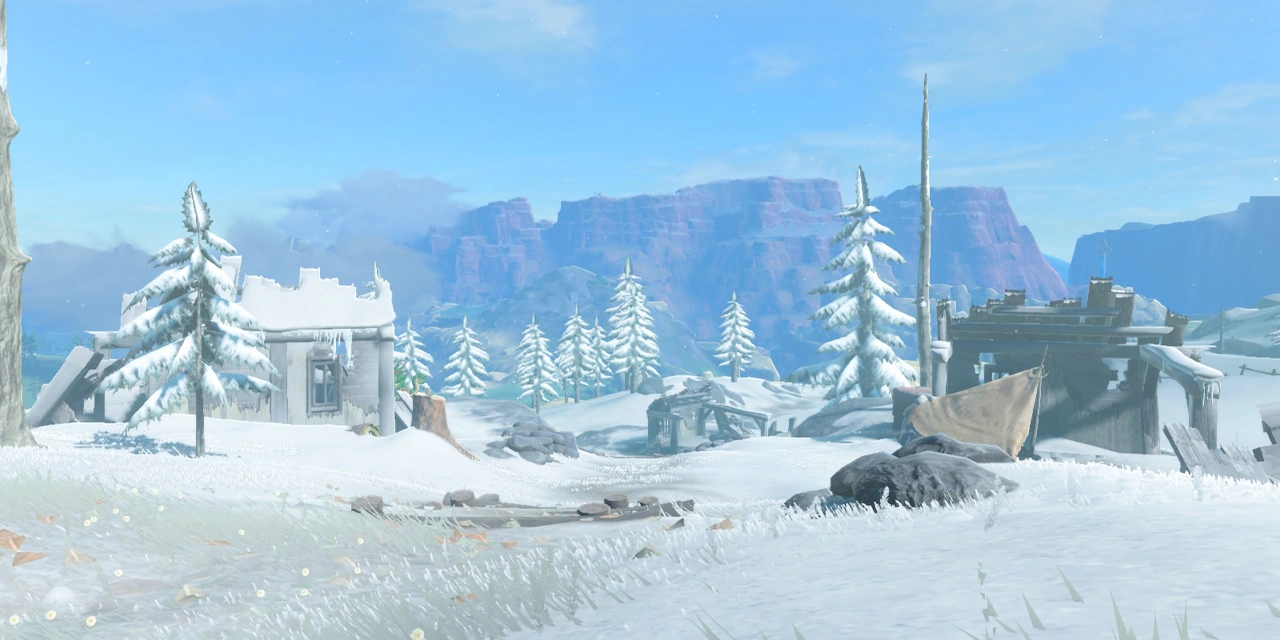
The sound of the Tabantha Tundra is both proper and precise, as the wind whines through the spars of stone which litter the landscape. The crisp crunch of snow beneath you is punctuated by the distant groan of shifting movement, perhaps a bold Bokoblin or something more sinister like a lunging Lynel. Silence of course can only be understood as part of the score, however. When the snow settles and the howling winds die down, this part of the game world contracts into a deafening hush that demands attention, rewarding such small moments with equally small discoveries. You might come across a cave, discover a hidden secret or find a lost explorer, someone just like yourself.
The sparse flora and fauna can be seen adapting to the altitude with elegance. The occasional tree, bent over by the imposing wind, can be found populating the rocky ridgelines, with a few frozen shrubs clutching to life in the sheltered hollows. When it comes to wildlife, living creatures in the Tabantha Tundra can only be described as pragmatic, with herds of deer and wolf packs moving in tight circles on the open steppe, trapped in some sort of strange negotiation with the surrounding landscape. The danger of the Tabantha Tundra is typically exposure to the cold or a misjudged jump, even for animals.
There’s a rather interesting undercurrent of melancholy to the overall aesthetic of this particular space. The scattered ruins, hidden hideouts and eerie encampments can sometimes tell stories without words, if you’re able to make sufficient use of your imagination. You’ll come across lifeless Lizalfos, marauding Moblins and hulking Hinox, hinting at lives lived in this utterly inhospitable place. These micronarratives make the place feel somehow alive, despite the apparent pallor of the region in general.
The situation is rather similar but not quite the same in the skies above. You’ll still find the climate cold but significantly more hospitable, at least in appearance. This of course creates a sharp contrast to the sweeping desolation of the terrain below, primarily consisting of dying vegetation and sweeping snowdrifts. The islands in the sky on the other hand are few and far between, when compared to the other parts of the game world in Tears of the Kingdom.
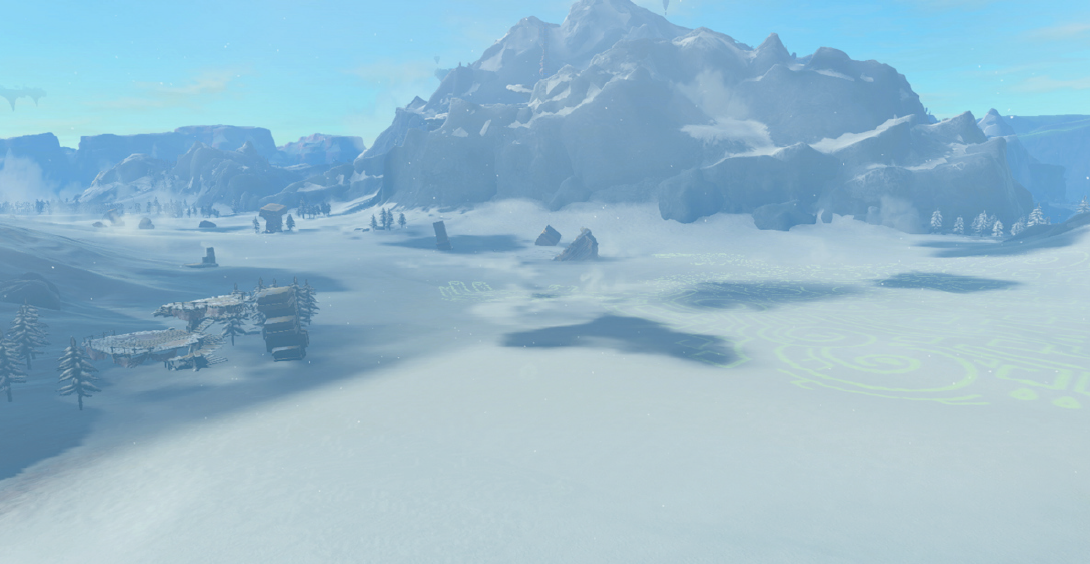
The steppes of the Tabantha Tundra could be described as constrained but somehow still open for exploration. The color palette is primarily gray, with some blue in the ice and brown in the earth, emphasizing the underlying accent colors. This could be a scarlet feather on a rising Rito, a greenish glow from a distant campfire or the amaranth reflection of saturated moss, in places where the temperature is warm enough to let life breathe. The game uses contrast to great effect, sunlight breaking through and slicing the landscape into convergent panels, rendering every nook and cranny in vibrant detail.
Tabantha Tundra is ultimately able to offer a unique type of reward, freedom within constraint. Your first visit will be an exercise in humility, being buffeted by the wind or disoriented by the foggy mist. Repeated journeys into this known unknown will however teach you to quite literally read the air. The region offers no easy path for travelers, but you can certainly take flight and ride the wind.
Tabantha Tundra in Tears of the Kingdom isn’t just about geography. The region is a muted commentary about how space shapes place and both make movement, memory and experience. The snow and stone are the primary protagonists in this particular tale. You can leave the region forever changed, although not because you’ve solved its puzzles but because you’ve learned to move in sync with its rhythms. When the light fractures across a drifting island in the sky or the breeze whistles a hushed song, you’ll realize how the steppe has been teaching you to listen all along.
———
Justin Reeve is an archaeologist specializing in architecture, urbanism and spatial theory, but he can frequently be found writing about videogames, too.