The Threads We Think We’re Holding
You feel compelled to support great writing…
I’ve never really had an issue with the idea of death. As humans, we are uniquely cursed in knowing that we will all die one day, so lying awake at night questioning life’s greater purpose is naturally a normal thing to do. But for me, these thoughts began after playing this game. I’ve had them ever since, and I’m still trying to work out whether or not that’s a good thing.
How Fish is Made is a free indie game that flopped onto Steam in 2022 with zero context and as much pageantry as a leaf hitting the grass. But that’s exactly what attracted me to it. Since gaining wider attention online, critics have described the game’s uncanny atmosphere as cold, disgusting and surreal. While these labels do describe it very well, I wanted to take some time to highlight how what should have been a short horror experience instead held an uncomfortable mirror to reality. That’s a kind of horror I wasn’t prepared for.
“No price is too high to pay for the privilege of owning yourself”, Friedrich Nietzsche famously once said, and as one of nihilism’s best known commentators, this quote perfectly sums up the existential numbness this game about sardines gives us.
Nihilism has long since been the go-to for young pseudo-philosophers looking to legitimize their teenage angst. But existential nihilism is, in fact, a very legitimate philosophical perspective. It doesn’t strictly preach doom and gloom like many believe, but highlights the idea that life has no inherent purpose, therefore the only real purpose our existence has, is the purpose we give it. Upon realizing that everyone on earth will face the same conclusion, and the greater universe is indifferent to our very existence, it’s not long before we begin to question what control we really have on our destiny.
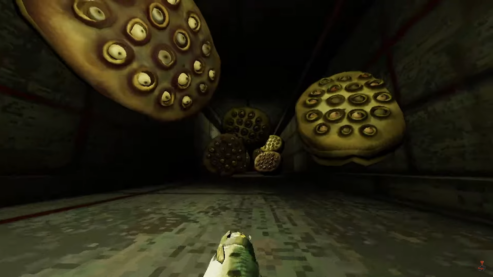
There are so many ways this game becomes a vehicle for existential nihilism, primarily through its claustrophobically linear journey and empty choices. We are introduced to our character, a nameless sardine with no distinctive features, as it falls hopelessly and without reaction down a metal pipe before impacting the ground. There is no music. There is no context. Our sardine didn’t ask to be here, and neither did we. To me, this is a perfect visual metaphor for birth. Isn’t this how all of us entered the world?
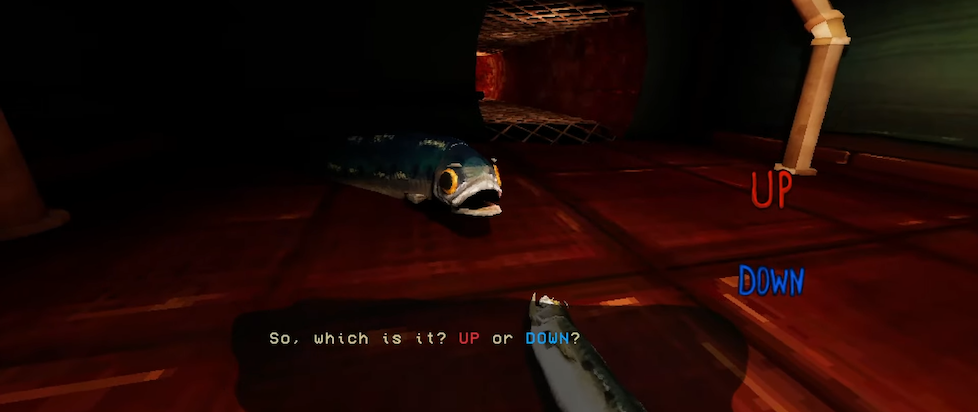
“Up or down?” is a question that regularly appears throughout the game, offered to us in different ways by various characters. It’s true meaning is never revealed, yet we are always forced to pick an answer. It soon dawns on players that this is most likely our final destination, and we simply have to choose.
Even though the path we take is always entirely linear, this is where the apparent “choices” began to rear their ugly heads. Players naturally fall for the “control” they are given at the beginning, but then things start happening, and this is where I found the sardine to become somewhat relatable.
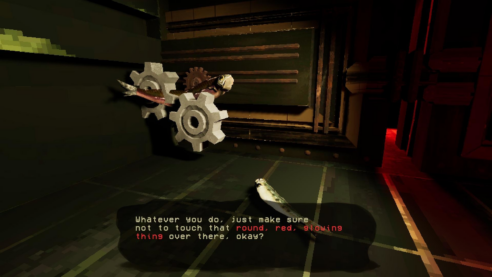
One infamous event that replays in my mind two years after finishing this game is when we find another fish is trapped in the gears of a giant mechanical door, calling on us to help, frantically instructing us not to press the giant red button that opens the door as this will kill him. I spent a long time trying to find a way to free him, but it soon became apparent that it isn’t possible. The only option, should we wish to carry on, is to push the big red button and continue on our path, graphically killing the fish we had just met. He was always meant to die, even though I was given a perceived “choice” to save it. This whole situation reminded me of the time when my own fish had died when I was a child; I still blame my younger self for not having more control over the situation, even though it was obvious there was nothing I could do.
Yet after witnessing this, our sardine continues on its way with no emotion or reaction. This was eerie at first, but it could also be perceived as another metaphor. Is this what we should be doing in life? If the control over our destiny truly is limited by unbeatable circumstances, and with life only having a purpose we assign to it, surely it makes sense for us to just disregard emotions like regret and grief?
True existential nihilism began to creep up on me when I was asked that question once again: “Up or Down?” Only this time, I was given the choice to learn what other fish had chosen, and whether or not this would influence my final decision. I would be lying if I said I didn’t start overthinking my own motivations, as I debated whether to alter my own narrative based on the decisions of an unseen majority. This was a rare opportunity to express agency and “own myself” just like Nietzsche said.
But this is also when it finally clicked. My destinations, “up” and “down”, were totally irrelevant. They were intrinsically the same, and offered nothing to me despite being presented as the story’s main focus. Everything finally fell into place.
The game is quite simply a road to nowhere. No matter what we do, our final destination always remains the same, and the developers wanted to remind us that life is simply about what purpose we assign it on the journey. This free fish game forced me to reconsider reality.
At just 20 minutes long, all I remember are the key moments. The endless corridors and dialogue? Lost to time. But I guess that’s what life truly is, key moments held together by blurry bridges of monotony. Sometimes we stay on our path, sometimes we diverge.
I’ll never look at sardines the same way again.
———
Matthew Wilson is an Irish writer with bylines spanning culture, mainstream news, music, and other things he should probably stop thinking about. He is particularly drawn to avant-garde storytelling, video essays, and horror.