Sea of Stars, Pond of Bulbs

This column is a reprint from Unwinnable Monthly #194. If you like what you see, grab the magazine for less than ten dollars, or subscribe and get all future magazines for half price.
———
Wide but shallow.
———
Genre is a trap, as I’ve felt and probably said a sickening number of times. The notion of a signpost to help folks navigate the various slices of culture makes sense, but before I get tangled up in Saussure, suffice to say that the sign is necessary, misleading and restrictive. Certainly with regard to roleplaying games.
On the tin we’re told that in these games one plays a role, fulfills a duty, gets into some real pretend. But there’s a tension between playing the part and engaging in improv. Are we learning our lines to embody a part, or are we bending the world to our whims? Of course, videogames being mostly static realms, there’s only so much give in their branches (unless you’re playing an online multiplayer game or even a tabletop game with other humans, but these are yet other forks in the road). I’ve written before about the well-meaning if unsuccessful notion of the silent protagonist, an empty cup for the player to fill – this simply leaves a central-character-sized hole in the narrative, a deeply unsatisfying blankness that would otherwise be extended missing scenes in a movie or torn pages in a book.
Personally, my favorite roleplaying games have succeeded despite this emptiness by filling the story with a vibrant and interconnected cast, diverse and fascinating enemies and a tight story free from any calorie-free stuffing. Even then these were less-is-more situations, where the dialogue wasn’t bursting and the side-quests were cut to satisfy rather than overindulge. And only after working my way through a few dozen hours of Sea of Stars did I realize that despite lofty goals and grand intentions, I was trudging along in the hopes that I’d hit the same highs of peak ’90s 16-bit RPGs, but the characters just weren’t there.
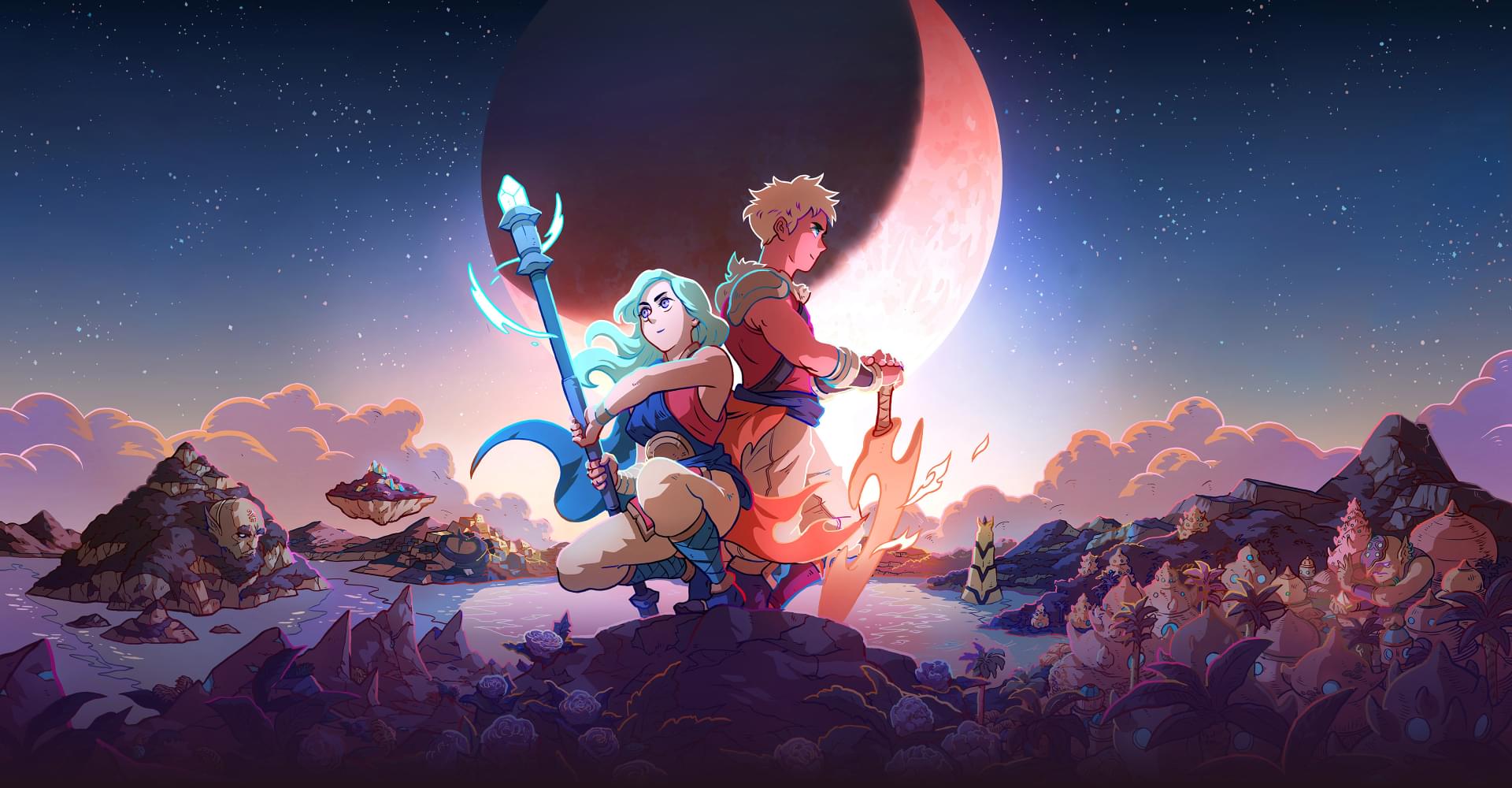
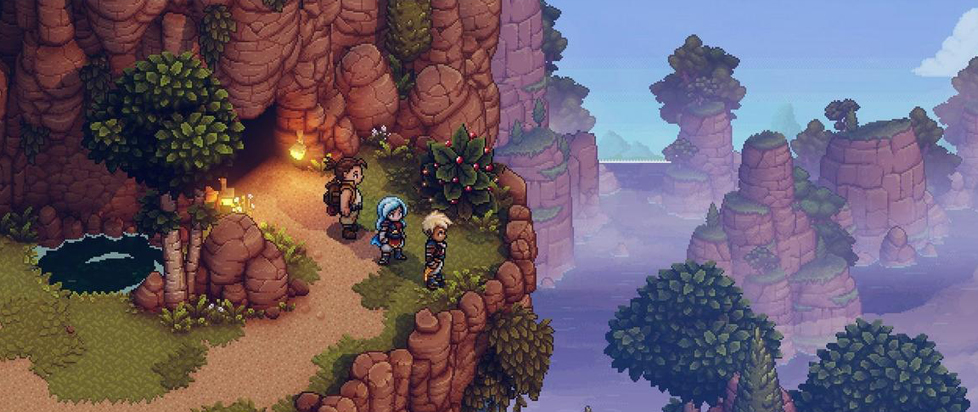
I am compelled to deliver some attaboys: Sabotage Studio clearly cares about the same games as I do, and studied them very deeply, and they got pretty close. The pixel work is lush, with backgrounds bursting with color and life (most of the time; I found the caves pretty dark) and enemies thrashing about in delightful hostility, and the battles combine timing with rock-paper-scissors elemental breakouts and fun combos in a way the keeps encounters interesting enough that spamming “Fight” isn’t an option, as your attention is necessary. The animated cutscenes work hard to meaningfully enhance the drama of the moment, and the music brings a lot of character to every stage and scene as well. In many ways, this small team got very far on the tracks built by Chrono Trigger, but the fact of the matter is that game was created by a dream team of RPG and industry veterans (one of which, composer Yasunori Mitsuda, actually contributed twelve tracks to Sea of Stars), where as this one was the second game for this studio.
None of this is enough to motivate me to continue playing past the first ending. This is because the narrative for Sea of Stars felt like a patchwork at best, with characters cutout from cardboard. What teemed with life visually on screen could not plant a seed that stuck in my mind. For the most part everything started out rather well, with the two solstice warriors wandering the world with their good friend to complete their destiny, baddies scheming in the background, betrayals outlined in neon on the side. Then there’s an attempt to raise the stakes: your colleague, the hooded god, is a friend with the big bad, the hooded necromancer of flesh attempting to condemn your world, in fact, endless worlds. This turns out to be an ancient rivalry with convenient rules, and your squad are but fleas along for the ride.
By the time of the big sacrifice, which is delayed in a way that stretches the malaise like black licorice taffy, everything feels loose and uprooted. Your team is shattered and you’re left with a cloud in a glass body that you don’t really know anything about, and the mute puppet of the god who got you in this mess. All meaningful connections appear to be severed and not really spun back up again, and the endings are limped towards. I read about some pillar missions after the first bittersweet finale, and I wanted to play through them all to see what the “true” ending would be, but the spirit was not willing. I was asked to go to places that did not register in my memory and the map was not helpful, in order to help characters I’d talked to maybe once and without a codex to refer to, though it was clear I was meant to recall these as momentous actors in the grand tapestry of this narrative.
From the point of the betrayal of the older solstice warriors, Sea of Stars is unmoored. I played the DLC, a fun little almost demo experience that pops but has pretty much no connection to the main game, and hopped back over with almost a complete memory wipe of what had been going on and why. The narrative threads were not spun much past the halfway mark, and the characters were not compelling enough to keep my own imagination firing on all cylinders. These were delightful toys kept pristine in their boxes, but I had no idea how to play with them. Give me my lines, show me the finely honed rails. Build your world and place your pickle barrels, but the story must satisfy above all else.
———
Levi Rubeck is a critic and poet currently living in the Boston area. Check his links at levirubeck.com.