The Woods Are Lovely, Dark and Deep: On Why I Haven’t Played Root, Like, Twice
You feel compelled to support great writing…

I see board games in the store and they always look so cool and then I buy them and bring them home, I’m so excited to open them, and then I play them, like, twice… This column is dedicated to the love of games for those of us whose eyes may be bigger than our stomachs when it comes to playing, and the joy that we can all take from games, even if we don’t play them very often.
———
I’ve never actually played Root. Let’s just get that out of the way right now.
One of the first games I ever wrote about in this column was Vast: The Mysterious Manor, an intriguing and sometimes frustrating game whose best quality was the art by Kyle Ferrin. Ferrin has done artwork for a large number of other board games, but the game that his style is most inextricably associated with is Root, a 2018 “game of woodland might and right” that has become one of the most celebrated board games of modern history.
Seriously, just skimming the number of different awards and accolades that Root has garnered since its release is a Herculean undertaking. While Root clearly isn’t for everyone, I don’t think there’s much argument to be made that it isn’t a great game.
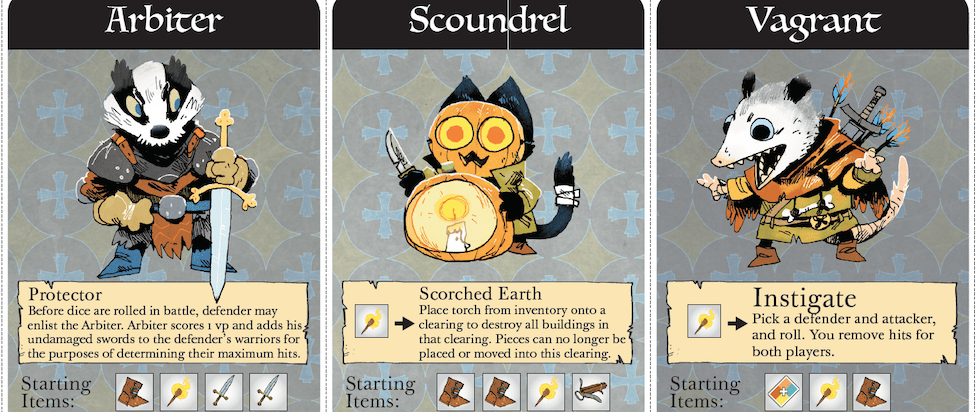
I’ll be honest, though, I didn’t pick it up because of its reputation. I picked it up because of Kyle Ferrin’s art. His children’s book-style drawings of ever-so-slightly anthropomorphized woodland critters is just… chef’s kiss. The Vagabond variant that is a black cat who has carved a pumpkin and is using it for a mask is one of the best character designs I’ve ever seen, in anything, anywhere.
In fact, the world of Root, as brought to life as much through Ferrin’s drawings as through any storytelling in the game itself, was enough to inspire a tabletop RPG version from Magpie Games – which I also own, but also haven’t played. And it may be that an RPG is a better fit for what I want from the world of Root than the board game ever wants to be.
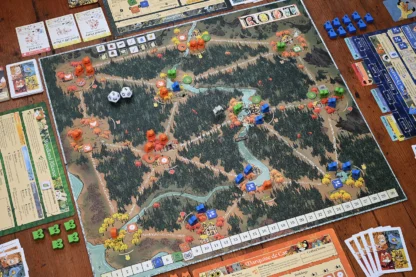
So what is the board game like? People have compared it to any number of things, and many of those comparisons are probably more apt than this one is going to be because, for all my having written a board game column for several years now, I don’t have a lot of experience with the kinds of games that Root (probably accurately) gets compared to.
What I usually tell people who have never heard of it is that Root is like Risk with asymmetrical storybook factions. Then, I usually have to explain what I mean by asymmetrical, and maybe what I mean by factions, because the kind of person who doesn’t already know about Root is often the kind of person who also doesn’t know a lot of board game lingo.
In Root, each player takes control of one of several groups that want to control the woodland. In the base game, there are the Marquise de Cat, the Eyrie Dynasties, the Woodland Alliance, and the Vagabond. Expansions have added a number of other factions, while the Clockwork Expansion(s) add the ability to play solo against the board.
Each of these factions is asymmetrical, in that they play completely differently from one another. They have different actions they can take on your turn, they score points differently, they win and lose based on different criteria. This is a big part of Root’s appeal – but it’s also a big part of why I haven’t ever actually played it.
“Learning the factions and figuring out strategies for them is incredibly rewarding,” writes one popular review on BoardGameGeek.com. However, as the reviewer continues, “Root is hard to learn, onerous to master, and discrepancies in skill have a staggering effect on the game.”
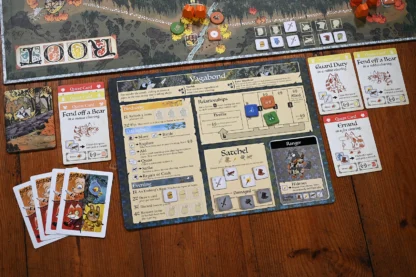
Which is all kind of a long way of saying that Root is a game for people who really want to play Root. It isn’t a casual game, despite its cutesy artwork and relatively small box size. The duration of an average game, according to the box, is anywhere from 60 to 90 minutes. And while it can be played with as few as two players (or even one, if you have one of the Clockwork Expansions), it’s ideally suited for a group.
As I’ve discussed before, that’s not the kind of game that gets much time on the table around here. Root is a game that encourages and rewards iterative play. Part of the appeal is learning the strengths and weaknesses of the different factions, trying out strategies in one game that you later hammer into shape in a subsequent one. But iterative play isn’t something that happens a lot when you only play games, like, twice.
The people I tend to play board games with don’t play a lot of games that take multiple hours. Or games that require a substantial commitment to master. We don’t meet regularly – Root would probably be great for people with a weekly gaming group. And often there’s only a couple of us playing.
I’m the only one here who is likely to dig deep into a game, and even I get intimidated easily by a game with a steep learning curve. Root can also be cutthroat, while the people I play with tend to prefer games that are more cooperative.
So, while Root was one of the earliest games I ever picked up in my quest to get back into board gaming (due to its reputation and Kyle Ferrin’s art), it is likely to always exist at the periphery, for me. Will I eventually play it, like, twice? Probably sooner or later. But it may be that it always lives more in my imagination than it does on my table – or maybe that’s where the RPG I mentioned comes in…
———
Orrin Grey is a writer, editor, game designer, and amateur film scholar who loves to write about monsters, movies, and monster movies. He’s the author of several spooky books, including How to See Ghosts & Other Figments. You can find him online at orringrey.com.