Nooks and Crannies

This column is a reprint from Unwinnable Monthly #194. If you like what you see, grab the magazine for less than ten dollars, or subscribe and get all future magazines for half price.
———
What does digital grass feel like?
———
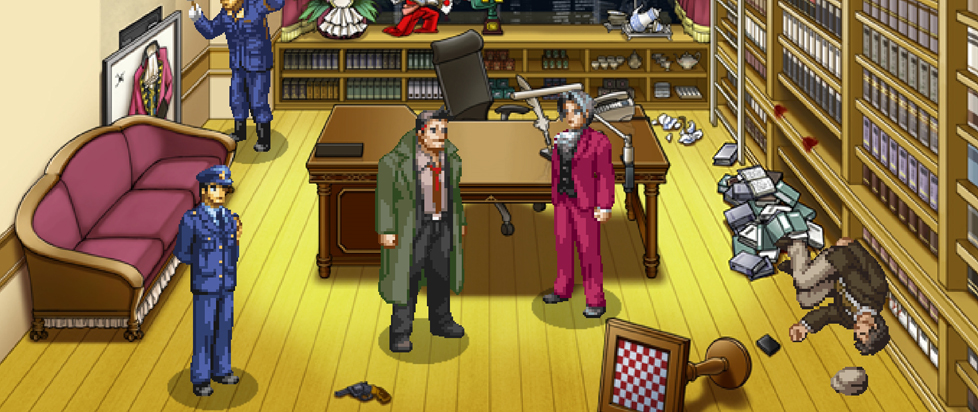
One of the big differences between the mainline Ace Attorney games and the Edgeworth-focused spinoffs, Ace Attorney Investigations, is that, unlike Phoenix Wright, Edgeworth can walk around. Where mainline investigations are typically one or two screen flat images stapled together to make up a space, the first Investigations opens by letting you physically explore your own office.
On the analysis podcast that I cohost, the two of us who haven’t played these games before wondered what kinds of environments this setup might take us to next. And I, who absolutely have played this game before, started getting a whole lot of gears turning in my mind.
Investigations and Investigations 2 are very different kinds of spin-off from one another. The first serves as a (mostly) fun little adventure in pointing at references, while the second is a much more interrogative look at the themes and character development of the original Ace Attorney Trilogy. But that brings them both into spaces the Trilogy only gestures at. Investigations has us explore the courtroom, a place that is only a backdrop in the Trilogy, while Investigations 2 reveals the inner workings of the prison, a place that’s not talked about much at all in the Trilogy despite the fact that you are responsible for sending at least one person there every chapter.
But having a fully mobile protagonist turned out not to have the effect that we were anticipating. Although it does add an intentionality to exploring scenes, it doesn’t actually necessarily make them feel any more impactful.
In large part this is because the 2D backdrops of the Trilogy already work so well. Well enough that Investigations still borrows them when you need to get into real detail, for example when examining a body. And it does that often enough that Edgeworth’s stock line for it – about searching every nook and cranny – has become a meme powerful enough to be referenced in Investigations 2.
The Trilogy’s backgrounds already give you a great sense of the space you’re supposed to be investigating. They have enough room and enough detail to hide all the clues and to incorporate plenty of flavor text. One of the first places you trawl through is your own office, and although it’s the tragic murder scene of your mentor, you can still learn about her favorite plant, Charlie. It’s a place where she lived, not just where she died.
The 3D rooms of Investigations just don’t add much in this regard. And more importantly, although Edgeworth can now walk between places, he’s also forced to walk between places. Gone are the (sometimes overcomplicated) move trees that could take Phoenix across town between, say, the detention center, his office, the scene of the crime and a nearby park where he can interview a witness. Edgeworth is curtailed by how far his feet can take him without a single camera cut. The spaces are closed; he can only move where he can physically move.
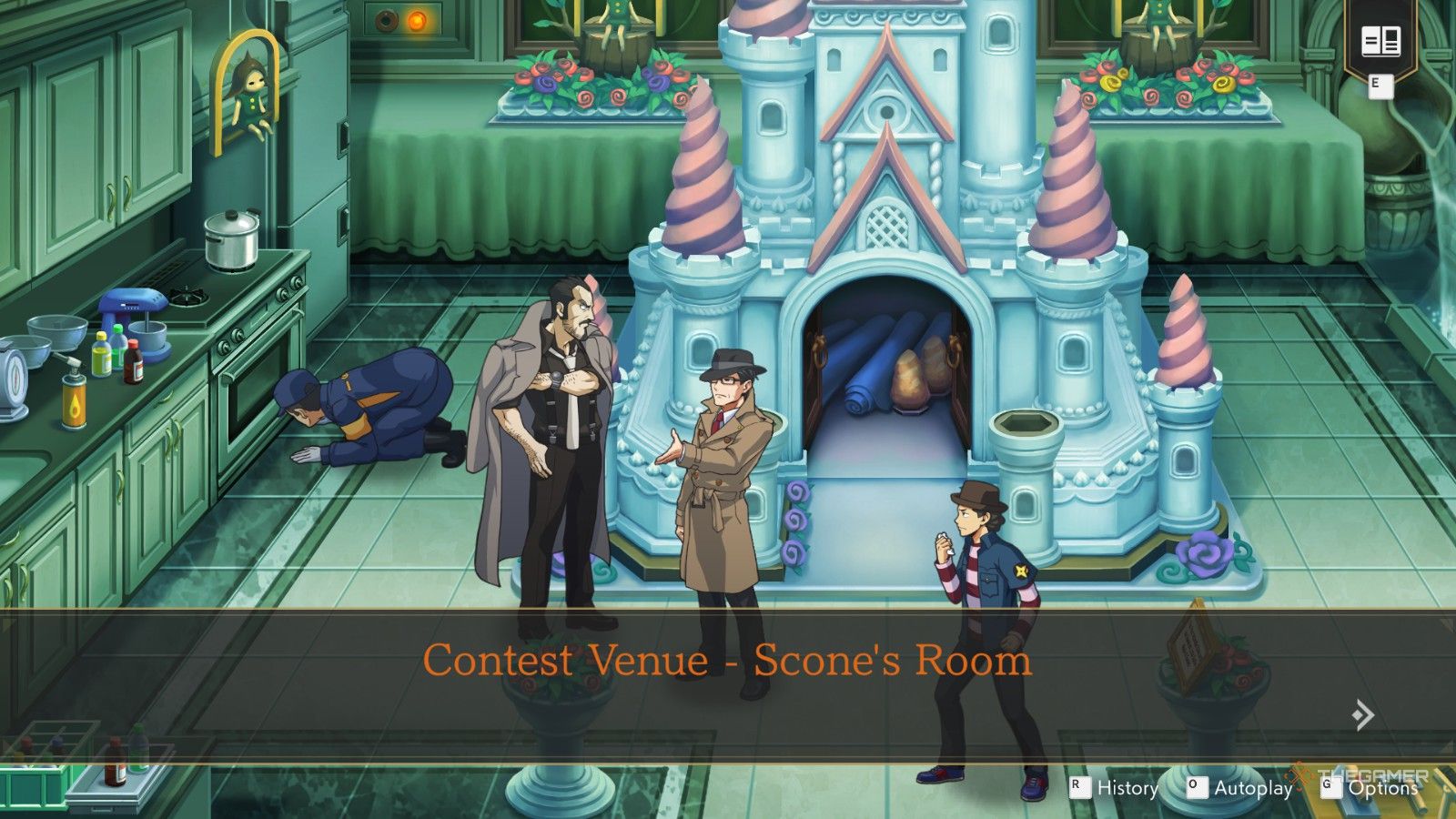
But his boxy world does have one advantage. Being able to see a scene from a vantage point rather than a flat screen leaves room for multiple characters. Instead of having one person who might appear in a room, they can now be spread out for Edgeworth to approach and talk to. Where Phoenix’s spaces are made to be jumped between as stages for single witnesses, Edgeworth’s are homes for entire groups.
That makes for a busier-feeling investigation. Not only are there side characters like forensics officers that you can directly interact with, there will also be multiple witnesses ready to give their potentially conflicting opinions at once.
Investigations’ spaces feel like spaces made for people. Everybody’s here trying to work out what happened, and you’re just one part of that puzzle. Of course, you’re also the part that’s going to get it right, and what that means for Edgeworth becomes a big part of the story.
And maybe this is the real benefit of an embodied Edgeworth. When I brought this topic up to my cohosts, they raised many smart points that I have plagiarized here with abandon. But Devon added something particularly salient as a joke: “the ultimate benefit of being able to walk around is being able to make Edgeworth rapidly spin.” And rotation aside, having Edgeworth be in the game, as opposed to the awkward position Phoenix is in as half character, half player stand-in, allows the games (Investigations 2, at least) to really dig into who he is.
Also, it resulted in the best video of all time. So, there’s that.
———
Jay Castello is a freelance writer covering games and internet culture. If they’re not down a research rabbit hole you’ll probably find them taking bad photographs in the woods.