THAT’S WHAT THE BLOG IS FOR! Mad Men S1E3–S1E4
You feel compelled to support great writing…

S1E3 The Marriage of Figaro
Mad Men deviates pretty early on from the Dr.-House-of-advertising version of the show. There’s no big pitch here. Don only saves the day from the blinkered perspective of a six-year-old.
The amount to which this episode is bifurcated is more common in the current TV landscape than it was when the show aired, but it’s still oddly paced after the more normative first two installments. The whole Sterling Cooper cast disappears in the back half, leaving us with Don and Betty in the suburbs. On this watch it is more clear to me how the first half is giving context for the second’s study in marriages. Pete is in domestic bliss after his honeymoon, excited to have steak waiting for him at home and really, really surprised that his wife is funny. This lasts until he sees Don flirting with Rachel Menken and then he becomes jealous. Peggy, meanwhile, is awkwardly forced by Pete to tell him that she is a big girl who understands that they won’t be hooking up again, and then confusingly subjected to an awkward compliment after Harry tells Pete that mild flirting is still allowed. Joan complains that the obsession with Mrs. Chatterley’s Lover proves that no one takes marriage seriously.
Helen Bishop, Don and Betty’s new divorced neighbor, is more proof of Joan’s argument, at least as far as Betty and all of her friends are concerned. Helen is either a threat or a charity case, depending on how much she’s talking to their husbands. At a time when New York State still didn’t have no-fault divorce, Helen’s presence is a constant reminder of adultery (the only legal pretext for divorce in the state until 1966!), not only that it happens but that it doesn’t have to be stood for. This is a frightening thought for all.
Then there is Don’s growing attraction, seduction, and rejection dance with Rachel Meken makes him simultaneously committed to and resentful of his role as Betty’s husband. His bohemian mistress Midge knows that he’s married and doesn’t really care so long as he doesn’t talk about it, but Midge has other lovers. Rachel isn’t interested in wasting her time with all that though, and so now Betty is in the way of Don getting what he wants. Betty is the threat.
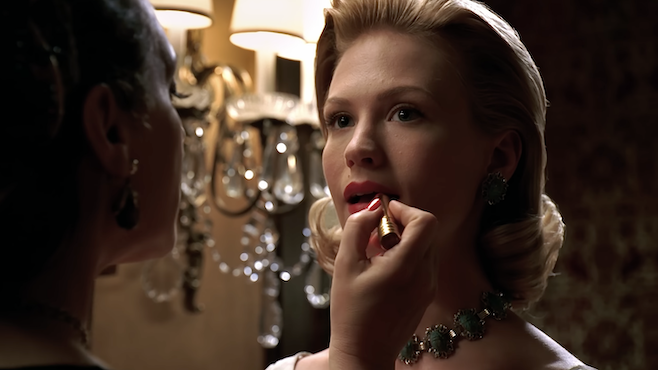
But Betty, and the life he has with her, is also safety. Safety from what? From whatever reason a man on the train calls him Dick Whitman, notably not the name on the purple heart he keeps in his desk. So he puts together the play house, he plays as nice as he can with the husbands and lets Francine cat call him, and he has at least seven drinks, and when he can’t stand seeing the children playacting the same domestic squabbles that their parents use as a framework (as Dr. Orna would say) he runs off to get the birthday cake and doesn’t come back until well after the party is over with a dog for Sally that is now Betty’s problem. A dog that Rachel had told him could be all that a girl needed for safety, and love if her dad wasn’t around.
More Thoughts:
It’s a very cinematic gesture to have Don see the truth of the party through the camera lens, but I was still very moved by the one couple at the party that seems to really love each other. So was Don, which is why he runs off. He knows love is real, whatever he needs to tell himself.
Don is an ass to Pete when he gets into the office, and he’s rattled on the train home when he drops his newspaper, but other than that he seems much less upset by the man calling him Dick on the train than I would expect. Although I have to imagine this also contributes to his disappearing act at the party. This is not Don’s first time running away and it’s not his last.
Pete staring at Peggy until she’s forced to say she isn’t going to tell anyone about their affair is so so funny and lasts for so so long. Vincent Kartheiser is a comic genius in the role and, as will be shown as I keep writing these, I’m a huge Pete apologist.
I love shows that don’t try to pretend good-looking people aren’t extraordinarily good looking. Don and Betty are constantly getting hit on and… yeah!
S1E4 New Amsterdam
Peter Campbell finishes this episode gazing at his OTP, by which I mean the City of New York. His wife is there too.
It’s all in the family. As we learn this episode, Pete’s mother’s family used to own and farm the top of the island, which leaves them today with not much money (whatever that means to them, his parent’s place doesn’t look shabby) but with the kind of connections that get him a job at Sterling Cooper that he is not naturally inclined towards succeeding at. Pete’s love of the city is given more light in later episodes (and is a huge part of why I’m such an apologist for his behavior), but this is where we find out he is New York, in the best and worst ways of the city.
One of the contradictions of my hometown that flavors its social terroir is it is a haven for strivers and manor-born, both. It’s a place where Peggy can get out of Brooklyn, and it’s a place where Don, born to REDACTED, can become the rich powerful person that he has become, but it is also a place where Don cannot fire Pete because of who his mother is, even though he’s pitched unapproved copy to a client in front of a couple call girls. There isn’t a lot of Don in this episode, but in the conversation he has with Roger about Pete you can see how alienated he is from their social class just by the way Roger misreads the issue as a generational divide rather than a classed one. Roger tells Don not to compete with Pete for the world, and what he means is that the young will always be coming up behind you, but what Don knows is that Pete and Roger both had a headstart on the world that he wasn’t born to. If they don’t compete, they’ll end up in the same place as they started. If Don doesn’t, he gets nothing.
This is hammered home less by what Don says (he mostly smiles enigmatically), then by Pete’s conversation with his parents when he asks them to loan him some money for a downpayment on an apartment. They refuse, and refuse to give a reason, at which point Pete asks them why it’s so hard for them to give him anything.
We gave you everything. His father responds. We gave you your name. And what have you done with it?
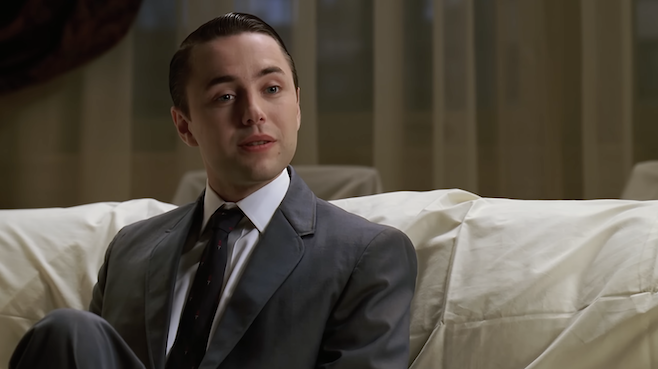
He’s an asshole, and he should probably just lend his kid some money, but he’s not wrong. Pete has an entreé into all the old parts of New York that are good for making you rich. The problem, for him, is that he has inside of him that other part of the city too, the part that loves new things, and creativity. I have ideas, he tells Don. And I believe him! He just isn’t very good at it. He’s not very good at schmoozing either, but his name smoothes that over in a way that it can’t in a more creative part of the field. And this puts him at odds with Don, the genius, each of them with what they were born to and what they are striving towards, and neither of them quite getting what they want.
More Thoughts:
This show is so skilled at spelling out a whole lifetime of character without too much exposition. The dialogue between Pete and his parents reveals very little, but it feels like such an old, worn, argument that you immediately understand what this family is, and more about why Pete is the way he is.
One-Upping Game of Thrones: CREEPY GLEN! This is not the first appearance of Creepy Glen, but it is the first creepy appearance. When Game of Thrones was on the air killing off characters willy-nilly I would frequently, (obnoxiously?) argue that no moment on that show was ever as shocking as the few really shocking moments on Mad Men. You never quite expect them to happen and then, ohmahgawd the child is watching Betty pee. Ohmahgawd now he’s asking for some of her hair. Ohmahgawd she’s flattered, and now she’s giving him some of her hair. Bettty’s value is so tied up in her looks, and she is so lonely, that she cannot separate the compliment from the fact that it is coming from a child. A normal show might have her befriending Helen Bishop and learning something, but instead she holds Helen at a distance and instead bonds with her strange boy. Betty’s reaction to this child’s behavior is genuinely unfathomable in a way that makes her feel so much more like a real person.
This IS the first appearance of Burt Cooper, Japanophile and libertarian. Another character where much is sketched out with very little ink.
First appearance of Trudy Campbell! I remember her parents being sort of overbearing and awful but they really aren’t so bad here. Pete just can’t stand them because his parents have poisoned his ability to trust familial relationships.
As much as I love Pete, I also love the stinger where his secretary fucking hates him.
———
Natasha Ochshorn is a PhD Candidate in English at CUNY, writing on fantasy texts and environmental grief. She’s lived in Brooklyn her whole life and makes music as Bunny Petite. Follow her on Instagram and Bluesky.