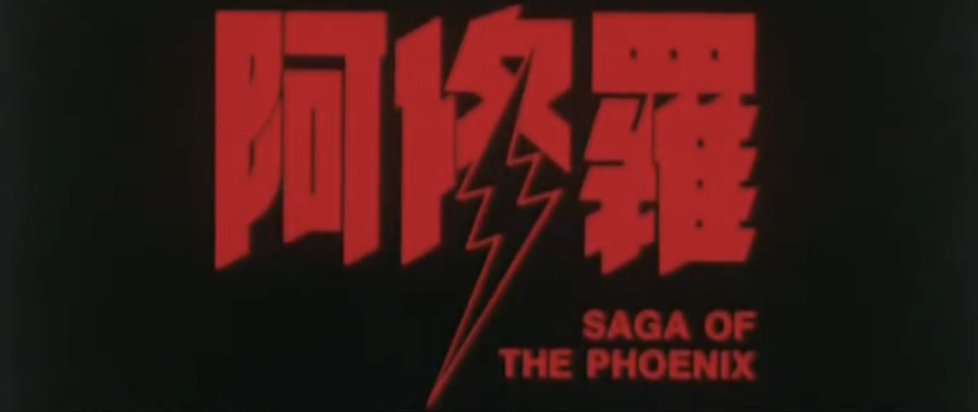
Life in the Human World is Far from Perfect: Watching Saga of the Phoenix (1989) Without Knowing What’s Going On
You feel compelled to support great writing…

“No one could’ve expected that another catastrophe would begin.”
As a certified Ugly American, I watched Saga of the Phoenix the way a person like me is supposed to watch something like this: out of order, and with almost no idea what’s going on.
Directed by Lam Nai-Choi and Lau Shut-Yue, Saga of the Phoenix is ostensibly a sequel to Lam’s 1988 film The Peacock King, a joint Hong Kong-Japan production adapted from Makoto Ogino’s manga series of the same name, which ran from 1985 until 1989 in the seinen (manga targeted to young men) magazine Weekly Young Jump.
Peacock King has been on my list of films to watch for a long while but, at the time that I received a copy of Saga of the Phoenix from 88 Films for review, I hadn’t gotten around to it yet. Which means I’m watching its putative sequel with no idea what’s going on, beyond whatever the film tells me.
The reason I am aware of any of these films at all is because of director Lam Nai-Choi. In the West, he is most famous (or infamous) for the hyper-violent Riki-Oh: The Story of Ricky from 1991 – itself also a manga adaptation. While I had heard of Riki-Oh, however, and have seen it since, my introduction to the films of Lam Nai-Choi was The Seventh Curse from 1986, a movie in which a young Chow Yun-Fat fires a bazooka at a monster and fights a flying demonic baby.
When people describe cinema from Asia as “bonkers” or “weird,” Lam Nai-Choi’s movies are the kinds of things they’re talking about. I have, at this point, seen roughly a third of his filmography, and he routinely makes the kinds of movies that are more fun to tell your friends about than they are to watch – though they are also a lot of fun to watch.
Lam Nai-Chois films tend to be visually – and sometimes narratively – bold; filled with ideas that seem impossible to pull off, and sometimes are. That’s all largely true of Saga of the Phoenix, even while it would be no one’s pick as an exemplar of Lam’s oeuvre.
You can lay this blame, in part, on the form. While I am told that Peacock King was an occasionally gnarly horror/fantasy hybrid, its sequel instead opts for an ostensibly family friendly approach. Why? I couldn’t say, but one of the essays included with the 88 Films Blu-ray suggests that it may have had something to do with the recent passage of the Hong Kong Rating Ordinance in 1988, which introduced a rating system for movies similar to our own MPAA ratings here in the States.
“Suddenly, filmmakers had to contend with content being appropriate for specific age groups, when previously that hadn’t mattered,” writes Andrew Heskins. “Yes, you could take your nephew to see Devil Fetus.”
The ratings were, in essence, three categories. Category I was “suitable for all ages.” Think of it like our G. Category II was “not suitable for children” – equivalent to PG or the later PG-13. While the soon-to-be notorious Cat III was “persons aged 18 and above only.” This would seem to be (and sometimes was) akin to an R in the United States, although Cat III films would soon push the boundaries of what movies in the U.S. might ever even attempt.
That’s an oversimplification of a complex historical web, and the infamy of Cat III films alone is enough that whole books have been written about them. Suffice it to say that the rating system may have led to films doing what films do here in the States and attempting to pigeonhole themselves into fitting a desired rating, which may have provided the impetus for the Peacock King sequel’s transition from grisly horror (I’m told) to family-friendly comedy.
The backbone of this “comedy” is provided by Tricky Ghost, a horrible gremlin brought to life via a combination of puppetry and stop-motion. Tricky Ghost eats all the food and attacks by farting a cloud of actual poison gas. When he needs to return to hell, he does so by flushing himself down the toilet – everyone knows that toilet outlets lead directly to hell, which does seem like a pretty efficient method for disposing of waste.
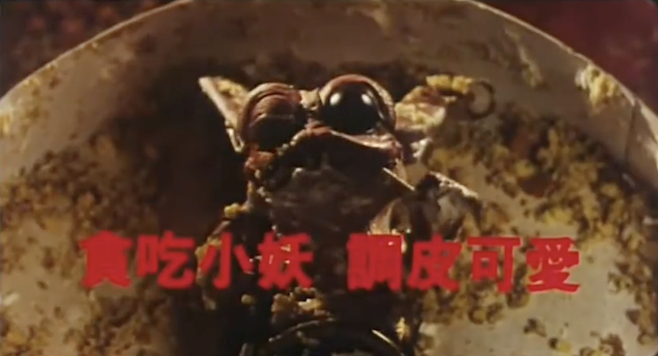
The success of Gremlins in 1984 (and, before that, E.T. in ’82) meant that the world was treated to a plethora of such gribbly little monsters in subsequent films. Besides an entire subgenre of Gremlins-alikes released here in the States (Ghoulies, Critters, Munchies, Hobgoblins, et al) there were plenty of other such puppet creatures showing up in other kinds of movies, just like our annoying friend Tricky Ghost here.
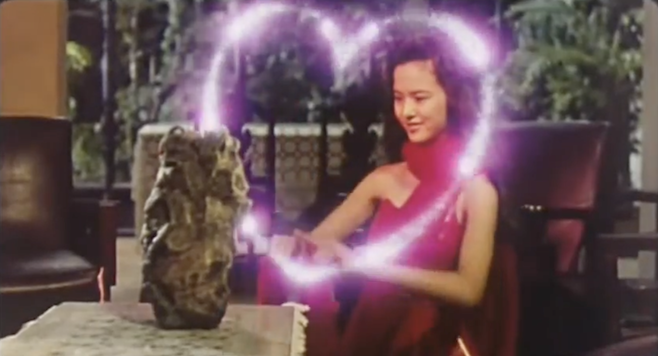
Fortunately, while he may dominate much of the screen time, Tricky Ghost isn’t actually the driver of the plot in Saga of the Phoenix. That’s Ashura, the Hell Virgin, played by Lam Nai-Choi regular Gloria Yip. According to some early voiceover, the demon realm and the spiritual realm are constantly at war. Buddha and his servants help to defeat demons, and the demon realm needs the Hell Virgin to bring them back. How does that work? I don’t know, and the movie doesn’t tell me.
However, the Hell Virgin is actually a pretty good-natured sort, who has decided that she doesn’t want to reincarnate demons and hurt people anymore. She just wants to live where there’s sun and hang out with her friends. The same voiceover assures us that, “By nature, she’s naughty and vivacious.”
Ashura wants to change her fate, but the Buddhist master (played by Shintaro Katsu, who was Zatoichi in about a million movies) says that to do so she has to practice repentance inside a dark Buddha statue for the rest of her life. She and the two monks who are her friends (named Peacock and Lucky Fruit, I’m not kidding) beg him for mercy, and he eventually relents and allows her to go live on Earth for seven days before coming back and serving out her sentence.
Unfortunately for everyone involved, Hell’s Concubine has a different plan. She hangs out in the Demon Palace, where she is attended by six more-or-less identical demons, who she sends up to Earth to do her bidding, making her basically the villain in a Power Rangers show.
Hell’s Concubine wants to drain all of Ashura’s qi so that she can be the one who reincarnates demons. Most of the movie is spent with her sending various minions up to try and fail to capture Ashura, while Ashura and one of her monk friends have sitcom misadventures – the other monk is shortly frozen in a block of ice in the Demon Palace, and stays there for the rest of the movie.
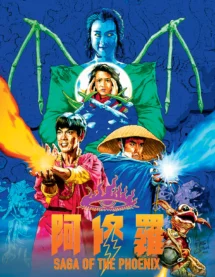
Eventually, of course, everyone gets into a big fight in the Demon Palace, where Hell’s Concubine transforms into a giant skeletal dragon/gargoyle designed by Keita Amemiya of Zeiram fame. Despite a lot of weird stuff in that hasty summary I just typed up, it’s the closest the movie really gets to Lam Nai-Choi’s signature bonkers visuals.
Looking over reviews online, Saga of the Phoenix seems to enjoy a rather poor reputation that it mostly deserves, and yet it’s not as annoying as it sounds on paper. This is thanks in no small part to winning performances from a number of the actors. Gloria Yip sells the otherwise one-note Ashura, who is just too genuine for anyone not to be on her side, while Japanese model-turned-star Hiroshi Abe is equally charming (and very pretty) as Lucky Fruit.
Even the supporting cast of brother and sister humans whose house our leads crash for much of the movie are pleasant, especially Hong Kong star Loletta Lee, who takes Ashura on a shopping montage and drags Lucky Fruit into the swimming pool. I was genuinely a little invested in her undercooked love story with Lucky Fruit.
Does anybody who doesn’t already want to watch it need to really cross the street for this movie, let alone pick up the fancy 88 Films Blu-ray? Absolutely not. Will those who feel called to do so regret it? Maybe a little, but not as much as you might have heard – assuming you’ve heard of it at all.
———
Orrin Grey is a writer, editor, game designer, and amateur film scholar who loves to write about monsters, movies, and monster movies. He’s the author of several spooky books, including How to See Ghosts & Other Figments. You can find him online at orringrey.com.