THAT’S WHAT THE BLOG IS FOR! Mad Men S1E1–S1E2
You feel compelled to support great writing…

S1E1 Smoke Gets in Your Eyes
“Advertising is based on one thing: happiness. And do you know what happiness is? Happiness is the smell of a new car. It’s freedom from fear. It’s a billboard on the side of a road that screams with reassurance that whatever you’re doing is OK. You are OK.” – Don Draper Season 1
“What is happiness? It’s a moment before you need more happiness.” – Don Draper Season 5
I’m going to try to keep things spoiler free and stick with the present as I write along with these episodes, but I include the quote from Season 5 above along with the one from this episode because the movement from one to the other is what makes Don Draper tick. This character movement is not an arc, but vacillation, an internal quake that sometimes frustrates viewers of the show who get as tired of Don’s shit as his family and co-workers do. Don sees thorough advertising, its cynicism and false promises, but part of why he is so good at it is that his life thoroughly depends on those promises making good at some point. Don needs the fancy car to mean freedom from fear, or that fear will eat him whole.
More on that in later episodes.
Don is stuck on a pitch for Lucky Strike cigarettes. He comforts himself by visiting his mistress Midge, who makes her living painting puppy dogs for greeting cards but, unlike Don, thinks of herself as an artist. You can tell by her artist’s loft and the men’s shirt she wears over black slacks. Don likes Brunettes, and he likes women who help him access something in himself he has trouble reaching otherwise. More on that in later episodes.
Mad Men, as a whole, is about people who are very good at communicating feelings to an audience (much like television writers), frustrated in their attempts to communicate themselves to each other (much like most writers). With Don (and others, later) there is always a suggestion that the advertising has harmed him psychically. That, if he had not been born poor and needing to make money he might have been a novelist, or a poet, and he might have learned to tell the truth, and might have been made whole someday by doing so instead of continuously putting the best parts of himself into lies that create more people like him: dependant on consumer aesthetics to sell the idea that they are happy.
Much like television writers who want to be working in film?
Don ends up improvising a wowza of a pitch for Lucky Strike (the quote up top is part of this), and makes a case for an alternate version of this show where Don is the Dr. House of advertising, a pitch-of-the-week type show. Spoiler: it is not that kind of show. That being said, it is fun when it acts like that kind of show, which is part of why there aren’t really any bad episodes of Mad Men. There are better episodes and worse ones, but none that are unpleasant to watch in the way that even some of my other favorite shows knock out once in a while. The worst thing about this episode – and this season as a whole – is when the show leans too heavily on the harharhar it’s the ‘60’s kinds of ironic juxtaposition it eases up on later. Harharhar the gynecologist is smoking. Harharhar everyone starts coughing at the smoking pitch meeting. Harharhar everyone is sexist including the closeted gay guy. Harharhar xerox machines.
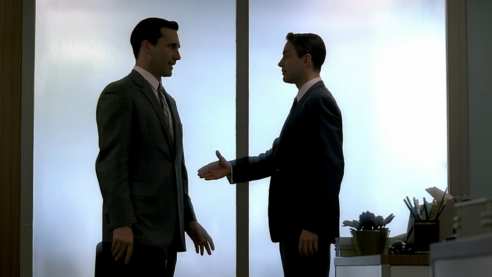
“How do I put this? Have we ever hired any Jews?” A good harharhar intro to Roger Stirling, Don’s boss and one of the most harharhar characters on the show, although John Slattery is so handsome and so instantly comfortable with the language of his character that he pulls it off. They have not hired any Jews! This is how Don ends up at client drinks later with department store heiress Rachel Menken to make up after he insults her in a meeting. At drinks he gives her the exact opposite of his Lucky Strike pitch:
Don: “You mean love, you mean the big lightning bolt to the heart, where you can’t eat, you can’t work – you just run off and get married and make babies. The reason you haven’t felt it is because it doesn’t exist. What you call love, was invented by guys like me, to sell nylons.”
Rachel: “Is that right?”
Don: “I’m sure about it. You’re born alone and you die alone, and this world just drops a bunch of rules on top of you, to make you forget those facts – but I never forget. I’m living like there’s no tomorrow; because there isn’t one.”
The thing about Don is that he really does believe this and he also believes in love with his whole brain and body each and every time it happens to him. These are the things he is trying to reconcile and the things he will spend the entire show throwing at each other to see which will win. Don is a cynic, and a romantic, and a liar, and a truthteller, and he knows all of it and forgets it all the time.
And then he goes home to his beautiful, blonde, horny wife, and he sits by his children. They all look perfect. He looks miserable.
More Thoughts:
• I barely talked about anyone else but Don here, which is especially egregious with regards to Joan, Pete, and Peggy. This is not quite as much Peggy’s show as it is Don’s, but it almost is. She is his counterpart/soulmate in many ways so it feels shameful to leave her out. But! She is mostly here to be our entry character into Sterling Cooper. Her willingness to let Pete into her apartment and sleep with him after earlier not even wanting to be in the same room with him because of his obnoxious sexual harassment has never quite worked for me, I always feel that the line he gives to her roomate (“For the first time today I’m not selling anything”) is more moving than the one he gives to her (“I had to see you”), but I suppose that for Peggy the combination of Joan repeatedly telling her that she’s at work to get a man, followed by a rejection from Don, might make sleeping with an engaged drunk man feel like a win. Pete and Peggy’s (also the names of my in-laws!) relationship to each other is one of my favorite arcs on the show, so if this isn’t the best start there is still so much to look forward to.
• Joan enters the show and just owns it. I think I read that they created the character for Christina Hendricks, and it shows. I love her.
• “I am over, and they are finally gonna know it.” Don says this about his writer’s block but OH BOY is that subtext for future episodes!
• I love the zaftig stripper.
• “I don’t think I realized until this moment, but it must be hard being a man too.” Rachel Menken predicting the male loneliness crisis. I’d find this line odious in most other contexts, but Mad Men is such a rich text on how male pain is almost completely self-inflicted that I love it here.
• Minor characters around the office: Ken Cosgrove is kind of a jerk! Harry Crane seems nice! Paul Kinsey seems normal! I’m sure this will stay the same.
S1E2 Ladies Room
In some ways “Ladies Room” follows the old-school rules of network television, repeating the pilot a couple times so that those who missed it last week can catch up. Don struggles with a pitch and then has a moment of brilliance from his personal life. Peggy is hit on in the office and not in the way she wants to be. Joan insults and provides wisdom in equal part. Roger is drunk. The episode also returns to the question of happiness, with Don asking at one point: “Who could not be happy with all this?” The big addition is Betty Draper, who only shows up in the last few moments of the pilot, and this is really her episode.
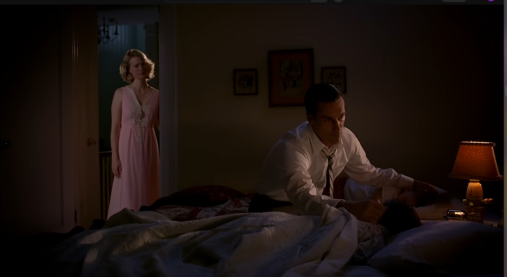
This always feels like The Sopranos episode of Mad Men, like Matthew Weiner hadn’t quite shaken off those movements yet, and although Don seems like the more obvious analogue for Tony Soprano (philandering, high pressure job where he’s kind of a bully, mommy and daddy issues), it’s Betty who plays out those beats here. Like Tony, Betty ends up in psychoanalysis because her panic attacks begin to cause trouble at work, (as a housewife, in her case). Her hands begin to go numb when she’s nervous or anxious, which leads to an awkward moment at a dinner with Roger and his wife Mona, and a low-speed car accident while driving the kids after seeing a divorced woman moving into her neighborhood.
Unlike Tony, who only agrees to therapy because the panic attacks are a more visible threat to his masculinity than getting his head shrunk on the DL, you get the sense with Betty that her spells are the pretext she needs to force the issue of giving her someone to talk to besides her judgemental friends and dead end of a husband. Don isn’t just closed off in emotional ways, he’s bizarrely secretive, getting upset when people dare ask him if he had a nanny growing up or revealing that they might want to meet his mother one day. (MILD SPOILER: if Betty not only hasn’t met his mother, but believes that she might one day… how the fuck did that wedding work? It’s hard to believe Betty would elope to City Hall, and later in the season we see Don carrying her in a Grace Kelly dress, and I think in a later season Betty’s father says something about Don having no one at their wedding. What excuse did he give that made Betty feel like she might get to know his family one day? Or is this something that gets ret-conned in a later episode?) Meanwhile, Betty is desperately telling anyone who might be sympathetic that her mother has died recently, only to be met with silence (awkward from Roger’s wife Mona, and cipher-like from her eventual shrink).
This all culminates in a horrifying, funny, and very sad little speech after she worries that Sally might have a scar on her chin from the car accident:
I’m just saying, if it had happened to Bobby it’d be ok because a boy with a scar is nothing, but a girl, it’s so much worse…. I keep thinking… not that I could have killed the kids, but… worse, Sally could have survived, and gone on living with this horrible scar on her face, and some long, lonely, miserable life.
What makes this so tragic, along with sounding like something both my Grandmothers would say in earnest, is that beautiful, beautiful Betty is living a lonely, miserable life without any blemishes on her perfect face to blame for it, and she can’t understand why any more than Don can. So much of this show is about Don cannibalizing his life to write the perfect facade for others to believe in, but Betty shows the cost of that belief.
More Thoughts:
• Don’s ad conundrum for the week is trying to figure out what women want in order to sell deodorant in a can. “Any excuse to get closer” he comes up with eventually, as he avoids his wife’s invasive questions at his mistress’ apartment.
• I had forgotten that Don’s “more happiness” idea is actually first expressed by Roger in this episode, complaining that therapy is the new candy pink stove for spoiled girls like his daughter.
• Don shitting all over astronauts is very funny. He is very good at defending whatever position he grouchily feels like taking that day (game recognize game).
• The episode title comes from Peggy, who I still didn’t talk about (I’M SORRY PEGGY). She sees someone crying in the ladies room at the beginning of the episode and later decides not to be that girl. These first two episodes lay good groundwork for the struggle Peggy has for a long time, torn between handling things “like a woman” or “like a man.” She spends a lot of these early episodes trying to be Joan, who is powerful in a way that Peggy is not good at and can’t access, but this little moment is a good indicator that she succeeds more when she emulates Don – for better or for worse.
———
Natasha Ochshorn is a PhD Candidate in English at CUNY, writing on fantasy texts and environmental grief. She’s lived in Brooklyn her whole life and makes music as Bunny Petite. Follow her on Instagram and Bluesky.