Inspired Wonder: The Old King’s Crown is a Game Created of Chance and Circumstance
You feel compelled to support great writing…

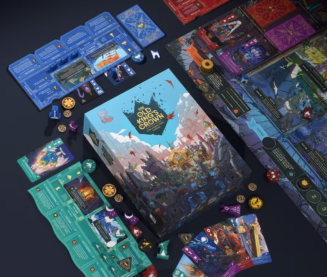
There are objects which, from just a glance, reveal that they are special. Quality craftsmanship has the benefit of not only enduring the corrosion of time, but also standing out. The Old King’s Crown, a most fascinating game, caught my attention after being mentioned in a conversation by my friend Fred Serval. It made a lasting impression on me as an invocation of a fantasy world that was.
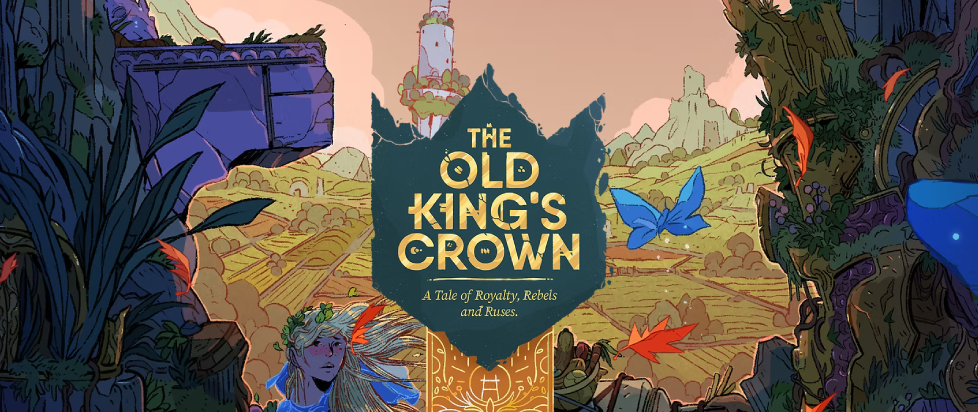
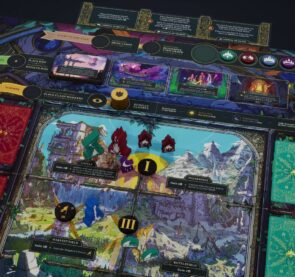
With its colorful illustrations courtesy of Pablo Clark, who also happens to be its designer, The Old King’s Crown beacons us to imagine. Adding to this, it plays like an ancient game – a classic – embedded with bits and pieces of modern board game complexity. To play The Old King’s Crown is to simultaneously try your hand at a most familiar card game transformed through time as a lane battler with the asymmetric complexity of a modern classic like Leder Game’s Root. What I am trying to say is that The Old King’s Crown is both the past and future of board games as a medium. And it is as hellishly mean as it is beautiful.
Anachronistic is the game’s mix of old and new. Hard to place at first, but the influences of reiner Knizia, western high fantasy, and games played across millennia dance among the worlds of Hayao Miyazaki, and the best of modern board game complexity to form a strand of the game’s double helix. As I learned its rules and played in its brutal world of decaying decadence and factional opportunism, I entered a state of jamais vu. Whichever of the four factions you choose to play as, you must be cunning and at times conniving to get ahead. No mercy for the enemy (or friends).
The following is a conversation I had with Clark via email (edited for brevity and clarity), where we discussed what inspired The Old King’s Crown, his prior work, and how he created something beautiful.
———
Tell me a little about your work as an illustrator. What did you work on previously to The Old King’s Crown?
Before leaving to work full-time in board games, I worked as a freelance illustrator and storyboard artist, primarily in the AAA video game and animation industries. I worked in-house as a senior storyboard supervisor, heading up teams, working alongside the director. A big part of drawing storyboards and concept art is being comfortable drawing a vast amount of pictures that very few people will actually see. If a storyboarder draws in the woods, [do they] even make a sound? So, it is a little surreal having my drawings so publicly available now (I was really open about the drawing process of The Old King’s Crown, sharing sketches and illustrations, in updates on our Discord and in art livestreams).
During my time as a freelancer I worked on projects for intellectual property like Destiny, Lord of the Rings, The Walking Dead, Transformers, Dungeons & Dragons, and Love, Death & Robots. Often stressful but always educational.
How has this experience in illustration and video games prepared you to make The Old King’s Crown?
Definitely that the craft and graft of drawing every day helped instill in me the ethos that you don’t wait for inspiration to strike. It is better to start drawing and find it on the path, especially if your livelihood depends on it. Better to get in the mud and start wrestling with it.
I think it was also very useful to see how projects came together over time, how different teams contributed to the whole. I was the lead on The Old King’s Crown so to speak, doing the design, development and illustrations but there were many of us together that brought it to life. Whether they were graphic designers, other developers, text editors or our wonderful playtesters spread across the world, working alongside them as a team was a huge, defining part of the process.
My experiences as a freelancer also helped to take criticism, as it’s so baked into the process. You need to be comfortable with or at the very least grow able to adjust your work based on feedback. This can be kindly and well intentioned or deliberately pointed. It is important to be able to rip up [the work done] and start again sometimes.
What inspired the making of The Old King’s Crown?
Chance and circumstance. It was something that came about organically over a long period of time. Long before it had a theme really, it was a prototype that I played with friends. In fact, at its heart, the first iteration I designed using a deck of cards, something we could carry and play with on a camping trip with my then girlfriend. We played it by torch and firelight. Strange to think that even there, in that first design, there was a bunch of foundational stuff that made it into the final design many years later. Though good luck playing the final thing in a tent now.
So, rather than set out to make this big, sprawling strategy game as a first time designer, the game and I sort of grew up together. Bit by bit, we figured each other out. So that slowly over time, when the scope began increasing, it felt natural and exciting, rather than unwieldy and intimidating.
How would you describe what it feels like to play The Old King’s Crown?
I think I’m very badly positioned to answer that – I’m lost in the forest of the thing perhaps? However, I think, I hope, it feels interesting and expressive. I hope it feels like pitting wits and maneuvering through a fog of war. One that encourages players to think strategically about their own moves but also to place importance on the movements of others. I hope it feels playful, experimental in places even. I hope players feel a sense of discovery and the satisfaction of threading together plans in inventive ways. I hope it feels rich with possibilities.
The essence of a classic card game is deeply felt when playing the game. What games influenced the design of The Old King’s Crown?
This is where I fear I may need to turn in my gamer badge and gun. When I first started designing The Old King’s Crown I had played relatively few board games. For example, the game is quite often referred to as a lane battling game but I had never played lane battling games, classics like Omen by John Clowdus or Battle Line by Reiner Knizia. I hadn’t played a lot of foundational stuff. I still haven’t in many ways.
I like wonder. I like being surprised and wrong-footed, so a degree of naivety when making things I think is valuable. We can overengineer our tastes a little I think? I’m not sure that playing games is any more important to making games as reading books is. That said, at that time, I had played a bunch of Cosmic Encounter and Citadels when living in Glasgow. We’d get together and play these two games regularly. I still have my threadbare, held-together-with-tape copy of Citadels. And, oddly, I remember ordering Hammer of Scots, a fairly traditional block wargame. I’m not sure I ever got to play it more than once or twice with others. Mainly I just thought about it. I remember thinking about all the potential tense fog of war and positional misdirection that was implicit in the design. That was exciting!
What are some of your favorite games (analog or digital)?
These are some games that readily spring to mind!
Board games: Cole Wehrle’s work is excellent and inspiring. Oath, John Company and Pax Pamir are all cherished in this house. I’m a big fan of Tash-Kalar, Ortus Regni, and John Clowdus over at Small Box Games. I love the leanness of his designs. He has been putting out some great iterations in recent years, but I also really like some of his earlier stuff like Stone & Relic and Soulfall. I’ve had a good time with the Levy & Campaign game Plantagenet: Cousins’ War for England 1459–1485. I have a soft spot for the Oniverse games by Shadi Torbey, lovely little meditative things, wrapped up in whimsy. David Sirlin does interesting stuff. Really uneven packages but often interesting (which is what you want). I like the old Lord of the Rings LCG and the older, weirder Middle Earth CCG (what a fascinating game to dink around in). The Barracks Emperors, Nusfjord (what a cosy game!), and Summoner Wars. And I’m looking forward to playing more Deckers by Richard Wilkins, who co-designed the solo mode for The Old King’s Crown with me, a very interesting puzzle.
Videogames: The loneliness of Shadow of the Colossus and Zelda: Breath of the Wild both loom large in the imagination. Link’s Awakening was formative. I like wrestling with Zachtronics games. Their Solitaire Collection is beautifully made too, some great variants in there (also Zach Barth designed a fantastic little card game, a physical one I mean, called The Lucky Seven). I love the original Baldur’s Gate. I’ve only dipped my toes in both Disco Elysium and the Outer Wilds, but I was hugely impressed with both. I keep trying, futilely, to enshrine the time to play them from start to finish. I like the original Turok and Deus Ex. Dicey Dungeons; I like the way it rips up entire roguelike deckbuilding mechanisms into short, puzzle-like runs. Advance Wars is great. I love old janky strategy games like Fantasy General and the original Age of Wonders, MDK, Shiren the Wanderer, Cave Noire, and The Etrian Odyssey games, and Card City Nights.
Leder Games, the markers of Root, Oath, and Arcs, helped with the development of the game. How was the experience of working with them?
So, throughout the process of making The Old King’s Crown, I ended up speaking to the folks at Leder Games, in particular Cole Wehrle, Nick Brachmann, and of course Patrick Leder. In fact for about nine months Cole helped us with regular guidance and support on the design. It was such a valuable and fascinating period, and was crucial in defining what the final game would become. It felt like an education in the best possible way. Even now they continue to be supportive and generous beyond measure in all sorts of ways. I consider myself very lucky to have gotten to know such a bunch – a wonderful, inspiring studio that produces some truly special games, behind which are some real good folks.
There is an expansion for the game in the works. The game feels so complete as it is. What will this expansion add in terms of experience?
That’s very kind. Yes, we absolutely wanted to make sure the game, in its original form, felt complete and whole. This expansion rather than filling holes, goes exploring instead. It has years of development behind it to inform its ideas and cards. The whole expansion can be seen as a way to celebrate the mechanisms of the base game. The rule when designing it was essentially, how strange and inventive could we push the systems, without bolting on new rules.
How could we challenge the norms of the game? How can we put players in interesting new strategic positions by upending established ideas? For example, one of the new factions is a lost group of questing knights, from some harr-y, half-glimpsed history, who long ago forgot what they were questing for, and have returned home (the expansion is called Songs of Home) to a kingdom that they no longer recognize, and which in turn no longer recognizes them. They play like a faction on the edge of the end. They need to keep churning and moving, and clutching on to their place in this world.
Additionally, the expansion introduces a new place to visit, expanding the world of the kingdom as well as who is in it. I can’t wait for folks to experience what you can do with that. Finally, it let us once again return to the Kingdom Cards of the game and explore some systems and ideas that we always wanted to originally, but didn’t have the knowledge or scope to explore the first time around. It has been a true pleasure diving into them again.
What would you like those that play The Old King’s Crown to get out of it?
In some small way, I hope they get some small sense of wonder from it. Whether from the strategies that they can explore or the world hinted at in the cards, I hope the imagination takes root in this weird kingdom we created. That would be the dream.
———
A review copy of The Old King’s Crown was provided by the publisher.
———
Luis Aguasvivas is a writer, researcher, and member of the New York Videogame Critics Circle. He covers game studies for PopMatters. Follow him on Bluesky and aguaspoints.com.