Whispers of the Grove

This column is a reprint from Unwinnable Monthly #193. If you like what you see, grab the magazine for less than ten dollars, or subscribe and get all future magazines for half price.
———
Architecture and games.
———
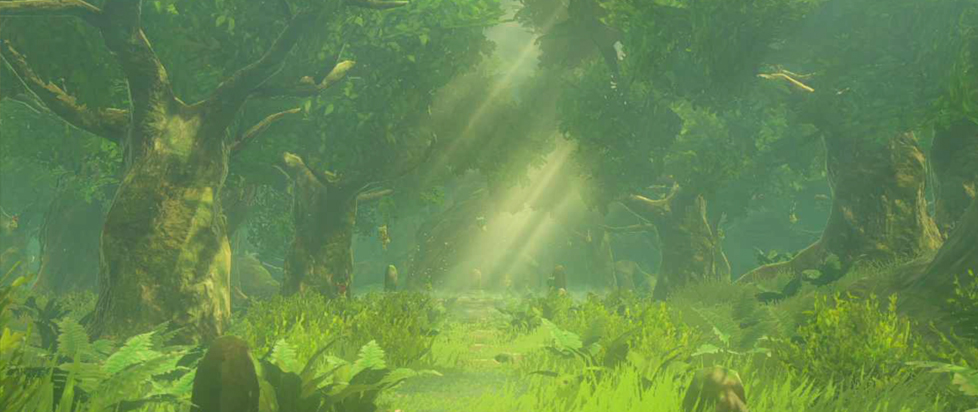
The same part of the game world in The Legend of Zelda: Tears of the Kingdom is a very different place, but if you take a walk through the Lost Woods in Breath of the Wild, you’re likely to sense an eerily familiar feeling, especially if you’ve spent some time with Majora’s Mask and Ocarina of Time. The same could also be said if you’ve seen a few jidaigeki or period dramas along the lines of Rashomon or The Sword of Doom, and of course flipped through some works of literature like Snow Country or Kafka on the Shore.
The forest in Japanese culture is more than just a landscape, having long been seen as a threshold between the realms of the human and the divine. The woods were understood to have their own particular presence, being places of both reverence and fear, home to kami or spirits and bakemono or monsters, representing areas of transition or transformation. This holds true today, despite the centuries.
The region in question made its first appearance back in 1986. Introduced in The Legend of Zelda, the Lost Woods clearly tapped into this long cultural lineage. The place wasn’t just a wooded maze but a wilderness where your sense of direction dissolved, representing a significant departure from the overwhelming majority of roleplaying games at the time, or even today. The place naturally changed over the ensuing decades, evolving in both form and function. The overall essence on the other hand remains rooted in the ancient idea that forests are places of both peace and penitence where people perceive the boundaries of their own understanding.
When it first appeared in The Legend of Zelda, the Lost Woods presented you with a puzzle, being constructed from a repeating grid of identical forest screens. You could wander indefinitely, looping endlessly unless of course you found and followed the right sequence of steps, typically through experimentation, although occasionally through luck. The solution was rather simple, but the concept couldn’t have been clearer, given that confusion created cunning and mystery made mastery. This was definitely no dungeon but rather a narrative space where exploration itself was the secret to success, curiosity eventually becoming the heart and soul of the franchise.

The designer behind the series, Shigeru Miyamoto, drew inspiration for The Legend of Zelda from the forests around his childhood home in Sonobe, near Kyoto. Miyamoto has frequently reminisced about losing himself in the numerous caves and woods of the region, becoming at once terrified and thrilled by a world that was much bigger, stranger and more interesting than he could ever have imagined. This particular experience became enshrined in the Lost Woods.
A Link to the Past was released back in 1991, and the Lost Woods appears to have transformed from a pure puzzle into a place imbued with stillness and setting. The environment was no longer just an obstacle but a form of atmospheric storytelling. The forest concealed secrets including of course the sword in the stone but also the location itself. You could perceive a blurred map with paths doubling back upon themselves, and the Lost Woods finally felt like something sacred, perhaps even poisonous. Traversing the forest was truly a rite of passage. This would of course become something of a pattern.
The most notable apparition of the Lost Woods would have to be in Ocarina of Time, released back in 1998. The game would forever bring Hyrule into three dimensions, and the Lost Woods naturally grew in terms of both size and scale, rendered as a twisting labyrinth featuring peculiar passages filled with a wide variety of different denizens. The location was haunting, with looping music punctuated by shrieks and screams, creating a sense of disorientation similar to some sort of strange fever dream.
This particular entry in the series however presented a meaningful sense of permanence. Tucked away in these dingy depths could be found the Kokiri Forest and of course the Forest Temple where so many of the sprites, spirits and sages of the game world resided. The clock seems to stand still in this part of the Lost Woods, reflecting or maybe refracting the obviously reappearing themes of change and growth which come to the fore in Ocarina of Time.

The subsequent games definitely deepened the metaphor. Majora’s Mask for example has you begin your journey falling into another world, having first been drawn into the Lost Woods, naturally. The forest functions in the game as yet another liminal space, but this time one that separated realities. The tone is famously darker and certainly more psychological. Twilight Princess took this a few steps further, coming out several years later in 2006. The game transformed the Lost Woods into the Sacred Grove, a place filled with echoes of the past guarded by ethereal entities.
The twisting passages of the forest in Twilight Princess mirror your own fragmented memories, and as you’d probably expect, they’re filled with a type of murky, muted music which recalls Majora’s Mask. The effect is most likely deliberate, perhaps a play on the nostalgia which had even then come to characterize the long running series. The area was now a space not only of disorientation but of remembrance where history folded back upon itself.
Breath of the Wild was among the most highly anticipated releases of 2017, and the game surprisingly represented the region as a navigational system instead of a maze. There would be mist enveloping your vision should you ever stray from the critical path. Flickering torches could be found guiding your way, ensuring that you don’t reawaken from a sudden slumber at the entrance. The forest was now alive, and reactive.
The experience in Breath of the Wild was more than just a puzzle. The place tested your awareness of the world around you, representing what could be described as the most accurate vision of the region, as seen through the eyes of Miyamoto. Supposing that you wound up getting lost in the woods, which was of course incredibly common, you didn’t fail in your endeavor, you just embarked upon a different stage of the journey. Tears of the Kingdom pushed this even further, preventing any and all access to the Lost Woods, at least without first going through the Depths.
The forest has always been a world apart in Japanese culture, representing a place which is at the same time dense, untamable and alive with mostly unseen life. The part of Hyrule known as the Lost Woods carries this legacy forward, given its dramatic mists, melodies and memories. The region has been a maze and most recently a myth. The Legend of Zelda continues to consider the forest a place of balance between past and future or human and spirit, providing a reminder that mystery is not meant to be merely seen but lived.
———
Justin Reeve is an archaeologist specializing in architecture, urbanism and spatial theory, but he can frequently be found writing about videogames, too.