Negative Spatial Awareness

This column is a reprint from Unwinnable Monthly #193. If you like what you see, grab the magazine for less than ten dollars, or subscribe and get all future magazines for half price.
———
Analyzing the digital and analog feedback loop.
———
Slight spoilers regarding Marion Marigold’s backstory in Blue Prince.
There’s an enigmatic picture book from the early ’80s that Blue Prince puts me in mind of. The inspirations and homages of Tonda Ros and his team at Dogubomb are well-documented. Armchair mysteries, board games, mathematical equations and Ros’ own puzzle events held at Airbnb properties, as well as games like Myst, Riven, Gone Home and The Witness are some of the oft-cited sources. But I went into playing Blue Prince without reading any criticism other than general mentions and discussions about its intricate puzzles and the randomness of them. As a result, when I started to encounter some of the story beats about Marion Marigold, the missing author and mother of the game’s player character Simon, The Mysteries of Harris Burdick by Chris Van Allsburg (of Jumanji and The Polar Express fame) began haunting me again.
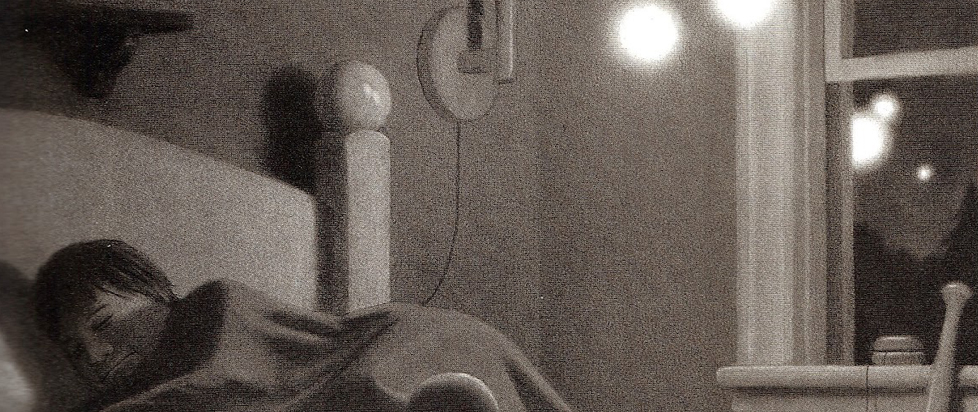
The book is a frame narrative about a book editor named Peter Wenders who met mysterious author-illustrator Harris Burdick. Burdick pitches a series of books based on fourteen images accompanied by captions, telling Wenders he will only bring the manuscripts if the whole series is to be accepted for publication. Yet the very next day Burdick goes missing and Wenders never finds him again. Van Allsburg then enters the text and suggests that they publish just the illustrations in the hopes that they will learn more about Burdick. This book hearkens back to the armchair mystery/treasure hunt genre but it is also about encouraging children to hone their imagination and become storytellers in their own right. The illustrations are also stunning for readers of all ages with their misty, monochromatic surrealism and have likely gone on to inspire author-illustrators like Brian Selznick and Shaun Tan. Stephen King has based one of his short stories off of the illustration captioned “The House on Maple Street” and has titled it the same. Furthermore, there was an anthology of short stories based off the illustrations, The Chronicles of Harris Burdick: Fourteen Amazing Authors Tell the Tales, published in 2011 as well.

When one gets older, The Mysteries of Harris Burdick is an obvious enough frame tale, as the illustrations match Van Allsburg’s signature style which I’d describe as ominous whimsy. The point of the book wasn’t so much to solve the mystery of Harris Burdick, so much as to suspend one’s disbelief and immerse yourself in this strange parallel world that is just off-kilter enough that one wonders at how constructed it is. Or whether the stories you construct from your individual inspirations of this parallel world are close to what Burdick’s unknown head canon, for lack of a better term, were. There are emergent puzzles with the formatting of the book, in other words, but it’s really the mystique of those puzzles and their irresolution that makes the reading experience memorable.
Blue Prince is imbued with a similar mystique, although there is a resolution to the grand puzzle scheme of the Estate and a linear albeit fragmented narrative, Tonda Ros has mentioned during an interview with one of his play testers that what his ludic inspirations have in common is atmosphere. In fact, working with a limited amount of specific game experiences he’s had was key to his eight years of development on his title. In his words: “the more games I play, the actual less options I have…I’m more of a negative space in terms of my influences where I purposely don’t want to play something [and know it’s been done before].” He also emphasizes that boardgames, especially card-pull ones, are responsible for the procedural nature of drafting rooms and starting each day with no resources from the previous, not rogue-lite games.
You can finish Blue Prince by discovering the hidden forty-sixth room, therefore fulfilling the stipulations of your late Great Uncle’s will. Therefore, whilst the narrative beats you discover give more context and direction to a player’s drafting choices and puzzle-solving, you need not know the whole story of Simon’s eccentric and politically charged family drama to complete the game. While there are several ways a player can begin to engage with the intergenerational story of the Estate, for my first play through the story began to suffuse my actions when I discovered the Security Room where Simon can view multiple rooms from various angles on glowing green CCTV screens. Here is where the scope of the Estate’s will impressed upon me as I interacted with the computer system and discovered more ways to manipulate the odds of being able to bypass more sophisticated locks as I headed further into the grounds of the Estate. You also gain some insight on the house staff, who have left a message on the computer for Simon to find, cheering him on. This room was also the first for me since starting my file that I witnessed a cutscene and while that says more to my upbringing as a player and what signifies as an important moment than it does make the Security Room sequence a definitively significant room, I think it bears mentioning. I’d spent around four days or so, therefore four gameplay loops, before I saw this sequence. Those four days lulled me into a sense that there wouldn’t be much beyond environmental storytelling for me to encounter.

The Harris Burdick experience intersects one more way with Blue Prince for me, and that’s the subtle sense of the occult interwoven throughout the Estate. The game isn’t explicitly magical realist, but there are assumptions about the system of the Estate’s drafting and procedural nature that are taken for granted by multiple characters you encounter in the lore. One scientist who was in your Great Uncle’s employ inquires about how her interns are supposed to put in consistent lab work if you can only sometimes stumble across the laboratory room, for instance. Other guests mention in letters their delight that they were able to access the billiards room once more, and so on.
The player early on is in the position of these characters and their limited knowledge until they stumble across another room: the Rumpus Room. I don’t want to reveal any more here, but let’s just say that after you literally “buy into” a story beat in this relatively rare room there’s a paradigm shift. Harris Burdick was treated in some ways as a proto ARG experience, with Van Allsburg keeping up the frame tale’s telling well after a decade from the original publishing of the book. In the introduction to the 1996 portfolio edition, the author-illustrator extends the narrative of how another of Burdick’s illustrations was discovered behind the glass of a mirror whose frame is decorated with character portraits from Through the Looking Glass. There used to be an official website for this edition of the book as well which would encourage creative writing assignments based off the evocative illustrations.
Although Ros has said he’s more inspired by mystery stories than he is detective stories, there is one real life mystery story involving Agatha Christie that I’d not be surprised influenced his story of the missing author Marion Marigold. This story incidentally dovetails with the atmosphere of both Harris Burdick and Blue Prince in that it exists in that same liminal realm of truth being stranger than fiction. Not to mention the speculations that proliferate when we work from limited sources of information.

Marion Marigold was known in the game for having a reputation for writing children’s books that often contained mysteries or riddles. She was also known as someone who publishers would refuse to accept manuscripts from due to their political nature. She’s a revolutionary figure involved in various intrigues that have plagued the different generations of Simon’s family and was mentored by a radical anti-royalist figure. When she goes missing in action her bibliography comes under major scrutiny and the family’s tensions with each other are strung taut. Simon can discover more of Marigold’s story and the nature of her disappearance via hard to discover letters that are all addressed in red envelopes.
While Agatha Christie’s disappearance in 1926 is not motivated by a political incident per se, her missing persons case was heavily publicized and went international on the front page of The New York Times. One UK newspaper offered the equivalent of around $6,000 USD as a finder’s reward. Over a thousand police officers and tens of thousands of volunteers searched for her. One of the early instances of a search by air in detective history is associated with this case as well as Sir Arthur Conan Doyle bringing one of Christie’s gloves to a spiritual medium to locate her via supernatural means.

I’m getting ahead of myself, however. The mystery writer, unlike Marion Marigold, was not quite the renowned household name she is today. But the circumstances of her disappearance and the genre she wrote in seem to be among the chief causes of the frenzied search. Christie left one night in her car after leaving her only child with her maid. This occurred after a huge fight Christie had had with her adulterous husband who wanted a divorce from her. Christie was also struggling with depression from the death of her mother that same year. Her abandoned car was found off the road in Newlands Corner in Guildford, Surrey with its headlights still on. Inside the vehicle were some of her clothes and an expired drivers’ license.
Similarly to Blue Prince, the key to finding more info about Christie’s location lay with three letters, one of which was lost due to being burned by her husband. Despite one of these letters to her brother-in-law explicitly mentioning she was headed to a health institution in Yorkshire, the police were dismissive of this possibility. Eleven days later she was indeed found at Harrogate, a Hydropathic Hotel in the region she mentioned in the letter. She appeared to be in what is suspected to be a fugue state, living under the name Teresa Neele (the surname of which was shared with the woman her husband was having an affair with) and believing herself to be from South Africa. Eventually with treatment she recovered her former memories, but those eleven days she spent since her disappearance remain lost to time and her suffering. Other than a mention during an interview years later where she explains that she likely had a car accident that caused her amnesiac state.
I end with these parallels because I’m fascinated by how much of the development and gameplay experience of Blue Prince is influenced by an intentional focus not just on hidden spaces, but on negative spaces and what they do to our speculative minds. You search for room 46, but also for the ephemeral legacies of your family and its place in the wider world. You search for your place in these legacies. Since Tonda Ros chose to play less rather than more games during the development of his debut title, he allowed his more subconscious influences from his personal history to influence his designs. Environmental storytelling and puzzles are at their best when they’re kept simple and almost subliminal. Some of the Estate’s hints are quite on the nose, like stained glass iconography or developing photographs. But it’s up to the player to choose how much attention they want to pay for these hints to become directives.
———
Phoenix Simms is an Atlantic Canadian cryptid who is a freelance writer and the co-editor of The Imaginary Engine Review a.k.a. TIER. You can lure her out of hibernation during the winter with rare SFF novels, ergonomic stationery, or if all else fails, gourmet cupcakes. Or you can just geek out with her where skies are blue.