Big/House

This column is a reprint from Unwinnable Monthly #193. If you like what you see, grab the magazine for less than ten dollars, or subscribe and get all future magazines for half price.
———
What’s left when we’ve moved on.
———
“A child and mice. The child represents the quality of Innocence. The mice are devouring the grain. Little by little it is diminished.”
– Susanna Clarke, Piranesi
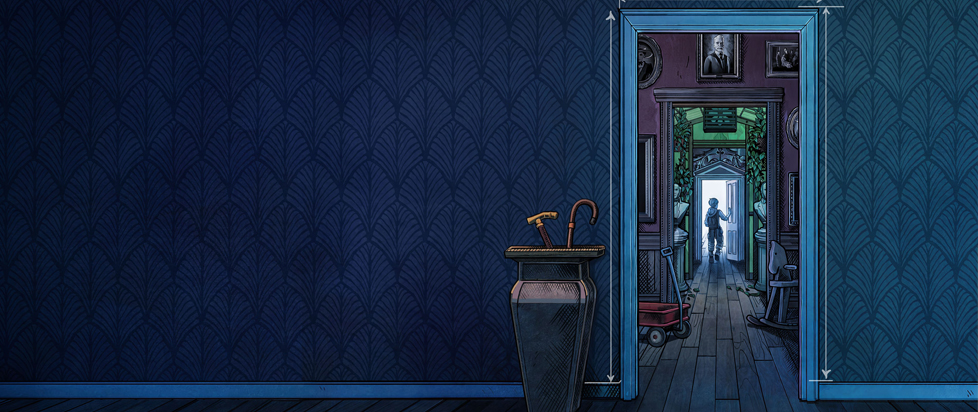
What is it with games and houses this year? The earliest point I noticed it was the trailer for Building Relationships, a dating sim where you play as a house which went semi-viral earlier this year. Fractured Blooms is a new horror game requiring you to do farmstead tasks in a home that’s cursed. The Seance of Blake Manor plops you in a house in the late 1800s and tells you to solve a murder by snooping through everyone’s room and going to the library. There’s Blue Prince, of course, and let’s not forget the many building and decorating games (Whisper of the House, Furnish Master) in which you rarely leave the stretch of four walls. There are so many games out in 2025 about houses, to the point that I’m willing to call it the theme of the year: games not just in houses but specifically about being in a house.
Being in a big house is potential fuel for a few genres. Of course, building and decorating in a home is a given, to the point that even games not about being in a house (eg Spirit Swap) feel the need to give you one to decorate on the side. On the other end of the scale, being in a house alone can be a scary situation even if the game isn’t scary itself. The exploration game Gone Home played that trick, maintaining tension (mostly) without scary scenes. While playing Blue Prince, even though I grew comfortable in the manor, if another humanoid thing had showed up I would have jumped out of my seat. Nighttimes in Crush House, when the live feed is switched off, can be spooky as you retread old ground looking for whoever else is up and wonder who might still be watching you. Finally, as Grace Benfell wrote about Silent Hill f in Endless Mode, even the concept of leaving home or being unable to can be fraught: home stretches out “like multiple locks on a door… home lasts forever. You can never get out.”

But why is it now that we’re spending so much time in-game wandering through houses? An easy answer might be the pandemic; indeed, this has been a popular explanation for games about isolation and loneliness for the past few years. Yet most of the puzzle-box houses in this year’s releases are not small and cramped but enormous and expansive. You’re trapped in them, but only insofar as the character is deciding to be there; each day brings new and fresh experiences as well as some things you should definitely not be doing in a house (poisonings, using a metal detector.) I feel creeped out in Blue Prince, but I don’t feel lonely, exactly; I feel driven or, sometimes, pursued.
Many of these games are playing with comfort in a familiar space. Part of this is the turn from cozy games to “cozy spooky games” that could also be a theme of this year or maybe the next. Fractured Blooms most obviously with its dark tradwife premise, but also Whisper of the House, which sets up its premise with dark spirits and a cabal behind the town you’re fixing up. Others, like Blake Manor, are less coy about the scary parts. You can walk down a hallway seven times, and one of those seven you’ll see a faint red outline of a ghost floating in midair. It turns exploration into a gamble as you become more used to the space: the game seeing if you’ll let your guard down and thereby get the shit scared out of you.
Last month I read the novel about being in a Big House: Piranesi, in which the titular character lives in a world made up of first, second and third floors taken up by sea, land, and sky and filled with hundreds of statues. I also read V Buckenham’s essay about a Piranesi actual-play “I Was A Child Of The House.” Something I pondered as I read the essay (and the book) was the way it turns being stuck somewhere into a comforting situation rather than a terrifying one. Of course, the LARP participants weren’t actually stuck there, and Piranesi is, uh, fictional, but in both instances, what comes from enclosure is comfort and leisure time enough to ask questions and explore.
In Piranesi, statues are a reflection of the outer world. (As he puts it: “the World (or, if you will, the House, since the two are for all practical purposes identical).”) They become clues for Piranesi to figure out his situation, which he does with scientific rigor. His research comes about through repetition: years and years of doing nothing but walking around memorizing statues. This, of course, reminded me of playing Blue Prince, a game all about treading the same rooms in a different order hundreds of times until a painting or a set of keys mutates into a meaningful puzzle solution. But the process of finding solutions, for me, was almost accidental: it needed to be, in order for my mind to settle enough to take in information and digest it enough to figure out what to do. The main gameplay action you can do in Blue Prince is wander around, and that’s in fact the most important thing to do.
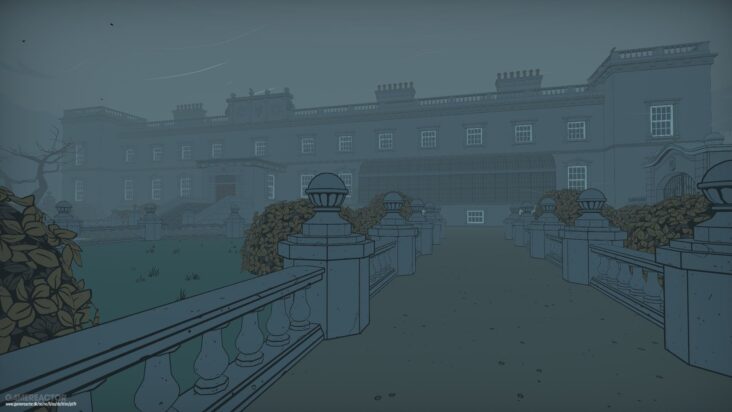
More than evoking tension or confinement, most of these House Games are using houses and their floor plans to cultivate familiarity and, on the way, feelings of responsibility, ownership, or mastery. I’ve had a similar feeling playing Silksong, which if you think about it is one giant metroidvania house you tread and retread. It’s similar to what people describe with getting good at Souls games. You can find meaning in the environments you have to walk through over and over again, because in doing so you become attached to those environments.
Games like Blue Prince fold this into their structure. If you’re going to walk through the Den a dozen dozen times, there might as well be something to learn about it. I never walked through Mount Holly just for fun, but one of my most memorable game moments of this year is walking through the manor after solving a particularly important puzzle and hearing the music swell, as though the house itself were pushing me forward on a wave. The impression that your immediate environment could be not just deceptively complex, but could reveal new wonders at any time in (almost) any sensory register, is given with what’s actually a limited set of tools and options.
At the risk of stretching too hard, I connect this feeling of contentment and stewardship in all these games to the reality of, probably, most of the people reading this: that we don’t and maybe won’t own houses of our own. While many of these games scrape the edge of the “landlord simulator” kind of house games, they’re not primarily extractive; they’re about building a relationship (ha ha) between the character and the environment. One of the most important parts of Piranesi’s relationship to the House is that he’s not an owner, but a child receiving offered gifts from what the reader perceives as a harsh world but he sees as a kind one. He stresses about leaving the House alone; what will it be without an Occupant like him?
To me, the house games of 2025 all strive in their own way to provide a fantasy of a relationship with a house, whether owner-renter, furnisher, or guest, that gives a feeling of mutual responsibility and even gives the impression that the house has, if not a life of its own, at least a force that can aid and harm you. Walking through these spaces is a complex combo of wish fulfillment and projection as well as, of course, a solid excuse for a game to happen inside them.
———
Emily Price is a freelance writer and digital editor based in Brooklyn, New York, and holds a PhD in literature. You can find her on Bluesky.