See You in the Next Adventure: The Familiarity of Yokai Quest
You feel compelled to support great writing…

I see board games in the store and they always look so cool and then I buy them and bring them home, I’m so excited to open them, and then I play them, like, twice… This column is dedicated to the love of games for those of us whose eyes may be bigger than our stomachs when it comes to playing, and the joy that we can all take from games, even if we don’t play them very often.
———
Way back in 2016, over 1300 backers pledged around $150,000 on Kickstarter to fund Yokai Quest, a game that I have never once seen on the shelf of a game store, but which seems to still be available (in an updated version) on the website of Spanish company Zenit Miniatures.
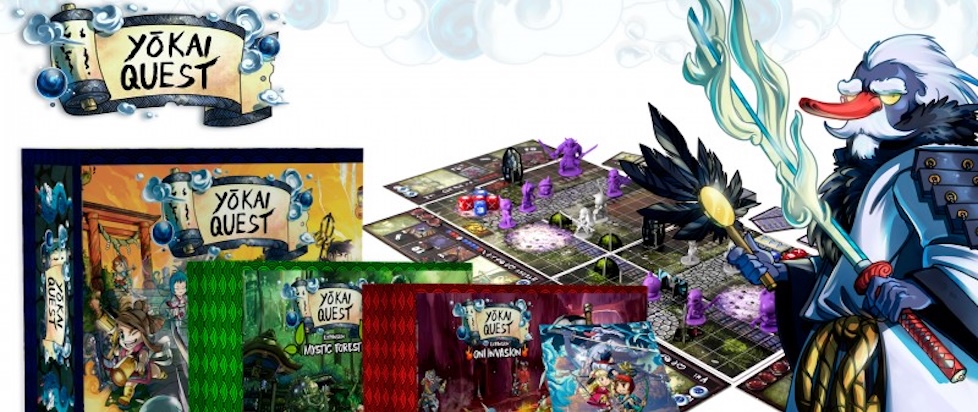
So, what is Yokai Quest? I’ll let designer Nicholas Diaz explain it, as he did in a post at Boardgame Geek: “Yokai Quest is a miniatures board game where players, portrayed by heroes over the board, collaborate to face enemies. These enemies are composed mainly by yokai: mythical creatures from the Japanese folklore, each one with their own unique characteristics and differentiations, ranging from the evil Oni and the crafty Tengu, to the prankster Tanuki.”
I used that quote both because it sums up the game nicely and because it gives you some idea of what you can expect from the tone and voice of Yokai Quest. Enthusiastic, sure, but not necessarily terribly well edited. And while the enthusiasm for Japanese folklore and culture is obvious, the fidelity isn’t always as strong, with the game’s various creatures and characters refracted through a very Western, anime-inflected lens.
Let’s go back to Diaz’s explanation for a minute: “The world is portrayed with a ‘chibi’ aspect. The characters, heroes as well as enemies, follow this design: big heads in comparison with the body, expressive faces and slightly childish, all in a fun and happy mood.”
This style will be familiar to longtime readers, as it resembles the miniatures used in everything from Marvel United to Arcadia and Starcadia Quest to Super Dungeon Explore, which might be the most similar in tone to Yokai Quest.
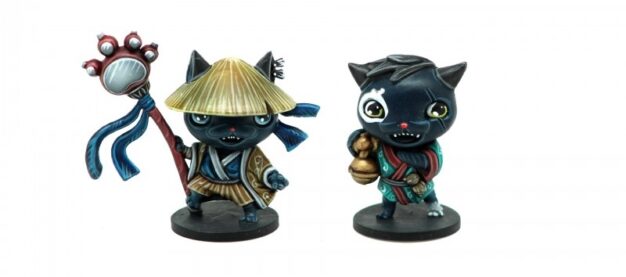
And probably the biggest selling point for Yokai Quest is seeing that chibi style brought to some of the game’s many yokai. Everyone is going to have their favorites, of course, but I’m partial to the lantern and umbrella-like obake. There are also the skeletal hone bushi, classic yurei, old-fashioned oni, and much more – including some sinister ninjas, of course.
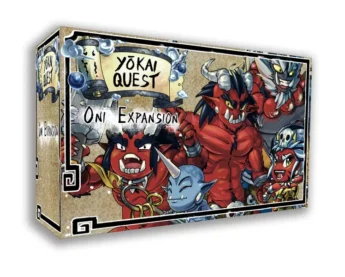
To get the oni, though, you need one of the two expansions that were wrapped up with the Kickstarter – the other one drops a number of forest spirits. Unlike a lot of Kickstarter-exclusive game add-ons, these expansions also appear to still be available from the manufacturer.
In 2021, a second Kickstarter campaign helped bring to life updated rules for the game, but I’ve never seen those. All I have are the initial release and its various expansions, which boast gameplay that is relatively straightforward, even if the rulebook itself – which includes 36 pages of actual rules, plus a bunch of premade adventure scenarios, and that’s not getting into the expansions – is not always as easy to follow as it thinks it is.
Just as the miniatures do, many of the gameplay elements will feel familiar to anyone who has played games like Arcadia Quest or Super Dungeon Explore. Characters move and fight, using proprietary dice to attack and defend that are marked either with crossed swords or helmets. A character’s stats determine what combination of dice they roll to make an attack, while each character has a number of special abilities available to them. Enemies, meanwhile, act according to a pre-programmed “behavior pattern,” a simple flowchart that determines who they attack, when, and how.
And, of course, being a game of this type, Yokai Quest is absolutely lousy with tokens and cards of various kinds, representing everything from items and special abilities to reload times for some attacks and how many yokai appear at once. There are even a few pieces of papercrafted 3D terrain that can be assembled to add some visual depth to your game.
While much of this is familiar, however, there are a few innovations at play. In fact, perhaps the most interesting aspect of Yokai Quest isn’t any of the chibi miniatures, but the plethora of area-of-affect abilities wielded by the various characters, allowing them to pull off some satisfyingly anime-ish attacks.
These include dashing forward and hitting all the enemies in a straight line, scything attacks affecting ranks of enemies in front, attacking in all four directions at the same time, charging up and unleashing a devastating blast, and hurling a magic bomb that explodes on impact. When it comes to special abilities, pretty much every character has some of these interesting area-of-effect attacks, which supplement the usual fare of stronger hits, defensive boosts, healing abilities, and so on.
Each character also has what we’re accustomed to thinking of (thanks to the parlance of D&D) as a “class” – in this case, Bushi, Shinobi, or Sennin, which give them access to a range of class-specific abilities. Combining these with their unique character abilities makes the various character options in Yokai Quest feel a little more distinct (and a little more customizable) than they otherwise might. It doesn’t hurt that there’s quite a few of them; six in the core box, and two more in each of the two expansions, which also add “hero pets” to the mix, including an adorable baku and a tanuki.
These interesting character mechanics make for a somewhat richer game than the familiar rules, simplistic enemy behaviors, and premade adventures might otherwise suggest – though probably not enough to justify going through the hoops you would have to jump through in order to actually get and play Yokai Quest here in the States.
Unless you just really like chibi yokai.
———
Orrin Grey is a writer, editor, game designer, and amateur film scholar who loves to write about monsters, movies, and monster movies. He’s the author of several spooky books, including How to See Ghosts & Other Figments. You can find him online at orringrey.com.