Forward to Where?

This column is a reprint from Unwinnable Monthly #192. If you like what you see, grab the magazine for less than ten dollars, or subscribe and get all future magazines for half price.
———
What does digital grass feel like?
———
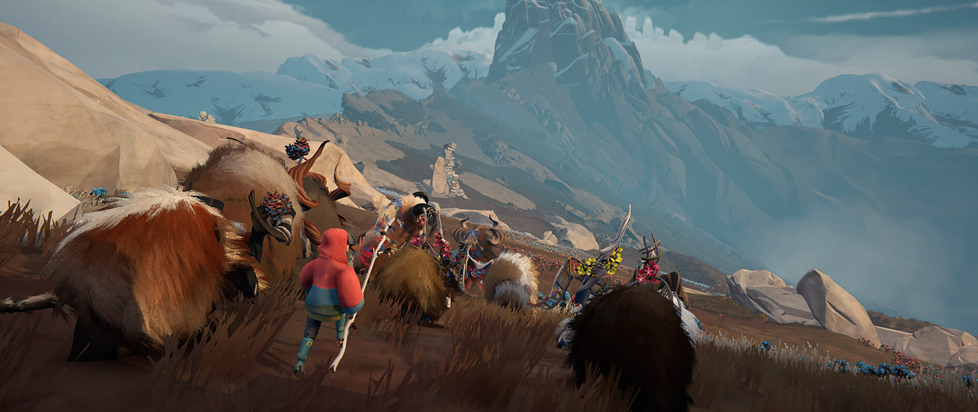
Okomotive make games about moving forward. In both Far: Lone Sails and Far: Changing Tides, you play as the driver of a huge, rickety vehicle; in Herdling you play as the driver of a herd of goat-like Calicorns. In all three games, you constantly go, until you can’t anymore, at which point you have to figure out a way to go again.
The most recent, Herdling, is also its most explicit that you are the one doing the caretaking. Calicorns go where you point them, they have natural predators in the world and they need to stop to rest and to play. But make no mistake, in the Far duology, you are also a caretaker. Those vehicles are under your protection, and they will need just as much devotion as any beast.
Maybe this is why Herdling doesn’t quite reach the heights of its predecessors. I didn’t need to be persuaded to care for my companions in these journeys of constant onward progress by giving them fur, names and the ability to pet them. I already loved Lone Sails’ creaky wind-powered van-thing and Changing Tides’ hulking, rusted boat.
And in introducing these animals, Herdling genericizes itself in a way that the Far duology doesn’t. Herdling opens in a city, but almost immediately leaves it, giving way to pastures and mountains. As we’ve seen so many times before, the city is dirty and dark, the natural world is beautiful. But the Far games have a much more unique setting. Huge open vistas are pockmarked by giant contraptions, the natural and the human-made intersecting and just as awe inspiring as one another. And, of course, there’s you, rattling along in something concretely mechanical and yet undeniably alive-feeling.
There are several ways that Herdling seems lesser than its predecessors – reviews point out the comparative simplicity of its puzzles, for example – but it’s this simplistic throughline that takes the momentum out of a game that should be all about it.
Forward progress in the Far games always takes you somewhere strange. Forward progress in Herdling always takes you exactly where you expect, from the first moment where you and a trapped Calicorn look longingly at a peeling billboard for a pristine mountain.
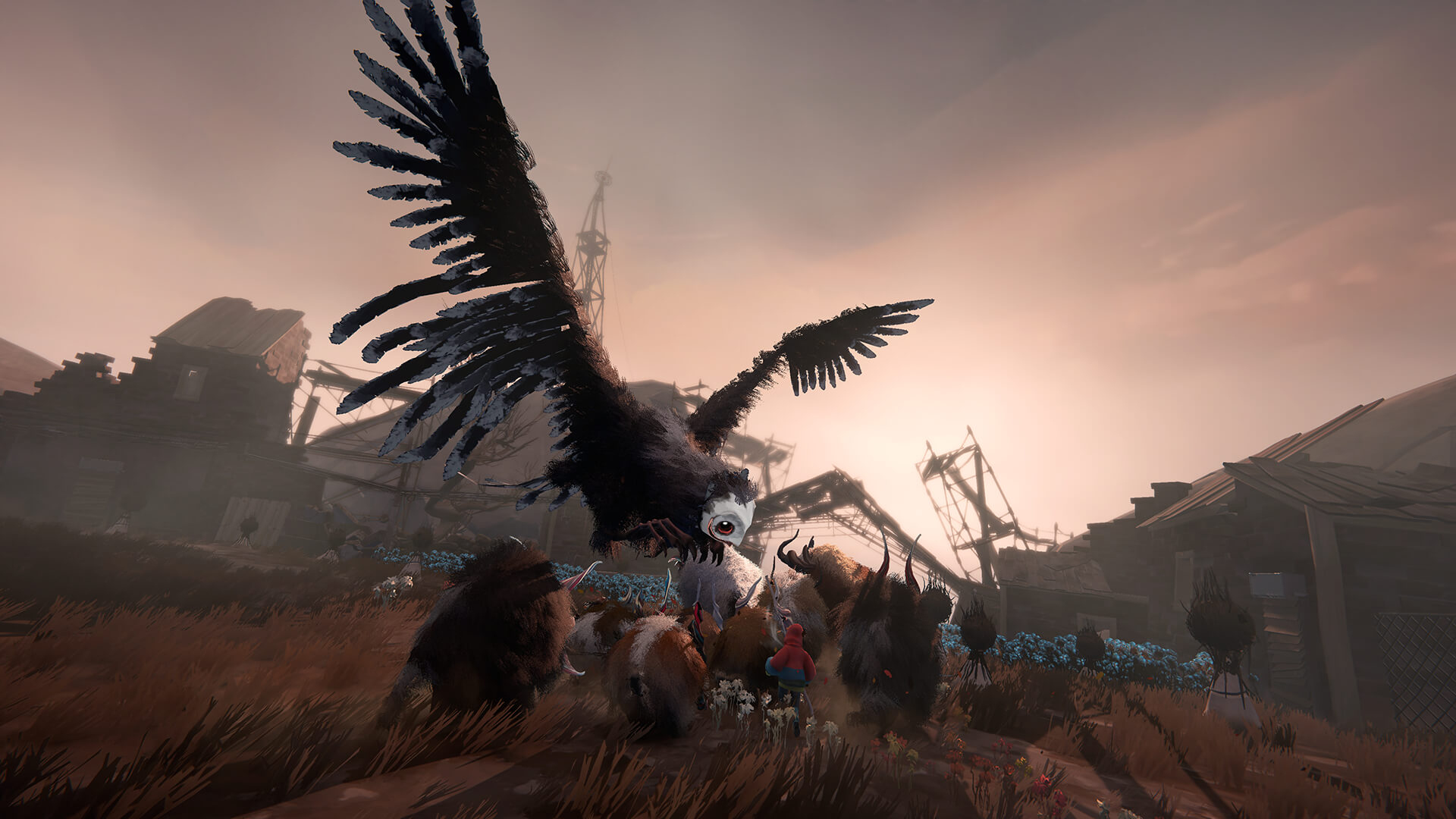
Except there is something strange about where you’re going in Herdling – there’s nothing else there. The loneliness of the Far duology give them their deliberately odd atmosphere and open-to-interpretation narratives. But the fields of Herdling just feel like bizarre voids. Other than the mean predatory owl-spiders, nothing else seems to live here. There’s not even any other Calicorns beyond the dozen or so that you round up. The world outside the city of Herdling is as barren as its streets, or the apocalyptic landscapes of either Far game, but it’s not presented that way. Fleeing the urban is your very first imperative, and the rural is supposed to stand in contrast.
The area outside the city is not free from human influence; rock sculptures and paintings abound. But the people who made these are nowhere to be seen. There’s the implication that they are other herders, like you, and perhaps the point is that this is the way to live in harmony with nature. A Calicorn without a human to shepherd them is a lonely creature, prone to getting into trouble.
But if Herdling wants to make a point about humans being an integral part of the ecosystem, it needs both humans and ecosystems. As it stands, all is well in the end for our boy and our flock, but the rest of the world is nothing.
What little there is only raises questions. What does it mean for the owls when all the Calicorns are protected and there’s no other food? Will the grasslands be overgrazed? And where did everybody else – human and Calicorn – go, anyway?
There are just as many questions in the Far series, not least that same one: where did everybody else go? But in Herdling the barrenness of the world seems to be portrayed as an uncomplicated good, the fresh, unspoiled wilderness. But all it does is make me miss the complications of the Far series. There, certainly something has gone wrong with human activity, but it’s nonetheless shown as something ingenious and vital, in the sense of being alive. By removing that and replacing it with actual alive creatures, Herdling only succeeds in muddying its waters.
———
Jay Castello is a freelance writer covering games and internet culture. If they’re not down a research rabbit hole you’ll probably find them taking bad photographs in the woods.