On Faith, Eternity, and Impossibility in Hollow Knight: Silksong’s Pharloom: A Symptomatic Reading
You feel compelled to support great writing…

Defying the constant regurgitation of dueling attitudes – impatient cynicism and unbridled enthusiasm – that anticipated Hollow Knight: Silksong’s release, Team Cherry’s faith in themselves and the creative liberty afforded by Hollow Knight’s commercial success produced an experience that feels impossible in both quality and scope. The exacting cohesion of its visual design language, mechanical precision, technical consistency, jovial sound design, and momentously orchestrated score generates the sublime feeling of working in tandem with the game, interacting with and shaping the configuration of its artistry.
Videogames, like any other creative works, are our connection to the infinite. Not in the sense of their longevity or enduring legacy, but rather in how they occupy a position within our shared universe of meaning – the symbolic register – transformed and interpreted beyond the sum of their component parts borne from the material production process. It is here where one can begin to read a work, and in doing so, disclose something unique about both the work itself and one’s own orientation and world.
What follows is a (un)timely exploration of the role faith plays in the world of Silksong: a critical engagement with its characters and themes, while tarrying with the increasing overlap of religious fundamentalisms and political tyranny occurring in our everyday life.
Valences of Faith
For Pharloom’s past, present, and future, faith functions as an omnipresent mediator, embodied and exploited in varied ways depending on the social position of its interlocutors. For the pilgrims beginning their ascent from Bone Bottom, it generally acts as a beacon of hope against what they recognize as a perilous journey awaiting them. Throughout your ascension, you encounter variations on the personal relationship one can have with faith, from dissidents viewing pilgrimage as a frivolous endeavor to zealots manipulating the faithfulness of others for material gain. Faith as belief in a notion, something to adhere to, exploit, or subvert, is the guiding principle for the vast majority of Pharloom’s denizens.
In the character Sherma, we find a believer both constrained and propelled by this orientation towards faith. While it is clear they do not grasp the true nature of what allows them to proceed on their pilgrimage – displacing causality from the material actions of the player onto the realm of divine intervention – their belief should not simply be written off as a form of false consciousness. Their resilience throughout the acts of the game represents the fatalistic dimension of freedom, as they fully identify with the destiny concomitant with their faithfulness. Concretely, this manifests as determined perseverance, creating a bond of solidarity with other pilgrims and encouraging generosity through the provision of care to those on their own journeys.
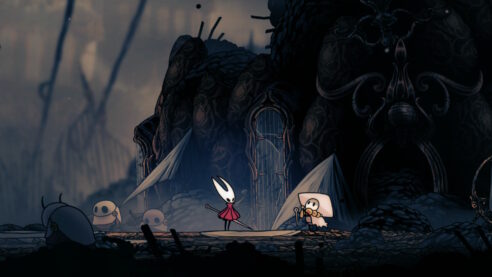
There is, of course, an obscene other side to faith in Pharloom. Woven into its history and environments is a traditional tale of a ruling class exploiting faith in service of pacifying and enticing workers who create their wealth only to be rewarded with the commodification of their basic rights. The Underworks, a place of toil and subjugation, exemplifies this barbarism, where the symbol of faith is used as currency required for both rest and confession. Benches, which require rosary beads upon each use, provide the space necessary for the reinvigoration of one’s belief to allow for continued labor. Confession booths, presented as core to the practice of one’s faith, are also available for a price.
Loam, a worker pushed beyond his means, perfectly exemplifies how faith can justify and obfuscate the domination of a class and how its related fantasies operate on the minds of believers to shoulder undue responsibility. The dangers of over-identification with religious belief and the subsequent commitment to labor as a practice of faith cannot be overstated. For those residing in the Underworks, faith only serves to ensure obedience to the system of oppression, while maintaining a sense of purpose – the regulated direction of surplus-enjoyment – in their meaningless labor for a civilization long lost.
Religion and Eternity: The Parasitic Fantasy of ‘All and Forever’
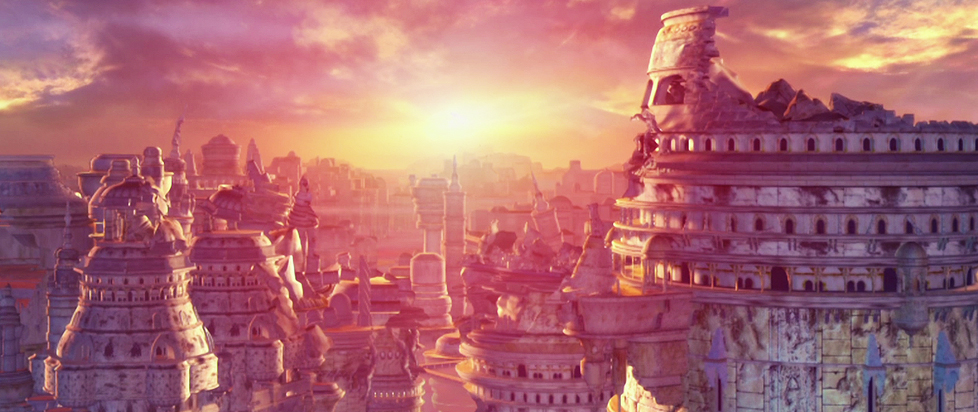
The allure of deification, transcending the historical-material conditions of one’s self and world, is interdependent with faith operative in both our world and Pharloom. This attempt at eternalization reverberates throughout the halls of The Citadel, which exists as a specter of its former self. It is through this stark imagery where Team Cherry is most ruthless. There is a clear parallel between the ruling class of Pharloom and our contemporary tech oligarchs in their shared fixation on the simultaneous transformation and preservation of humanity through unconstrained technological advancement.
In Silksong we see this fantasy in the design and creation of automatons operating in the Cogwork Core – machines programmed to facilitate the smooth functioning of The Citadel – which serves a double function. The first is to reinforce the futility of wage labor still ongoing in the Underworks and remind us of the connection between faith and the reproduction of systemic oppression.
The other, equally as insidious, is the dream of using human labor and creativity to create a class of being which visually and functionally performs the same tasks as their living counterparts, yet is stripped of all the constitutive elements of human nature. These creators’ preoccupation with ensuring the perpetuation of their dominion over civilization turns the vibrancy of life into an empty signifier; no one is left but automatons who lack the critical self-awareness to recognize the needlessness of their operation or the hollowness of their existence.
This fantasy of endless self-replication signals not an era of unprecedented progress but an open admission of the “end of history”: a depoliticization and a hubristic belief in having reached a zenith. It imagines only the perpetuation of the facsimile of life without its lack or vitality. Nowhere is this orientation more visible than in the Memorium, an attempt by Pharloom’s rulers and faithful to preserve and catalogue the variations and diversity of their world. What this represents is not an appreciation of beauty in all its (un)natural forms, but an ontological transgression devolving into the realm of mythology. This attempt to capture and replicate a moment in time is a falsely totalizing endeavor. It eliminates the essential generative component which provides the very conditions for life itself, and in turn transforms cultural activity into fossilized remains.
For both those in power in Pharloom and our own world, supposedly ushering in an age of progress while creating an affect of stagnation, it is clear that what is missing in their ambition is the understanding that what makes us free is our very incompleteness, the “hole-iness” of our perspective and our world.
Be Realistic, Only Impossibility Can Save Us!
What the survivors of this ruinous regime at the heart of Pharloom and its rulers and zombified followers have in common is music. Songs operate as a source of control for those in the ruling class, a means through which to disseminate and enforce strict adherence to faith. The Choral Chambers exist as the hub for the disparate elements of The Citadel to combine. In this univocal extension of faith and its institutionalized practice we hear melodies haunted by what has been squandered by the exploitation and subjugation of a people clinging to their devotion and faith in progress.
And yet for those who remain, from the creatures to be slain to the residents struggling to get by, music contains an element of subversion, providing space for reflection on what used to be, and in turn, what could come after. It offers an ethical suspension of the present apocalypse, a re-discovering of the past in order to open new pathways for the future.
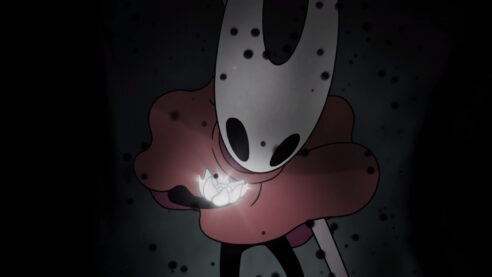
It is at this intersection between past, present, and future where the protagonist Hornet exists. She carries herself with courage and clarity, resolve and empathy, determination without pretension. Hornet’s orientation towards faith is what provides a future for Pharloom: neither dogmatic subordination to a deity nor an attempt to transform oneself beyond the point of recognizability, but faith as fidelity to oneself and others which allows Hornet to occupy the point of impossibility in the society depicted in Silksong. She does only what she feels is necessary, drawing on her capacity and history to meet the moment which others deem as hopeless, and sees in that hopelessness the courage to not despair, but begin again. Fully recognizing the abyssal nature of her freedom allows her to bring to light and confront the contradictions and antagonisms driving Pharloom’s plight.
Much like our contemporary global predicament, the only realistic option left is to adopt Hornet’s stance; to reckon with the severity of our myriad crises, not resigning ourselves to the inevitable, but acting with the courage to try again, fail again, and fail better.
———
Christopher Spina lives in Toronto with his partner and their cat. When he’s not grumbling about capitalism to any and everyone who will listen, you can find him attempting to combat the endless waves of eSlop through curating games and writing short-form reviews here.