Ghosts-B-Gone: The Mysteries of Ghastly Manor
You feel compelled to support great writing…

I see board games in the store and they always look so cool and then I buy them and bring them home, I’m so excited to open them, and then I play them, like, twice… This column is dedicated to the love of games for those of us whose eyes may be bigger than our stomachs when it comes to playing, and the joy that we can all take from games, even if we don’t play them very often.
———
Several years ago, I wrote a series of mail-order murder mysteries for Open Road Media. Called “The Murder Chronicles,” they arrived to subscribers in branded manila envelopes, stuffed with various bits of ephemera – fake newspaper clippings, art objects, maps and blueprints, ginned-up full-color photographs, and more, all of which combined to form a mystery for subscribers to solve.
I conceived, wrote, and designed the mysteries themselves, along with all the included text, and concocted the various puzzles. Some required people to compare two similar images, others involved number ciphers, one required them to reassemble a torn up picture, while another came with an actual metal key. Fortunately, while I may have designed the puzzles and props, someone more skilled than I in the graphics department at Open Road actually crafted them.
Beyond that, however, Scooby-Doo: Escape from the Haunted Mansion was as close as I had ever come to the kinds of murder mystery games that have been around forever but seem to have become newly popular in recent years, commensurate to the uptick in interest in various true crime stuff. Some of these are mail-order subscriptions, like more elaborate versions of the ones I wrote for Open Road, while others are boxed games that you can find in your friendly local game shop.
Possibly the most ubiquitous of them all are the Hunt a Killer games, which, as near as I can tell, come in both varieties. Ghastly Manor is an example of one of these, advertised on their site as a “premium game,” released in time for Halloween back in 2020 – when none of us could get together with friends to play party games in the first place, though fortunately this game, at least, can also be played solo.
I got my copy secondhand, though it appears to be complete and, indeed, unplayed. It comes in a box advertising itself as a “Mystic Messenger” (think Ouija board) and even features a branded planchette with a picture of the ghostly figure associated with the release. And honestly, it’s worth having on my shelf just for that box art, and for some of the oddities that come packed inside, including full-color illustrations and maps of the haunted Thistlemore Manor Inn, a cardboard spirit radio, and a “tin containing mysterious ectoplasm.”
Here’s how the Hunt a Killer website describes Ghastly Manor: “A world-class ghost hunter, you’ve never met an apparition you couldn’t handle. But when you and your team are called to Ghastly Manor, a hotbed of haunting paranormal activity, you’ll be faced with your most difficult task to date: banishing five powerful spirits from the infested inn while making life and death choices that put your whole team at risk.”
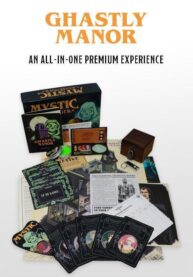
Basically, it operates much like any other murder mystery party game, except that instead of solving a murder, you are attempting to solve the “puzzles and riddles” of the manor’s five ghostly inhabitants and “answer the questions that keep them tethered to the physical plane.”
The game manual only offers two pages of anything resembling rules, and is the only part of the box’s contents that isn’t intended to be immersive. For the most part, the in-world documents are designed to lead you through the game and help you to solve the various mysteries of the ghosts who haunt the Thistlemore Manor Inn. There are clues in the text, of course, but also hidden various other places. You can use the planchette to reveal hidden messages on a ghostly photograph, there are notes on the map only visible under black light, and there’s something secreted away in that “ectoplasm.”
Here’s the thing: At the time of this writing, I haven’t actually played Ghastly Manor. I’ve read through all the parts that can be read without opening them, but the various envelopes and the jewelry box with its secret letter are all still sealed. This is, in part, because a game like this isn’t really designed to be played even twice.
After all, these sorts of murder mystery games typically have only a single solution. (In the case of Ghastly Manor, each ghost has two envelopes, a “right” answer and a “wrong” one.) When the question is “whodunit,” there is usually only one solution. And once you’ve discovered that answer, you can’t very well forget it in order to play the game again.
So, sooner or later, I will play through Ghastly Manor and try to lay the various ghosts to rest. I will solve the puzzles, work out the riddles, and see if I can’t win the game. But once I’ve done all that, odds are I won’t do it again, so for now, the box sits on my shelf and remains an intriguing mystery – one that may be more fun as a source of potential than as an actuality.
Either way, though, the game-as-object is worth quite a bit. The artwork on the “Mystic Messenger” box is what made me pick it up in the first place, and that same style extends throughout the game’s components, from the cards representing various characters to the map of the manor itself. (Possibly due to its “immersive” nature, the artwork seems to be uncredited in the game, but appears to be the product of Alaska Kellum, who has done several of these for Hunt a Killer.)
The envelopes that contain the game’s various resolutions even have decorated edges and are tied with a piece of twine. It’s these little touches that make Ghastly Manor worth having, even if I never even play it, like, once.
———
Orrin Grey is a writer, editor, game designer, and amateur film scholar who loves to write about monsters, movies, and monster movies. He’s the author of several spooky books, including How to See Ghosts & Other Figments. You can find him online at orringrey.com.