Mending the Gardens of History

This column is a reprint from Unwinnable Monthly #191. If you like what you see, grab the magazine for less than ten dollars, or subscribe and get all future magazines for half price.
———
Analyzing the digital and analog feedback loop.
———
This article is full of spoilers for South of Midnight’s later chapters, mostly nine onwards.
Categorizing South of Midnight’s narrative as one of nature versus nurture feels too reductive. There are just enough polyphonic yet tenebrous layers – of histories personal, “official,” diasporic, and folkloric – interwoven in this game, that gothic rock opera is a much more fitting appellation. An EcoGothic one, to be more exact (yes, I haven’t tired of this beat yet, the rhythm of it is too much in step with me). Though there are strong EthnoGothic themes, of dealing with racial traumas via Gothic tropes, as well. Hazel’s tale is one about cultivation: of care for both blood and found family across communities, time and, by extension, for the land. A land which has been ravaged both physically and spiritually by intergenerational trauma. This tale is also one that makes strange the concepts of paradise, purgatory and hell.
As Hazel inherits the role of the Weaver, essentially a social worker on a cosmic level, she reckons with the systemic oppression that causes the more vulnerable and marginalized figures of the universe’s patterns to strain, fray and tatter. She also reckons with her grandmother Bunny, a descendant of the antebellum South’s elite and someone known in Weaver lore as a False Stitcher. What this epithet means is she did not inherit the magic of Weaving but instead sought it out through her vast generational wealth and resources, practicing not to heal past collective hurts but to force the resurrection of her lost child, Cherie. As a recent Academy of Interactive Arts & Sciences interview discusses with two of the major writers for South of Midnight, Zaire Lanier and Dani Dee, Bunny in a sense is colonizing Weaver magic and is twisting its sense of care with her personal obsession and loss of total control over her legacy. Many including Hazel, are obsessed with reuniting with lost loved ones throughout the narrative, in fact. Some, like Laurent the Rougarou are mourning not just for their family but for their loss of innocence at an early age. Bunny’s tragic past, of losing a child to an accidental drowning, parallels a story late in the game of an African mother, Ayotunde, who loses her son to drowning whilst they are in flight from slave patrols. But there’s positive obsession, a la Octavia E. Butler, an obsession for wanting to speculate about better futures in spite of all doubts and dangers – and then there’s toxic obsession. Bunny’s inability to let go of the past poisons all her relationships to the family she still has and she even twists the memory of her dear Cherie by conjuring her spirit into a tree, keeping her in eternal limbo while she tries to perfect the resurrection process.
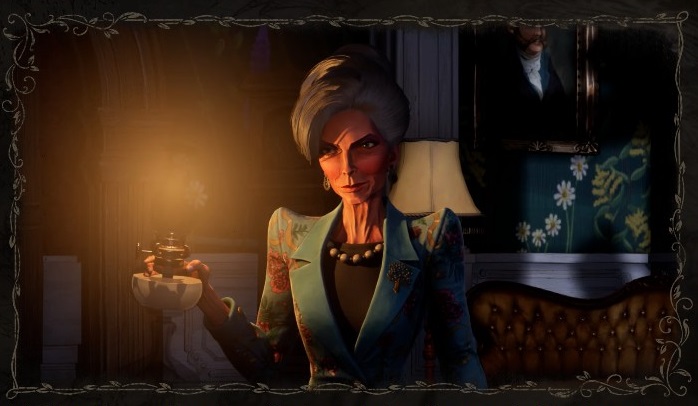
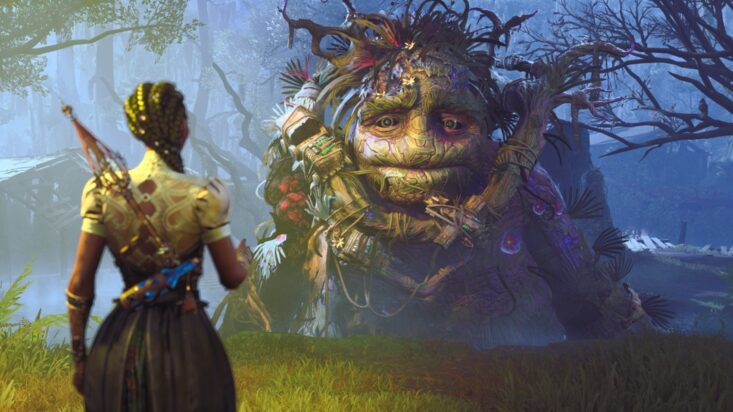
Admittedly, both tragedies are intertwined regarding how hard it can be to let go. Ayotunde searches for her son endlessly in the magical swamp until she is transformed into the fearsome and giant mermaid known as an Altamaha-ha, which is able to sink ships with her despair as she digs in the mud. The difference between the two is defined by Hazel’s interactions with the two grieving mothers: Bunny is enraged that Hazel intervenes and puts Cherie’s soul to rest, Ayotunde finds solace in embracing her son who is also changed by the magical swamp into a giant plant creature known as Honey (after the swamp region, suggesting he’s become a sort of genius loci). Nature can seem cruel to people when we live as though we are above it and not a part of it. But nature can also bring us peace if we accept that the peace in some instances might be bittersweet. Ecology aside, Bunny and Ayotunde’s plight is also about the complexity of hope and care. Hazel in this chapter of her story is also caught in a purgatory of uncertainty, hoping for a reunion with her mother, Lacey, who she previously lost along with their house to a hurricane flood. She briefly finds her unconscious mother bound up in a cocoon adorned with flowers, the impetus for her misplaced rage for Hugging Molly, the giant spider woman who was actually attempting to heal Lacey.
Hazel has also been following in the spiritual footsteps of Mahalia, the Weaver of yore who built a refuge for escaped slaves and the disenfranchised, and witnesses Mahalia’s despair at not being able to heal Ayotunde’s hurt and find her lost child. As an introduction to a poetry anthology about climate change and mental health, Speech Dries Here on the Tongue, asserts: “hope itself is not an uncomplicated remedy; it can be used to purify or to shift blame from powerful entities onto individuals.” Unknowingly, Mahalia cared for Honey, the lost child and between that gentle beast and members of her haven’s community shouldered the emotional burden. Bunny, meanwhile, has killed Hugging Molly by emotionally manipulating her granddaughter, blaming her and her father’s memory for keeping her from resurrecting Cherie. Hugging Molly’s heart brings her no closer to her paradise and leaves the destitute children Molly was protecting without any recourse.

South of Midnight uses nature throughout to underscore the ways that human care and legacies of hatred scar not just on a human-scale. We come from the dirt and eventually return to it. How we do so determines not just our singular fates, but whether we enrich the ground for future growth. Hazel spends the game searching for her mother who she loses after falling out with her about neglecting her for her demanding job as a government social worker. Each step of her journey as a Weaver teaches her about how torn her mother is between caring for her beloved daughter and caring for the abused and downtrodden of a neglectful system in the fictional Southern region of Prospero. Although Lacey is not a Weaver, she is just as much a conjure person in the sense that as a social worker she doesn’t operate from “the sheltered position of an enlightened outsider who knows better,” as Puig de la Bellacasa puts it.
As explored in my previous musings on care in game narratives, both inherent and emergent, care is something that should be situated within interconnected systems and living and being. After all, Hazel and Lacey are connected via Lacey’s late father Trey, to Bunny’s family line which is tied up in a lot of the systemic oppression that is causing both social and environmental degradation. That doesn’t automatically implicate them in said oppression, but it does make them keenly aware of how politics, heavy industries and local communities are all interacting and impacted by one another. In other words, both Lacey and Hazel are constantly grappling with what Roux, the right-hand man to Kooshma (god of dreams and nightmares), rightfully states as the “fine line between mercy and justice.” And before I get too lost in the weeds, I should clarify what a conjure person is, in Gullah Geechee culture, which has inspired a lot of the game’s magic system.
According to Imani Perry in her book Black in Blues, about how the color blue is vital and pervasive in Black history and culture, that Hoodoo is associated with “various aspects of traditional Black spiritual-medical-ethical-social practices that don’t constitute a religion formally speaking” but an insurgent “system for collecting and preserving information to navigate life.” This was especially the case in pre-emancipation era America when slavery and diasporic cultures resulted in a cosmopolitan quilt of people, each with their own traditions of knowledge and spiritual practices. But this sort of blurring between spirituality and folk knowledge threads through to the present day. Perry describes Hoodoo and the conjure people who practiced it as conducting “certain rituals, [so that] the natural world might yield to human desire.” Lacey and Hazel are on the same page in this regard – they do not try to bend nature to their will, but they do want to gently persuade nature to work in concert with them, for the sake of the collective. Lacey may not be privy to much of the supernatural goings-on of Prospero, but she’s clearly got faith in something bigger than her. She invokes God on behalf of Hazel’s safety, but she also seeks out a folkloric monster like Hugging Molly to help her take care of the orphaned and abused children during the hurricane.
A last consideration for the EcoGothic tone of South of Midnight’s game narrative design is that of the symbol of the garden as a way to exclude or include community. Olivia Laing recently delved into the history of gardens while rewilding an eighteenth-century walled garden attached to her Suffolk house’s property. Particularly, she delved into the way that gardening as a concept can speak of the political zeitgeist of any era and the ways that people envision a paradise. Bunny’s mansion is surrounded by a stately garden full of roses and other perennials, but it’s a garden enclosed by wrought iron gates. It’s also a hotbed of stigma, the snarls and festering threads of the cosmic pattern that attract haints that Weavers must untangle to free troubled spirits and creatures. Hazel eventually discovers that most of the stigma threads burrowing throughout all the regions she’s travelled along her journey are connected to the Flood mansion. In many instances that burrowing is literal, with animals’ homes needing to be purified with the help of Hazel’s adorable companion Crouton. The mansion also houses a mausoleum, underscoring the sense of history and sorrow that Bunny hasn’t reckoned with.

There’s an environmental storytelling touch that I’m in love with regarding gardens, cultivating care and communal healing. Whenever Hazel finishes unraveling and clearing stigma from an area, that area flourishes with many luminescent wildflowers, making a rebel victory garden of sorts. These gardens are a riotous display of color. Some of these blousy flowers are blue or a sort of light magenta and I like to think some of these flowers are ones significant Gullah rituals, perhaps morning glories or periwinkles. Periwinkle blue, also known as Haint Blue, guides you in place of the usual yellow markings. Periwinkle flowers often mark the graves of slaves in the Deep South as well, according to Perry’s research. From their appearance, however, they are likely just flowers common to the South like hollyhocks and hibiscus. Regardless of which varieties they are, these victory gardens represent a rewilding of ground that was previously toxic and often privatized. When you’ve wound your way through the rest of regions, the land becomes representative of a common Eden that welcomes the weary and disregards arbitrary boundaries drawn by property lines.
When asked how they managed telling Hazel’s journey, which is often about trauma, with nuance, Dani Dee said a lot of the game narrative design process was about making sure that the “journey was recognizable and supported by the environment”. This included choosing to make the game linear, emphasizing pushing forward and staying persistent even when worn down by the tough times. Making the game linear allowed for the creative team at Compulsion Games to “curate” the emotional beats of the narrative as well. At the risk of sounding hackneyed, this team’s monumental efforts to portray an intersectional community and highlight African American culture and history deserves all the flowers. It’s part of an Eco – and Ethno – Gothic tradition (along with Bitter Root, Sinners, Castlevania: Nocturne and more) that I want to see continue to grow.
———
Phoenix Simms is an Atlantic Canadian cryptid who is a freelance writer and the co-editor of The Imaginary Engine Review a.k.a. TIER. You can lure her out of hibernation during the winter with rare SFF novels, ergonomic stationery, or if all else fails, gourmet cupcakes. Or you can just geek out with her where skies are blue.