Bioshock 2 Asks You to Have the Faith of a Child

This column is a reprint from Unwinnable Monthly #191. If you like what you see, grab the magazine for less than ten dollars, or subscribe and get all future magazines for half price.
———
Finding digital grace.
———
Children hold a very special place in religion and spiritual culture. There’s as much said these days in existentialist movements about children “breaking generational curses” as there is in the Bible about how the sins of a father can spread to their child. It’s those points of discussion that kept coming to mind as I revisited Bioshock 2. It’s an old favorite of mine, especially because of how it tackles something so many games boast yet fail at: reflecting on, and demonstrating the consequences of, moral choices.
Morality in games is often a binary. I still remember being irked with how the final inFamous game refused to move beyond “help grandma across the street” and “kick grandma into traffic”. That’s what 2K Marin did so exceptionally well with their first game – instead asking two very different questions of you: How far will you exploit others to achieve your own goals? And can you forgive others of their own misdeeds?
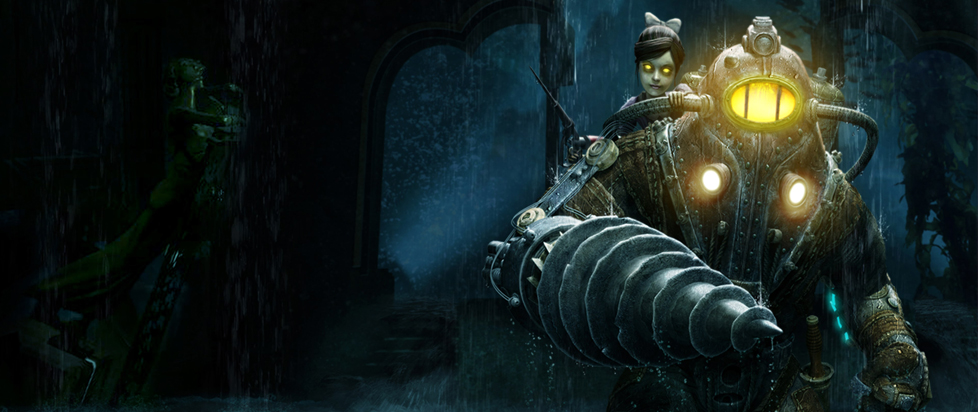
While it unfortunately indulges in some moral dessert via late-game rewards for being kind, there’s a distinct difference in how this makes you approach the moral framework protagonist Subject Delta. Delta was one of the first Big Daddies, guardians of the genetic material harvesting Little Sisters. His Little Sister, Eleanor, is reclaimed by her actual parent, Sofia Lamb, on the night of Rapture’s infamous collapse. Then Sofia pointedly makes Delta shoot himself in the head, seething with contempt for him even though he had no say in his or Eleanor’s fates.
Then, several years later, Delta awakens, desperate to find and save Eleanor. Sofia has taken over Rapture, and in the process, has a scheme somehow more heinous than what was already inflicted on Delta and Eleanor. So, with Eleanor’s distant aid, Delta has to kick all kinds of ass across the ruins of Rapture to save the closest thing he has to family. Over the course of his unexpected resurrection tour, Delta faces three people who helped contribute to him ending up a giant, diving suit enclosed monster of genetic manipulation.

This is one of the first brilliant little narrative flourishes of Bioshock 2. Delta should be the heartless bio-organic machine, yet he is more capable of genuine empathy than Sofia. Sofia simply sees psychology and humanity as broken computers that can be solved for. If she jams all the genetic memories of everyone in Rapture into her daughter, she thinks she’ll erase the very nature of consciousness, creating a “Utopian” in the process. Obviously, Eleanor isn’t keen on this and chooses to instead find beauty in the world and faith in humanity’s ability to be better. As the now teenage Eleanor later tells Delta, “But love is just a chemical. We give it meaning by choice.”
Therein is the trick, though. You have to choose to be kind. You have to choose to let the past go and live in the present. And what you choose fundamentally alters Eleanor, as she watches you from afar. She wants to be her own person, not a “Utopian” that acts like a machine. So, she turns to you, as Delta, her “Father,” to guide her decisions.
And thus, we return to the moral questions of exploitative measures and forgiveness. Because in addition to confronting the three individuals responsible for Delta’s – and in two cases, Eleanor’s – misery, there are a whole new generation of Little Sisters being carted around to harvest the genetic manipulation material known as ADAM.
So! Do you only care if Eleanor survives? Will you sacrifice everyone else in hopes of getting stronger faster? Even the man over the radio guiding you, Augustus Sinclair, calls out that the Little Sisters are far from human now. Worse still, Delta’s reprisal to the land of the living is a ticking clock. The longer he’s away from Eleanor, the more his body will start to shut down.
Yet if you dish out damnation upon the three individuals and heartlessly harvest the Little Sisters, you don’t find the sweet, innocent girl who was crying out to you. This Eleanor looks sickly. Her voice drips with malice. And after a brief sequence where she has you mind control a Little Sister to free your body, she proudly declares that she’ll do to this one just as you have to the others. And you watch her do it from the Little Sister’s gaze. It’s… genuinely uncomfortable. And it should be.

However, it doesn’t have to be this way. If you spare the Little Sisters, then Eleanor becomes a Big Sister to them all. She ensures they all escape. Yet they’re not the only ones who must rely on her to survive. Sofia Lamb may have descended into demagoguery, but as you learn across the game, it’s thanks to Andrew Ryan’s machinations against her. Sofia, however lost she may be, is just like Delta – a monster made by Rapture. Can Eleanor truly forgive her mother? Well, it hinges around if you’ve exemplified forgiveness yourself.
It’s often the case in games that our decisions are reflected more in rewards than anything else, yet what’s appreciable about Bioshock 2 is that multiple world states can arise from the conclusion. There are functionally eight different outcomes based on the player’s decisions, with many shades of gray. It’s possible to save all the Little Sisters and have Eleanor be kind… but let Sofia die. Or to unwittingly mold her into a monster, then refuse to let her harvest your essence to have your knowledge in the back of her mind – whether out of bitterness at your body failing, or one last desperate attempt to give her pause at the road she’s heading down. And I love all of this.
When thinking about what we believe and do, we often forget that our actions do influence others, especially children. Every action molds them and yet so often we lose sight of that. We forget the innocence we once had, the value in how it informs us, and what it can teach us about what we can do for the generations ahead of us.
Jesus invited a little child to stand among them. And He said: “Truly I tell you, unless you change and become like little children, you will never enter the kingdom of heaven. Therefore, whoever takes the lowly position of this child is the greatest in the kingdom of heaven.”
– Matthew 18:2-4
I’ve always loved these verses, not simply for the kindness, but that it’s a fairly universal lesson regardless of belief system. We say that children are our future, but they’re shaped by our actions today. That we can’t give up on the child within ourselves either. Even the most secular psychology is finding that an “inner child” is part of our subconscious.
Like Delta, we can’t shelter our inner child or those we are safeguard from everything. Delta couldn’t save Eleanor from being made into a Little Sister, or Sofia’s inhuman experiments to create a “Utopian,” but he can use the time has left to guide her out of the dark. Delta dies in the process, all spent up, but his memory lives on in.

In the happiest ending, Eleanor, for one last time, uses her ADAM syringe to absorb Delta’s consciousness into her. We see the POV shift to hers. “You’ll always be with me now, Father. Your memories, your drives. And when I need you, you’ll be there; on my shoulder, whispering.”
At the end of the day, that’s the most we can hope for, and also heed carefully. That we mustn’t lose the hopeful faith of our innocence, and nurture it in others. To remember that we can rise above the dark. It’s through that hope that we remember our best selves, and encourage the best in others. It doesn’t mean we’ll be free of tragedy, but that we’ll remember that one day, we can overcome it.
And that was the end of the Rapture saga, thus far. An open-ended but fitting conclusion. It’s beautiful, poignant, and absolutely involves no weird baptismal violence. It’d be really awkward to follow this up with a game that dismisses and contradicts the prior two. Especially if it somehow managed to fundamentally misunderstand how multiverse theory works. Boy, wouldn’t that be awkward!
…Okay fine, next month we’ll finally address the elephant in the corner.
———
Elijah Beahm is an author for Lost in Cult that Unwinnable graciously lets ramble about progressive religion and obscure media. When not consulting on indie games, he can be found on BlueSky and YouTube. He is still waiting for Dead Space 4.