Staring at Japan’s “Fantasy Industrial Complex” at Anime NYC 2025 with Matt Alt
You feel compelled to support great writing…

Oh, how times have changed. Hard to believe that five years ago the Javits Center was being used as a field hospital during the beginning of the COVID-19 pandemic. This year from August 21–24 the Javits Center just finished hosting the biggest Anime NYC to date with over 148,000 attendees. To put these figures into perspective, last year there were about 101,000 attendees. The continued success of Anime NYC is a testament to the prominence Japanese culture has on a global stage. It is not only popular, but also big business.
Last year, I attended the convention to cover Play NYC, the gaming-specific convention inside the larger convention. Then, I could walk through the main exhibit hall without much trouble, but this year wandering the packed hall on Saturday took me over three hours. I remember in the 1990s resorting to extreme measures to get my hands on new anime films; now anime is presented as a selling point of many streaming services, and merchandise is ubiquitous. Throughout my travels, people wearing t-shirts adorned with characters from popular anime like One Piece, Dragon Ball Z, Pokémon are not only commonplace, it is guaranteed. Growing up I never once saw anyone wearing a Sherlock Hound shirt.
To talk about this juggernaut of a phenomenon I met with one of the foremost voices covering Japanese popular culture: Matt Alt, the author of Pure Invention: How Japan Made the Modern World, while at the convention. I planned on interviewing Alt for a feature for NPR last year, but due to budget concerns and the bonkers news cycle it was unfortunately shelved.
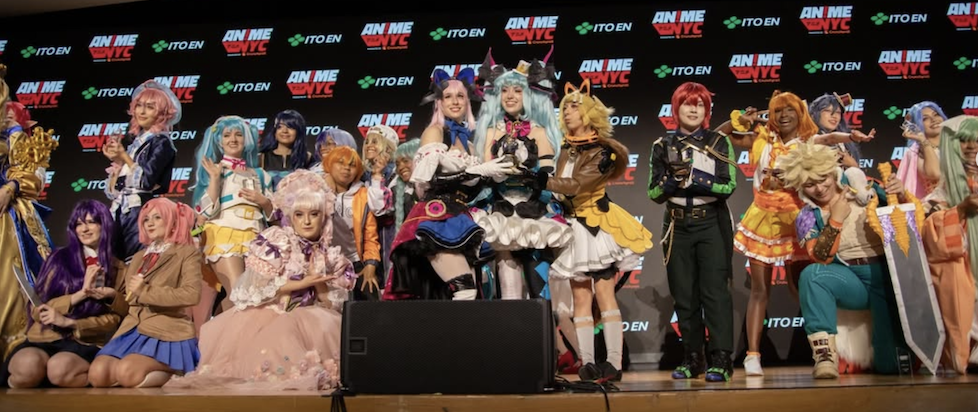
As I made my way across the main exhibit hall to the location where I would meet Alt, I overheard someone saying, “I love your antennas!” Instinctively I said, “thank you” but realized that the pleasantry was not meant for me. I was not wearing antennas. Embarrassed, I hurried away. I waited next to the Aniplex booth beside a Shohei Ohtani cardboard advertisement for Ito En brand tea. Waiting next to this cardboard version of the greatest baseball player of the modern era, I contemplated if I should have dressed like Piccolo. (I don’t have the body, but I have the confidence.) In the few minutes I waited, the hall became increasingly crowded. Furries, cosplayers with human sized foam weapons, and the ever present yet misplaced American superhero all flooded my vicinity. Anime NYC 2025, where cans of green tea became as scarce as Labubus (yes, I know that these are not Japanese) or the latest hit light novel at the Black Sail booth.
Every moment at the convention offered the opportunity to be entertained. Cosplayers with incredibly detailed costumes of the most popular anime, check; musical concerts (this year Yoko Takahashi performed to a sold-out crowd), check; or a Japanese food court selling grilled squid on a stick (no better sign of the strength of Japanese soft power), check. There was a lot to do.

I noticed Alt amongst the crowd and said hello. He has had a prolific career as a translator and localizer of Japanese cultural products. I was first acquainted with his work back in 2001. His name, alongside his wife and business partner Hiroko Yoda, appeared in the credits of the greatest game ever made, Dragon Warrior VII (Dragon Quest VII) on the PlayStation. For close to twenty-five years, he has had a hand in some of the most important cultural exports making their way outside of Japan through the consulting firm AltJapan with Yoda.
Alt recently started the Pure Invention Newsletter. His podcast (co-hosted with author Patrick Macias) Pure TokyoScope is a superb way of staying up to date with Japanese popular culture. Always busy, Alt recently published a profile of mangaka Takeru Hokazono and the ongoing success of Weekly Shonen Jump for the New Yorker. Hokazono’s Kagurabachi has been a big hit for Jump and looks to be on its way to being adapted into an anime. Alt’s article “How Weekly Shonen Jump Became the World’s Most Popular Manga Factory” provides an in-depth look at the industry and how Hokazono, a nascent young artist makes his manga. It is worth a read and like Alt’s work is full of elucidations on Japan’s tremendous soft power. Just one quick look at the current pop culture landscape and it really does feel like Japan made the modern world.
One insight Alt shared about Hokazono’s work with me is that manga as an industry and art form is self-referential in nature. Historically it has almost exclusively looked inward for inspiration. Hokazono is different. Kagurabachi draws from anime and manga classics but also from Hollywood and American comics for inspiration. Hokazono is fascinated by American media’s portrayals, and even stereotypes, of Japan. Think Kill Bill or John Wick. This makes his work doubly perceptible to audiences who have grown up consuming both Japanese and American pop culture.
This year at Anime NYC, Alt led a panel focused on Hokazono’s and Kagurabachi. Ecstatic fans were treated to a live drawing of their favorite characters by Hokazono, who was showing off his skills by also answering questions at the same time. The mangaka is very protective of his privacy. He wore a mask for the entirety of the panel. At events like these fans come to be validated, just as much as they are there to learn and hang out with fellow enthusiasts. The mere mention of their favorite character, series, or movie throws them into a frenzy. As Hokazono listed some of his influences, the shouts and hollers from the audience became increasingly audible. It was easy to be pulled into the excitement.
Anime NYC’s exponential growth impressed Alt, though he was not surprised. He has witnessed it first-hand as a participant in the convention for some years now. People come to Anime NYC because they love Anime, manga, and Japanese videogames. The diversity at the convention is breathtaking, both in terms of demographics and fantasies on offer. Bemused and starry-eyed, he tells me: “Anime is another form of drag for the human race.” I ponder the statement. And it makes sense, people wearing exaggerated costumes of archetypes, and they have a ball whilst doing it. Binaries break down. Outside the Javits Center’s wall the uncertainty of our fractured world is put on hold, if only for the weekend. Anime and manga according to Alt are one of the few things that a large number of people agree on. At a place like Anime NYC, “Japanese pop culture brings us together.”
Alt wants to write more about what he coins as Japan’s “fantasy industrial complex;” the soft-power alternative to the United States’ military industrial complex. His book Pure Invention was the beginning of this research. Anime, manga, and games are part of the complex’s “fantasy delivery devices.” At Anime NYC I felt the power and potential of Japan’s “fantasy industrial complex” at full display.
While walking with Alt, I overheard someone dressed as a Madoka Magica character say to a companion, “I keep buying things! You need to stop me.” Spending money is a big part of the convention. The main hall of the convention was full of vendors. Those patient enough to braze the crowds could express their fandom via the main way we living in a capitalist society do – by shopping.

Later in the day, I accompanied Alt to his second panel led by Yoda on Japanese spirituality as presented in anime. The panel focused on themes and ideas from Yoda’s forthcoming book Eight Million Ways to Happiness: Wisdom for Inspiration and Healing from the Heart of Japan. Judging from the audience response, questions, and number of enthusiastic people wanting to talk to Yoda after the panel, the book will have a wide audience when it releases in December.
After saying goodbye to Alt, while on my way to the press room, a Pikachu lost its tail. I follow behind wanting to get to the end of the trail, but I could not find it. Dejected and unable to console the brave and resilient cosplayer dressed in the inflatable costume for what I can only assume was the whole day, I made my way to the press room to write this story. In the press room I asked a friend from the UN Press Corps “do you know where Pikachu’s tail went?” Bewildered, he changed the subject and proceeded to share war stories with me. “Look!” I said to the grizzled photojournalist “this is Anime NYC. We are supposed to have fun here.”
I gazed at many gleeful faces throughout the weekend. I wanted to dwell on that for a few more moments. He understood and in solidarity shared pictures of someone dressed as Doraemon that he took at the convention. We nodded in approval and in unison said out loud “The good old Anime!” Japan’s “fantasy industrial complex” has left a mark on many hearts, minds, and wallets.
———
Luis Aguasvivas is a writer, researcher, and member of the New York Videogame Critics Circle. He covers game studies for PopMatters. Follow him on Bluesky and aguaspoints.com.