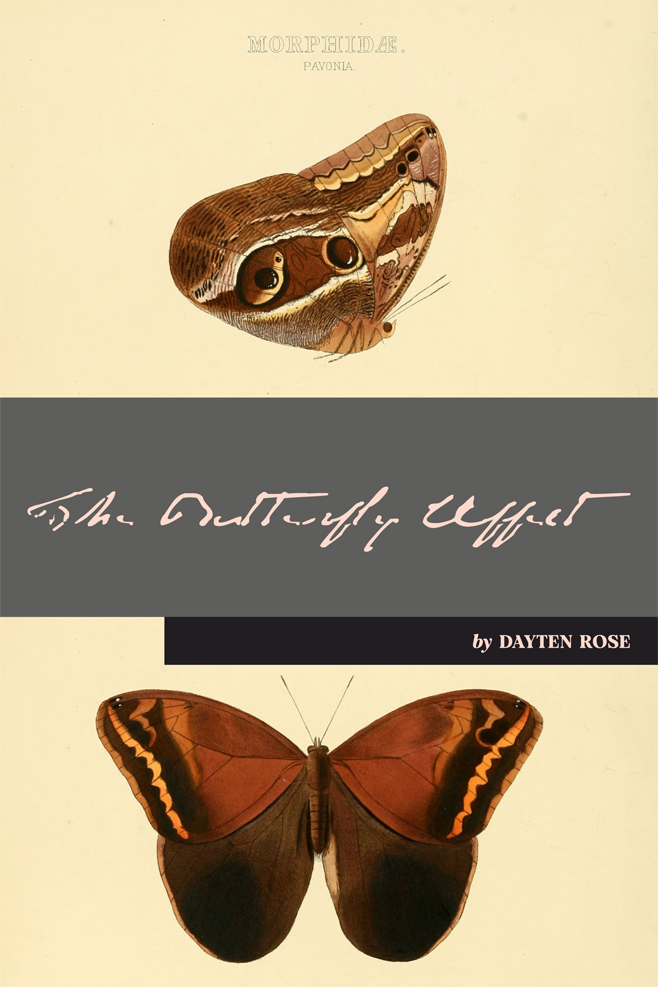
The Butterfly Affect
This is a feature excerpt from Unwinnable Monthly #191. If you like what you see, grab the magazine for less than ten dollars, or subscribe and get all future magazines for half price.
———
The announcement trailer for Call of Duty: Black Ops 7 has a surprising literary flourish. A single red butterfly animates the antiseptic halls of a tech facility. It passes through a hologram, emphasizing its unreality, then sinks into a screen – revealing, perhaps, its own unreality, the tenuous boundary of reality itself. A nightmare unfolds. Fear and technology are both tangible illusions, the sequence seems to suggest. A hand crushes the insect, destroying not just reality or the illusion, but the distinction itself, a merging of the two.
Butterflies have an abiding symbolic resonance, akin to roses and skulls in their ability to contain and convey deep meaning by their mere introduction into an artwork. And they’re all over the place in games. In fact, it may be easier to ask what games don’t have butterflies in them, as one Reddit user did while searching for games to play with his lepidopterophobic partner. The ensuing 100+ comment thread instead names dozens of games that do feature butterflies (gotta love Reddit), and they don’t seem to run out of steam.
Themes that preoccupy the makers of games are magnetic to the image of the butterfly: spectacle, attention, illusion, mortality, autonomy. Butterflies are of this world, but not convincingly. They can be admired, but only with effort. My grand plan here isn’t much more than applying that effort to the butterflies of the screen – a little hallucinatory nature walk – to admire how they flit into our worlds of make-believe.
Nature seems to have made them the objects of her peculiar care, and designed them […] for the adornment of the universe…
– James Duncan, The Natural History of British Butterflies
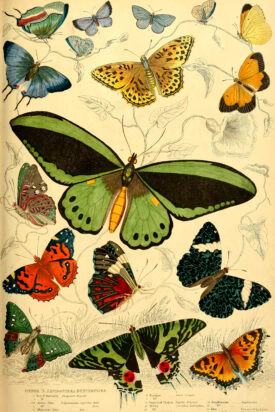
Games are expensive to make. Every detail is placed by hand. Butterflies must be economical to appear so often, and sure enough, the first function of the videogame butterfly is largely practical: they are among the tiniest indicators of life not associated with rot or decay. In an otherwise motionless screen – lying in wait in the bushes of Battlefield 1, say, or milling around the woods of Stardew Valley – butterflies serve as tiny pops of vibrance.
Of course, they do this in the real world, too. And people notice. Butterfly collecting as a pastime has been recorded in the West as far back as the 18th century, with famous collectors like Vladimir Nabokov and Margaret Fountaine traveling the world in search of interesting specimens. They are (pushes up glasses) nature’s collectibles. This tradition extends much deeper into gaming, where butterflies may be purely ornamental (Animal Crossing, Terraria, RuneScape) or used as crafting ingredients (Skyrim, Elden Ring, Monster Hunter). In some Zelda games, they congregate around secret rewards, serving as a kind of diegetic objective marker.
In an if-you-squint metaphorical way, I think this is the same basic use case of butterfly iconography in the Black Ops 7 trailer. Butterflies remind us that our environment is alive. So it is in the teaser: Mason’s sterile environment is invaded by a speck of life. Just as a butterfly beyond the screen asserts nature, the butterfly within the screen calls nature into question. The butterfly is a border-thing, neither here nor there.
The use of butterfly wings in depictions of fairies was popularized in Victorian painting, representing a supernatural borderland between bat-winged hell and bird-winged heaven. Their use in games emerges from the Fey of Dungeons & Dragons (creeping into videogames by way of Baldur’s Gate 3), as they are well-suited to neutral, mystical forces. Bayonetta, with her attendant demon Madama Butterfly, may be the best example: affiliated with Inferno, but ultimately safekeeping cosmic balance. Again, we see butterflies linked to the in-between: characters of indeterminate morality, not quite angels or demons, but with a supernatural spark. Us, plus.
Suddenly he woke up, solidly and unmistakably Zhuang Zhou. But he didn’t know if he was Zhuang Zhou who had dreamt he was a butterfly, or a butterfly dreaming that he was Zhuang Zhou.
– Zhuang Zhou, “The Butterfly Dream”
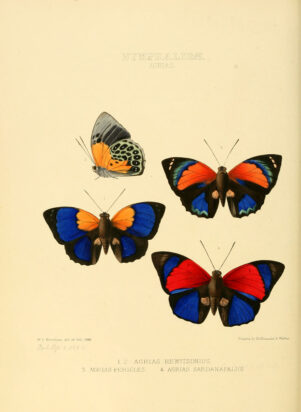
Butterflies share an abiding cultural association with the soul. Psyche, the Roman goddess of erotic love, is typically depicted with butterfly wings, and her name is translated from Greek variously as “soul,” “ghost,” and “butterfly”; “The Dream of Akinosuke” follows a man whose soul escapes from his mouth in the form of a butterfly, enacting his dreams. These aren’t universal, of course, but they are shared in European and Japanese folklore and their antecedents, two of the primary acculturating influences in videogames.
Specifically, the symbol can be read in terms of the soul’s transformation, metamorphosis being something of a signature trait for butterflies. Blue morphos are used by Bioshock 2’s antagonistic cult to symbolize Rapture’s transformation, while the Little Sisters see corpse flies as blue morphos, indicating exactly how Rapture’s metamorphosis will play out. Death is, after all, the final transformation. And in Silent Hill 2, Maria’s butterfly tattoo foreshadows her identity as a “reborn” Mary, symbolized by the moth. James not only murders his wife, but corrupts the transformation of her soul in his own mind.
More recently, the transformative symbolism of butterflies has taken on a more positive aspect, representing queer journeys and transgender identity. A butterfly grants the heroine of Sayonara Wild Hearts the power to embark on her journey of self-transformation, and Butterfly Soup uses the liquefied state of the caterpillar mid-metamorphosis as a metaphor for the process of its cast of LGBT youths discovering themselves.
Stories like “The Dream of Akinosuke” and “The Butterfly Dream,” a parable from the Taoist philosopher Zhuang Zhou, imbue butterflies with a secondary association of dreams and illusions. Persona’s Philemon embodies many of the series Jungian ideas about the subconscious, a kind of operationalized theory of the soul. (“The Butterfly Dream” also appears in the intro of the very first Persona title.) Kirby games used to begin with a butterfly alighting on Kirby’s head as he entered Dream Land and leaving at the end of the game, before that butterfly transformed into the soul-eating Morpho Knight.
———
Dayten Rose is a Kansas City-based writer covering puzzle and detective games. Follow them on Bluesky.
You’ve been reading an excerpt from Unwinnable Monthly Issue 191.
To read the article in its entirety, please purchase the issue from the shop or sign up for a subscription to Unwinnable Monthly!