Wiring Games for Lightbulb Moments – The Power of Realization over Revelation
You feel compelled to support great writing…

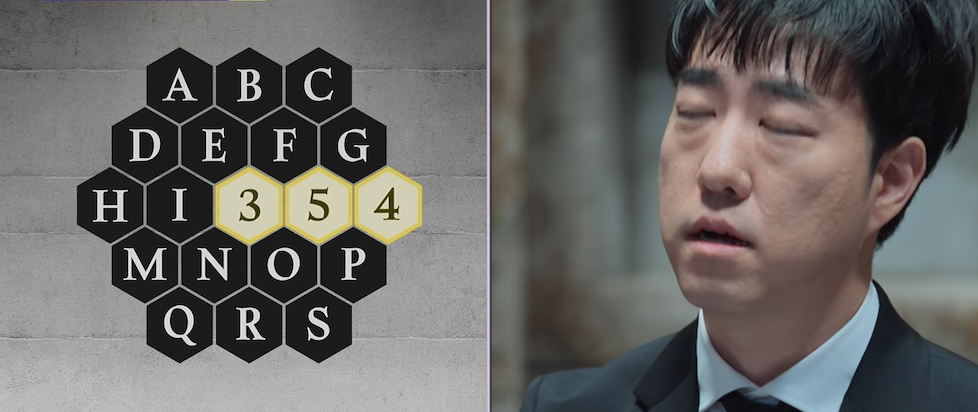
The Devil’s Plan is a Korean reality show in which the nation’s best and brightest compete in a slew of complex and rules-heavy games, running the gamut from social deduction and bluffing games to logic puzzles and escape room-esque secrets – but always dense with an uncompromisingly crunchy ruleset. For a board game and puzzle lover like myself, it’s quite brilliant.
In an episode from the recent, second series, the players were tasked with blindly queuing up attacks against a series of monsters, with the hope that with a little coordination, they might be the one to land the killing blow and bag some loot. This was a fine, if a little pedestrian game. That is until one of the players had a startling realization. The rules stated that they were free to attack enemies within a double-lined border on the game board. Halfway through the game, someone notices that this double border also surrounds the players with the lowest two scores – they’re free to be picked off, the players suddenly turn on each other, and the entire dynamic of the game completely shifts.
It’s moments like this which provide The Devil’s Plans’ best moments – sudden revelations or realizations in which information that has been available from the game’s start suddenly coalesces into a new understanding of the rules. Not only does this change the course of play, but the information itself is now a powerful commodity, to be shared with allies or weaponized against adversaries.
Compare this moment with a game from the previous episode: Players were tasked with navigating colored cubes around a board, trying to reach the center. The structure of this game was such that rules would be dished out to everyone at set points, and until they were fully revealed, players would be eliminated or moved around the board without much suggestion as to why. Rather than providing the sudden infusion of drama that a lightbulb moment of realization can provide, the players were mostly stuck in a frustrating slog, constantly making guesses at the hidden rules, then second-guessing themselves, rather than making shrewd deductions to give themselves a leg up. These two games signify a subtle distinction in game design between revelation to the player, and realization by the player.
Capturing these satisfying moments of realization and finding ways to dole them out to a player is a hallmark of some of my most memorable gaming moments over the last decade. In Outer Wilds, I’m faced with a crumbling vertical wall, which neither I nor my ship can scale – but I must find the information at its top, and crucially I know the game has laid out everything I need to accomplish it, probably in my first 30 minutes of playing.
A few years later, I’m struggling to decode the secrets of Tunic’s fictional in-game manual, all written in an unreadable language. None of it makes sense – until I stare at the pictures and my surroundings for long enough, that it suddenly just does.
I see a pathway across a pit of spikes in Animal Well, apparently unreachable – until I realize a tool I’ve had in my back pocket for hours can be used in a way I’d never imagined before, to get me there easily.
Earlier this year, I’m playing Blue Prince, noticing that each room has two framed paintings of seemingly unrelated objects – this fact sits in the back of my brain as I continue to explore, until suddenly their relationship, and the implications therein, become immediately and painfully obvious.
Creating these invisible mental barriers and providing just enough visual information to stew in the back of the player’s brain without giving the whole thing away is a fine line to walk. Any of these moments might have devolved into futile frustration and exhaustion (and in many cases in these and similar games, does happen), and the job of the developers in these instances is to lay a veil of obfuscation of their game worlds, just thin enough for the light to peek through.

As a development challenge, this is obviously no mean feat, especially when accounting for variability between players. While these games will often offer more explicit direction hidden in corners of their worlds, they are often held back behind other puzzles or obstacles, and so still feel like a satisfying reward, even if the player wasn’t able to intuit the answers themselves. Keeping these moments of discovery on the side of player realization, rather than revelation (outright telling the player what to look for) is a unique challenge, and one without a universal solution for all players and all games. But when it works, it really works – like a well-crafted murder mystery, which lets attentive readers discern the killer’s identity as the characters reveal themselves and events unfold, but crucially, before the parlour room accusations.
Often, some level of systematic collation of your knowledge is a crucial element in making these realizations concrete and tangible, as in the clue systems found in murder mystery games The Return of the Obra Dinn and the Golden Idol series. Both these titles force you to do the detective work yourself through careful observation of a murder scene, but clearly signal to the player when they’ve made enough correct deductions to make concrete progress on the case – each new realization another satisfying piece of the puzzle, acknowledged by the game without leading you there by the hand. The shining example of maintaining this balance across an open-ended game is the Outer Wilds’ ship log. Every morsel of information you acquire, every problem you have yet to overcome, is stored in the log, but it never actually tells you anything new, it merely collates knowledge you’ve gained from exploring the solar system and translating the messages of your space-faring predecessors. The narrative wrapping for this system, all contextualized by your role as an interplanetary explorer with a newly-developed translation device, marries perfectly to its gameplay function. You are using the ship log in the exact way in which your Hearthling avatar is. I’m hardly the first person to note the genius of the log’s design, but the clarity of its layout, constructed in a way that accounts for endless variation in players’ approaches, constantly updating a complex network of clues, while offering subtle hints of where to explore next (but never what to expect), cannot be overstated. Your curiosity is constantly tugged along, not by quest logs, but by a simple message displayed on your ship’s monitor – “There’s more to explore here.”
This design philosophy has been implemented across some of the best reviewed puzzle games over the last decade, with a seminal entry being 2016’s The Witness – a game entirely designed around assembling a mental toolbox through interpretation of visual patterns in puzzles and the world itself – all without any explicit direction. But it can also be peppered into games from a variety of genres. Bloodborne’s “insight” system allowed players to perceive more of the game’s unknowable, Lovecraftian setting, by witnessing horrifying bosses, or consuming items conveying forbidden knowledge. Increasing one’s insight has a variety of effects, from altering background sounds and music, to unveiling colossal beasts scaling the Gothic towers which litter Yarnham. While the true nature of Bloodborne’s world is eventually unveiled through story progression after a pivotal boss battle, savvy players can reveal it much earlier, through industrious grinding of their insight stat. In this case, the process of realization is transferred from the player’s grey matter to a mechanic in the game itself – yet the moment of realization, of piercing the veil and seeing the truth of the world in which you’ve spent hours exploring, which had always been there – offers a similar thrill.
Invoking this feeling doesn’t need to be built up over many hours to work, it can be distilled to one delightful moment. Playing platformer Celeste in 2018, I stumbled upon an out-of-place looking part of the first level. Against a background of jagged purple rocks, there’s a smooth, white box seemingly bolted to the background. I know this box from somewhere…. Suddenly, the memory of watching my older brothers play Super Mario Bros 3 many years prior jolts to the front of my brain – an identical box in the third level of that game, which, when crouched upon for enough time, would lead to a secret room. In Celeste it allows you to reach a secret collectible heart. A delightful, bite-size moment of realization, quite apart from anything else seen in the game, and reaching outside the game itself into a nostalgic memory from decades previous. As big titles continue to butt up against budgetary and graphical ceilings in order to wow players, moments like these show a different way in which games can take our breath away – and better still, in a way which requires the player as an integral part of its mechanism, and thus capitalize on the strengths of being a game in the first place.
A later episode in The Devil’s Plan required teams to navigate a diorama of a maze, using lengths of bent metal poles of set dimensions to dictate their movements. Some of the obstacles in the maze, high walls and water-filled moats, are making all the players scratch their heads, seemingly impassable with the selection of moves available to them. That is, until one player starts thinking in three dimensions, twisting their pole above and below the confines of the maze to end up exactly where they needed to reach. The team’s excited dance of glee upon making the realization that not only was this always permitted in the rules, but was in fact the key to success, is a feeling that any game should aim to instill in its players.
———
Jonathan is a biological researcher by day, but spends much of the rest of his time obsessing over games, music and music in games. You can follow him on Bluesky and at Medium.