The Danger of Playing Other People’s Games
You feel compelled to support great writing…
It’s not weird that we find identity through play. If anything, it makes the most sense about us as a species. The capacity for play, of putting aside the rules of survival and doing things for the sake of enjoyment, is not unique to humans, but no other known being has taken it as far as we do.
It’s not particularly hard to approach life as a game, or our common fictions and abstractions as a simulacrum of sorts. Society, money, courtesy, decorum – it’s all a bunch of rules that might not all directly go towards our survival, but allow us to participate in our human world and keep existing in it.
A dollar bill won’t feed you, but we understand as part of our mutual rules that it allows us to get food, to exchange value for goods and services, and so on. It’s all a bit of a performance, and we could debate endlessly if it’s a natural occurrence or a deliberate enforcement of certain hierarchies.
Regardless, humans are human, and we like to play. We try to understand the rules of a game, a situation, or a relationship. Whether we play along or try to break the mold, it’s all built upon an understanding of what we as a group are doing.
Being able to participate in a fictional or abstract situation can also be really fun, right? Anyone who has ever enjoyed a role-playing game with friends can attest to that. We’re all holding a fiction, a mutual understanding of our fantasy adventure and the roles we occupy in it.
It’s more than fun: it’s a cool way of exploring ourselves, of putting ourselves in different skins and situations, trying to understand our values and perspectives.
Roleplaying is storytelling, and the biggest story we tell is our identity, our personal expression. That doesn’t mean that every character we play is an actual part of ourselves, but there is a big exploratory component to it.
People can explore themselves a lot through roleplaying. As a neurodivergent person, I can attribute finding much more of what makes me myself to roleplaying, experimenting, and trying to understand how to tell stories in which I feel comfortable.
We’re all playing a game. A game of telling stories, and of creating shared fiction. It’s a wonderful phenomenon of emergent meaning and found camaraderie.
It is, however, a great way to open yourself to being exploited.

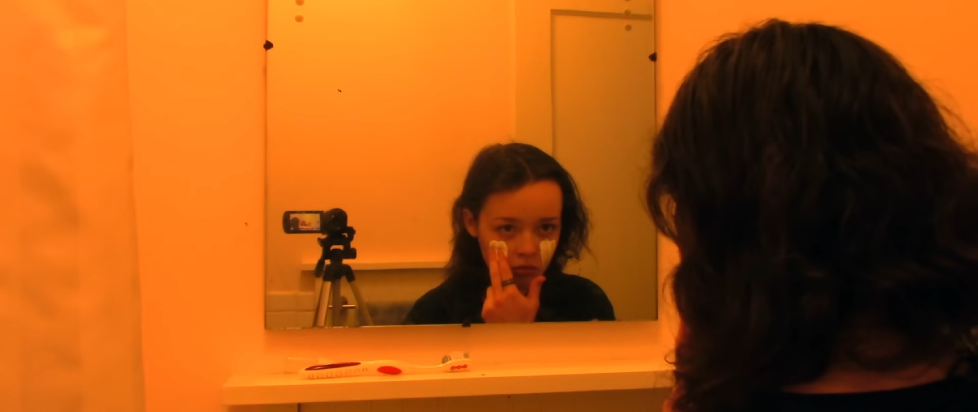
In Jane Schoenbrun’s We’re All Going to the World’s Fair, the idea of roleplaying as a collective fiction is taken to the limit. The participants of the World’s Fair trend tell a story and seek creative fulfillment, often through transformation, while seeking validation and connection from other people participating in this fiction.
They show themselves, they are seen, and they are validated through interaction.
When we play with other people, it’s not enough that we follow the rules. We need to know that the other players are doing the same, that we’re all in agreement, doing this together.
This agreement is validating, in a way; they’re telling you that you’re a great player. You’re great at showing yourself.
The fun is cut short, however, when someone seeking such an agreement finds a player happy to change the rules to suit themselves.
Casey wants to be a part of the narrative. She wants to prove herself as a creative, real person and receive validation. The person who answers her, however, is someone with ulterior motives.
This other player, JLB, is not there to engage with her artistically or emotionally. He’s there to talk to her about rules, lore, about things he’s made up. The game stops being free-form and starts moving into whatever interests him.
Casey has found interest, maybe even validation. But from the very start, it all has to move in a certain direction. She has an audience, and the audience expects something of her performance.
The game is corrupted, suddenly. The fiction is there, the desire for fulfillment is there, but now it all passes through other people’s wishes and wants.
I’ve known this dependency firsthand. A special way of playing, a meaningful story you want to perform, it all becomes muddled by a necessity to please. The play gets wrapped in layers and layers of discomfort, but you can’t really quit. It’s the thing you enjoy so much, and that person is giving you the oh-so-desired validation you seek.

Eventually, it all stops resembling anything you liked. A well-meaning person might push you into an uncomfortable situation by accident. But some people know what they’re doing. Suddenly, your fiction, your story, your identity, is tied to theirs.
Perhaps, your need for validation makes you indebted to them. You are the one seeking them out… Before you notice, it seems like they are even doing you a favor by performing the play. It’s all in service of their desires. It’s all meaningless.
Casey’s trapped frustration is apparent in the ways that messages for JLB start appearing during her performances. While expressing herself, she now needs to reject the things that are harming her, the parts of the play that are no longer hers.
Her co-player doesn’t seem to really get the memo. At the end of the movie, the man reveals his concerns about Casey. Is she really becoming something bad? A danger for herself and others?
The fiction is broken. The play lost all its power. The shared fiction is useless now. Of course, it’s all a play. Casey now sees that he wasn’t really playing: he was exploiting her desire for validation.
While she cuts off all contact, he retreats to his head. He needs it all to end differently. He tries to tell a story of meeting her again and finding a connection.
He needs to repair his broken fiction. They weren’t playing the same game. His just included taking advantage of her.
———
Claribel F. Millgress is a trans writer, game developer and narrative designer from Argentina. Deeply in love with fiction, games, and storytelling through play and dynamics. More online and on Bluesky.