An Evening with Solitaire Mystery
This column is a reprint from Unwinnable Monthly #190. If you like what you see, grab the magazine for less than ten dollars, or subscribe and get all future magazines for half price.
———
What’s left when we’ve moved on.
———
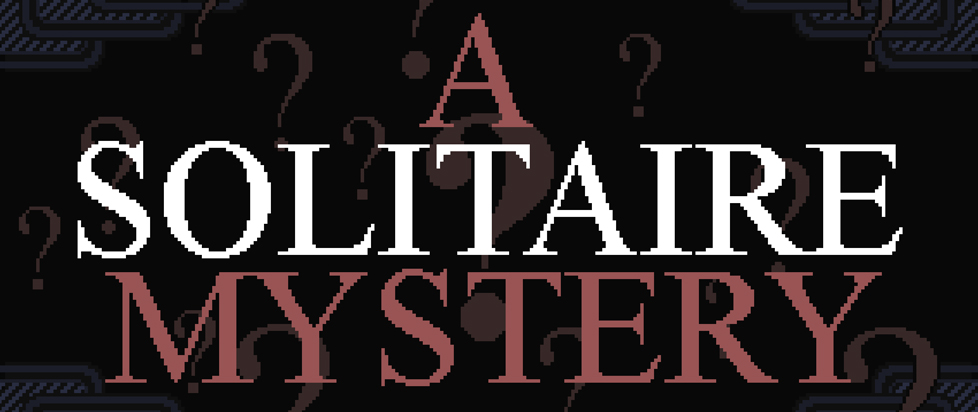
When I bought Solitaire Mystery, the newest game from the developer of Baba is You, I did so mostly out of curiosity. A Solitaire Mystery is a collection of alt-solitaire games which are actually logic puzzles, scientific experiments or poker. The game’s premise is a promise of value: 30 games in one!
I’d be lying if I wasn’t also making the connection between “weird solitaire” and “weird poker,” i.e. the gameplay of famous breakout hit Balatro. I loved Balatro and played it until I could no longer justify playing it – even now as I write, its CRT screen green background calls to me from my memory. But the two games are completely different. If Balatro is a game of poker with your grandfather who’s using a joke deck, Solitaire Mystery is a man who’s been trapped in a dark room for ten years telling you the rules to a game he made up, and every so often he kicks you in the shins.

It’s my own fault: I don’t even like solitaire that much. But I have to admit I found Solitaire Mystery a challenging experience. At the same time, it was a kind of experience I’ve been asking for. I’ve complained in this very column that I keep having gaming experiences that are surface-level. Nothing wrong with a game being simple or conflict-less; games from Dorfromantik to Animal Crossing are proof. However, I’ve played a string of games that refuse to push back on me at all, whether mechanically or conceptually. I played a lot of Fantasy Life i, but at the point I discovered that my only enemy was my own energy bar, I lost interest. Same with Granblue Fantasy: Relink, whose smooth, easy combat I couldn’t stick with long enough to find the challenge I heard was waiting at the end. Let’s not talk about the stories of any of these, which are nonexistent at best. Narratively and mechanically, I keep feeling my muscles atrophy.
So one would assume a challenging game is just what I want. But I’ve had this problem before. The Banished Vault; Dwarf Fortress; any dungeon-crawler with less-than-pretty graphics. A wise person looking at that list might see that these are all games with complex systems and rules you have to keep track of. My brain refuses to do that. Give me a long industrial chain or more than a paragraph of text without a gameplay demonstration, and I won’t keep it straight. On the other hand, there are challenging games that convey information kinetically versus in text – Dark Souls 2, for example – that I’ll take any day. Puzzle games can go either way, which is why A Solitaire Mystery had a chance.
Sadly – maybe you’ve realized already – Solitaire Mystery is made for people with a good grasp on solitaire and the patience to read written instructions without a demonstration to follow. It’s also a game with 30 sets of directions. It and I would never get along. When I’m challenged by the gameplay of something, my mind tends to jump to evaluate its aesthetic properties. This was easy with Solitaire Mystery, which is beautiful. My favorite game visually is Eldritch Invasion, which includes sprite art of horrible monsters across a pretty purple background. The card colors in each game are a mix of vibrant and utilitarian and make it easy to play.

But most people don’t play games to evaluate them as visual art. When I began thinking more about my experience playing, the first word that popped to mind was “friction.” When I say it, I mean “things that make completing my objective more difficult while contributing in some way to the gameplay experience.” The spikes below a platform in Mario could be friction. The tiny rocks in Death Stranding certainly are. When I’m having an experience and a reaction, there lies friction. Conversely, it’s obvious even in comforting and simple genres when something you do has an impact and when it doesn’t. When I grow ten radishes in a farming game, does it matter that I grew them, has it changed anything in the world or my capabilities, or have I just made $100? Can I make my RPG teammates mad or am I the greatest hero in existence forever, despite myself?
A Solitaire Mystery put up obstacles between me and “just one more round.” I’m not necessarily complaining; failing as a slot machine means succeeding at not sucking more time from me than I intentionally spent. I can’t even ask where it falls on the spectrum of “games should be fun” to “games should be about something” because, surely other people found this more fun than I did and also, I don’t know if I could name what this game’s message is if I tried (solitaire?) Of course, games do many different things and none of them are necessarily exclusive. But then I think about Solitaire Mystery against Balatro and my own assumption that a card game would want me to play as much of it as possible, and would sweeten the deal with dopamine to get me to do so. A Solitaire Mystery doesn’t much care if I play it. It’s not player-hostile, exactly, but player-neutral. Fitting, for a game about a game you play by yourself.
A Solitaire Mystery’s reward for winning a game is the pleasure of learning and winning, and it will not teach you to win beyond offering you opportunities to teach yourself. As a card game it dances closer in content to gambling than most while staying far away from the addictive loop that games and gambling both use. It’s a simple equation: do you like this? Play more. The moment you stop having fun, A Solitaire Mystery won’t try to convince you that you still are.
———
Emily Price is a freelance writer and digital editor based in Brooklyn, New York, and holds a PhD in literature. You can find her on Bluesky.