Sleep Tight: Beating the Stuffing Out of Stuffed Fables
You feel compelled to support great writing…

I see board games in the store and they always look so cool and then I buy them and bring them home, I’m so excited to open them, and then I play them, like, twice… This column is dedicated to the love of games for those of us whose eyes may be bigger than our stomachs when it comes to playing, and the joy that we can all take from games, even if we don’t play them very often.
———
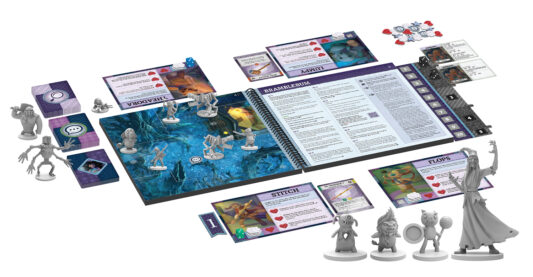
The first of several releases by Plaid Hat Games and designer Jerry Hawthorne to be subtitled “An Adventure Book Game,” first hit shelves back in 2018. What is an “Adventure Book Game?” Essentially, it’s a variation on the dungeon crawler where, instead of tiles or boards, the various missions are represented on pages of a heavy-duty, spiral-bound book.
In the case of Stuffed Fables – and most other “Adventure Book Games” that I’ve seen – the rules for each mission are on the righthand page, while the play map is on the left. Most of the time, these maps match all the usual criteria we are accustomed to from dungeon crawl games. They are divided into squares, which characters (represented by plastic miniatures) navigate using movement and investigation mechanics, while certain colored lines impede movement in various ways. Meanwhile, enemies (here called Minions) show up from time to time and must be battled.
There is the occasional shakeup, however, as in the mission called “The Thrill Ride,” where rather than moving normally, players place their characters in positions within a wagon that is careening down a mound of discarded toys. Instead of moving or fighting, you make various checks to try to control the heedless flight of the wagon and steer it toward your destination.
As you may have guessed from the wagon and the pile of toys, the premise of Stuffed Fables sees players taking control of one of six stuffed animals, or “stuffies”, belonging to a little girl. When the girl goes to sleep, the stuffies come to life and protect her from the things that lurk under her bed in a series of adventures.
The art is whimsical, but the stories themselves are loosely horror-themed, as the stuffies contend against a boogeyman named Crepitus, a ghostly girl named Skreela, and more. As such, despite the game’s childish conceit, the suggested age range is 7+ and younger kids will definitely need a little help and context from their parents.
There is also some obvious inspiration drawn from Toy Story, not just in the premise that toys come to life when their owners aren’t watching – which is, after all, far from unique – but in the design of some of the enemies, including spring-like mechanical hounds and creepy little crab robots with broken doll heads.
Much of the fun of the conceit comes from taking the accoutrements of real life and shrinking them down or blowing them up for toy-sized adventures. Various items that can be used as weapons or armor include pencils, scissors, sand buckets, and much more, while items are bought and sold using buttons as currency.
The game also introduces a novel mechanic where the stuffies can only take action when the girl is asleep, so various conditions cause the players to draw sleep cards which determine whether the girl is sleeping soundly, restless, or waking up, all of which may have effects on the game itself.
As of this writing, Stuffed Fables is the only “Adventure Book Game” that I have explored, though there are several others, including Aftermath, Comanauts, and the more recent Familiar Tales (which positions itself as a “Story Crafting Game” instead, but uses a functionally identical game book).
Other games have used a similar approach, such as the Kickstarted dungeon crawler MiniQuest Adventures, which is marketed as a “board book game,” or the simplified Gloomhaven: Jaws of the Lion.
The advantages of this system are as obvious as the drawbacks. Rather than a bunch of loose dungeon tiles, everything is neatly bound into a book, and each mission can tell you where to proceed from there, depending on what you do, similar to the old “Choose Your Own Adventure” books many of us grew up with. And, in the case of the “Adventure Book” format, most of the rules and references you’ll need for each mission are also right there on the facing page.
The primary downside is that no mission map can ever be larger than a single page of the roughly 8×8 book. This also means there’s not much in the way of exploration – a drawback when compared to games like the original Warhammer Quest, perhaps, but not so different from most modern dungeon crawlers, which tend to use pre-generated missions with bespoke maps.
Instead, the exploration component of Stuffed Fables comes from navigating the game’s various stories, which link the individuals missions together. These stories unfold in a specific order, though your actions within a mission may determine (at least somewhat) where you go next, and what sort of ending you get.
What this means is that, like most modern dungeon crawlers, Stuffed Fables has a limited (albeit fairly copious) number of unique missions that it can encompass. Once you’ve played the whole way through the game, you’re basically done, unless you want to retread the same ground again.
To mitigate this at least somewhat, the makers of Stuffed Fables released an expansion in 2021. Called Oh, Brother!, the expansion introduces a new baby brother into the mix, along with a new Adventure Book filled with new missions and stories, as well as two new playable characters, a unicorn stuffy and a legally distinct He-Man action figure (who is much more articulated-looking than an actual He-Man figure).
I haven’t picked up the Oh, Brother! expansion, so I can’t speak to its qualities, but apparently it introduces some new wrinkles to the gameplay in the form of the action figure, who is made of plastic instead of stuffing, and so behaves somewhat differently than the other characters. (In one of the game’s cuter conceits, the stuffies use stuffing as health, and become “collapsed” when they run out.)
———
Orrin Grey is a writer, editor, game designer, and amateur film scholar who loves to write about monsters, movies, and monster movies. He’s the author of several spooky books, including How to See Ghosts & Other Figments. You can find him online at orringrey.com.