Achievement Hell
You feel compelled to support great writing…

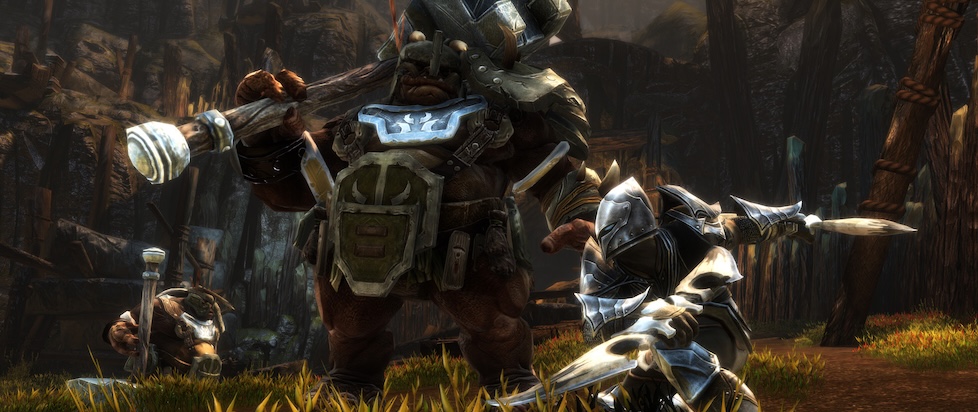
About a year ago I picked up a copy of Kingdoms of Amalur: Re-Reckoning for $10 on clearance at my local Wal-Mart. I’d bought the original at some point when the PlayStation 3 was my primary gaming console, but I was younger, less attached to the notion of games as a product that ought to have a proper quotient between money spent and time spent. Back then, I’d treated it a bit coolly, perhaps as it deserved: an occasionally fun, middling RPG a decade too late to be punchy and too scorched by development hell to feel properly cohesive.
There are a few side-stories to Amalur in our world that give the game the modicum of notoriety it still has: it was a botched franchise born of an aborted MMO fronted by MLB pitcher Curt Schilling. It was also a game that failed so badly that its IP was for a time owned by the state of Rhode Island to try and recoup lost investments. Let me give you a third reason to remember this game: it was the reason that I, your second-favorite writer for Unwinnable.com, got medically diagnosed with moderate-to-severe Obsessive Compulsive Disorder.
It’s not Amalur’s fault, but it does make for the kind of punchy opening publishers and readers love. Forgive me Curt Shilling and THQ Nordic. I thought the game was alright. I don’t really remember anything about it, beyond little incoherent flashes akin to the deja vu of long-delayed dream recall. No, what happened was that Amalur was the straw that broke the camel’s back.
Of course, as you might see in my bio, I’ve been playing games since Doom II when I was four. Around 2020, in the months after COVID-19, something changed. I started not to play games, but to complete them. There’s a pretty cut and dry motive there: in those long months of quarantine, when the apocalypse was upon us and at least half of us were hunkered down trying to survive the plague, there was no sense of accomplishment. The world froze and was stagnant. My University was on hold and online classes were middling and meaningless.
Enter the PSN Platinum Trophy, and the Pavlovian bell of a trophy being acquired. In that time, those audio cues directly intertwined themselves with my dopamine receptors. Suddenly every game in my backlog was another change to get a hit of that wonderful ping, to fill my Trophies page with an endless brick wall of 100%. There wasn’t much else to do beyond doomscroll.
As things started to move again, though, this habit of mine continued – I was playing games obsessively, not to think about them and engage with them as art, but to get trophies. There were games that I did not buy because I’d googled them on PSTrophies.com and found a 10/10, 200 hour achievement grind for a jpeg of a trophy to be attached to a png of a game’s logo. Soon enough, when I was wrapping up college and writing my second thesis, I’d reached the milestone of 100 Platinum Trophies. Many of them were acquired deep into the night when I should have been sleeping.
Some of them were, as they should be, fun! Grim Fandango’s platinum encouraged me to talk to a lot of characters, to find silly dialogue options that were a bit buried in dialogue trees or conditional, and to really appreciate the tongue-in-cheek sadness that I’ve discussed before. Insomniac’s Spider-Man was reasonable for a completionist. Nothing felt too out of the way or obscure, and I’d enjoyed the game. The Platinum trophy was a sort of review, then – like I’d enjoyed the game enough to go above and beyond and see everything it had to offer.
A lot of them aren’t fun. The majority of them are not fun. They’re either utterly banal (for example, Undertale takes the piss with arbitrary trophies that don’t even try to act like they mean anything), require the collection of 10,000 pinkish giblets, or require a player to utterly master a game to the point of loathing it. Wolfenstein II’s Mein Leben comes to mind. I love that game; I don’t hate myself enough to invest the time necessary to ping that one. At least, not now. That’s a couple of years behind me.
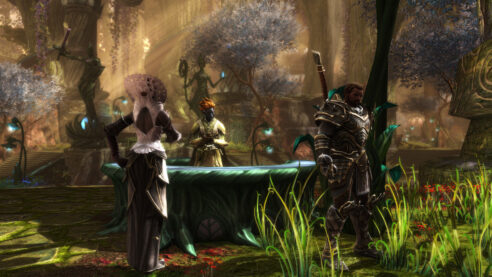
Kingdoms of Amalur: Re-Reckoning found itself on my platinum trophy chopping block. And I platinumed it. It took two playthroughs, one on the hardest difficulty, and required me to jump through plenty of arbitrary hoops: sidequest completion, item collection, item forging, pickpocketing 25 people, killing 500 monsters, etc. It took me 75 hours and some change.
From my acquisition of the first trophy to that accursed platinum chime, five real-world days passed. I don’t need a calculator to tell you that means I spent 15 hours a day playing a game I can’t remember anything about. I lost that time. For a jpeg.
This is about me, of course, and not the game. I could easily have opened this article by talking about Skyrim, Dark Souls III, or whatever other game ate that much of my time. I think that it does speak to a specific frustrating mentality, though. So many of us are desperate to feel like we’re working towards something in a decade of stagnation and outright regression. What’s wrong with a bit of achievement for achievement’s sake?
There’s an imbalance here, though: I respect games as an art form, but the addition of Trophies have become parasitic. Achievements do not respect the player. Kingdom Hearts Re:Chain of Memories asked me to grind Riku and Sora to level 99 in the endgame dungeon over the course of 12 hours and I happily barked like a dog because I was so desperate for a bit of dopamine. I had experienced everything the game had to offer fifteen hours before that. I was turning myself into an employee for a piece of media, a serf desperate to crack open the bones of entertainment to drink the last dirty dregs out of it before tossing it aside. Maybe I’d put a podcast on to dissociate while my fingers took me back and forth in and out of rooms, in and out of the same fight that I’d done a hundred times before.
A pretty profitable niche has emerged on YouTube of achievement hunters (no, not those ones), who make a song and dance of getting the hardest and most impossible achievements for a digital crowd. You’ll see expressions of rage in thumbnails promising “THE HARDEST PLATINUM I EVER GOT!! (400+ Hours)” and watch a trimmed video summarizing the Sisyphean journey of the gamer going for it. And what happens when it finally pings? There’s usually a flash of joy. Then, as the endorphins of overcoming what is self-inflicted suffering hit, it switches to relief. Sometimes, grief. I think a lot of those guys are covertly mourning the time they wasted whether they know it or not. At least YouTube and Twitch pay out.
I hope the profit to enjoyment ratio ends up being worth it.
The commodification of art – ever encroaching, ever sinister – encourages this mentality in a specific subset of people. If I enjoy a game, am moved by it, spend time thinking about it, writing about it, and wrestling with its themes, then I’m spending less time playing newer games with more trophies. The dark side of Completionism is that it has the potential to turn an individual into a devotee to the religion of consumption.
I must get my money’s worth by making myself miserable with this piece of entertainment. I must drain it dry of all dopamine before turning to the next one, my body a shambling corpse that hungers for meaning. But these are all empty calories. I find no satisfaction, only its shadow.
I’d like to think that I’ve pushed past this dark age in my career as a thinking gamer, but it’s still ever-present in the back of my mind. On my lower days I scroll through my PlayStation account or my Steam Library looking at my digital hoard, half-proud of it. I’ve booted up a few games on Steam just to smooth out an achievement I missed.
But I’m not playing games for meaningless achievements any longer. My first ever platinum – Mass Effect 2 and that long night I spent in the Suicide Mission on Insanity – meant something real to me as a young teenager. That trophy became a little fragment of the love I still have for that game, something I remember vividly with a nostalgic warmth. When the shuttle boarded – no casualties, Commander – I felt at 2 a.m. like I’d done something only a select few had ever done. I’d proved something to myself that night about my tenacity and ability to get things done.
Perhaps, I think now, that moment is the one I’ve been chasing for so long.
———
J.M. Henson has been playing video games since Doom II at the age of four, and hasn’t shut up about them since. You can find them on Bluesky posting very occasionally.