Android and Human Solidarity Forever

This column is a reprint from Unwinnable Monthly #189. If you like what you see, grab the magazine for less than ten dollars, or subscribe and get all future magazines for half price.
———
Wide but shallow.
———
With a friend over and the heat receding for the moment, we figured a light movie-game could be a good way to spend some time. A quick gander at sales, and soon Detroit: Become Human was installed, with expectations low and the quick-time-event difficulty set to “casual.”
As a Quantic Dream (a French studio mired in reprehensible behavior) game, Detroit: Become Human bears hungry Shyamalan-ian eyes along with a tiny stomach in terms of ambition. I’m not too interested in rehashing much of those discussions, as I feel they landed pretty well accurate. The game definitely pushed forward the technology of choice-based narrative games, building off the motion-capture technology meticulously built by The Last of Us, if not quite reaching the same heights. The actors in particular are squeezing blood from a script of stone foliated with layer after layer of groan-worthy tropes. From the heavy hitters to the fresh faces, each earns their cut treading the boards with grand ideas that are sadly far from ripened.
This is all understood, there’s nothing new beyond my personal shocked Pikachu mug witnessing it all in real time. We’d scour the flowchart wondering what went wrong, when of course the answer is you’re given four vague prompts meant to contain complex ideas with any number of nuances in delivery, and hoping that the one you selected also matches the tone, purpose and intended reception of your statement. Not every choice left me feeling bamboozled, but it still happened more than I would have liked.
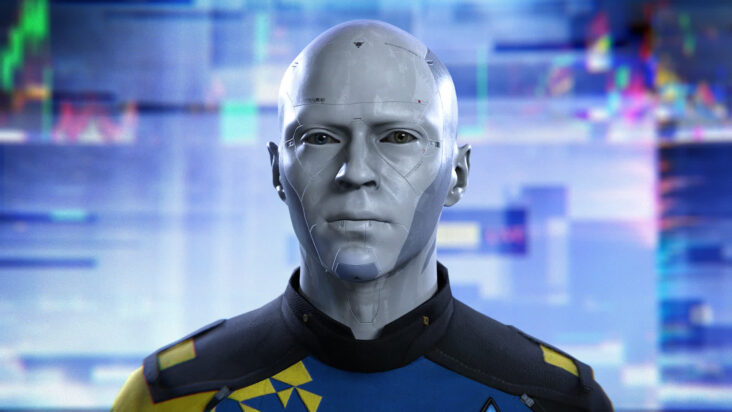
Though I am wary of treading too close to a game take, what really set me back about playing Detroit: Become Human is that it is now 2025, and generative “artificial intelligence” consumes all of the oxygen in the discourse and on the planet, as well as the remaining fresh water and old growth forest. All despite the recent Unwinnable special issue on the subject; someone should twist Altman’s arm for a sub. Anyways, Detroit: Become Human tells the tale of androids equipped with “infinite intelligence” manufactured to serve as machine slaves which has resulted in 28% human unemployment and a government shrugging off any substantial action or culpability. A smart man just figured it out, including the “bio-components” that perfect the nature of flesh, so androids are not merely the apex of intelligence but of the body as well.
I don’t need science fiction to explain everything in a single story, hardness of the sci-fi notwithstanding. But if the question is what if we created life and consciousness but then actually had to deal with the ramifications, it feels like there’s a giant gap between replicating neural pathways and physical forms in ways that we aren’t anywhere near understanding within ourselves, and not only inventing it wholesale but in a way that dodges all of our own limitations and peculiarities. And beyond that, to imagine that we did this, while somehow forgetting to address the larger social organism of society – keeping people fed, sheltered, healthy, educated and allowed the time and space to make life meaningful – reveals a surprisingly limited imagination.
What’s possibly most infuriating, despite Detroit: Become Human’s big swings, is to compare it against what is known as AI nowadays. The game posits that humans are mostly vile, vain, self-centered creatures completely held to the whims of their emotions and desires. Given the option to purchase a device so human-like that without the glowing LED sticker no one would be any wiser, we are essentially told that androids exist only to be abused in every possible way. And yet, for the many avenues where Detroit: Become Human dehumanizes the humans within its story, it seems so quaint to consider a time where humanity created technology that simply surpassed us, rather than threatened to obliterate our own emotional, social and scientific intelligence.
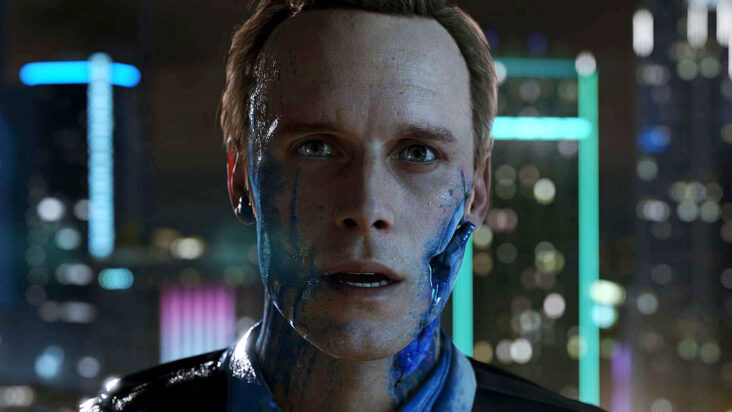
Whether it’s reading about how large language model usage is literally rendering analytical thought impossible for many who use it, or about people downloading multiple AI chat apps to run their own mobile phone polycules, or those with so little buy-in to society that they’re quickly convinced of global pseudo-religious conspiracies, what’s becoming clear is that technology is dragging us to its level – sophisticated in many ways but incapable of literal thought or material analysis, with a focus on base individual desires through the promise that one needn’t really consider the needs of anyone else. If the app gets lippy, just feed it a bunch of prompts to back on course, or delete the history and start over, or turn to one of your other bots.
Current reality has proven to be so much more disappointing than Detroit: Become Human, an infuriating statement to type, because the game presents a lightless reflection of ourselves. It paints us as incapable of seeing the real villains of our lives – billionaires running roughshod over the social order as if they had no responsibility to the human beings buying their android products. That people would accept the absurd idea that androids are responsible for job loss instead of solidarity as an abused and overtaxed work force is the fiction I really struggle to suspend disbelief for.
Playing through Detroit: Become Human, it seems unbearably short-sighted in its view of humanity. I still feel that way, but it’s difficult to deny that the power of a technology built explicitly to hammer our dopamine buttons to the point of total self-negation is playing out before our eyes. GenAI is so vacuous that it has me here wishing that I was in the Detroit: Become Human’s world, demanding that I hand it to Quantic Dream. But I refuse – humanity remains as capable of collective survival as the androids, and we all will always have more in common with each other than with any self-described “visionary” bloodsuckers.
———
Levi Rubeck is a critic and poet currently living in the Boston area. Check his links at levirubeck.com.