On a Roll with Kulebra and the Souls of Limbo

This column is a reprint from Unwinnable Monthly #188. If you like what you see, grab the magazine for less than ten dollars, or subscribe and get all future magazines for half price.
———
Thoughts about being something else.
———
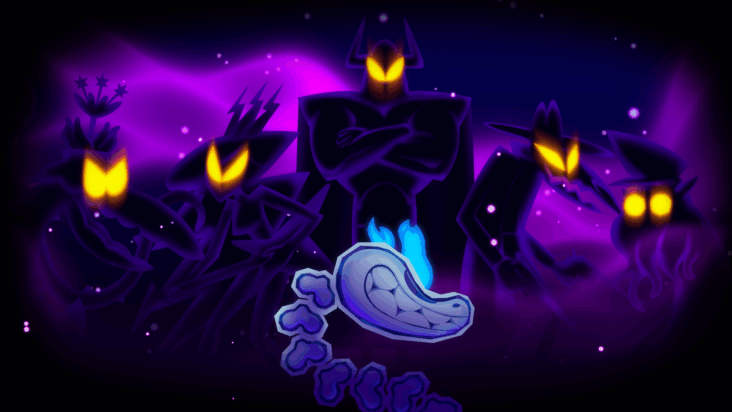
You know what has some negative connotations? Snakes. Skeletons. Combined, that’s like two times the negative vibes in (traditional) pop culture. While the Bone Hydra in Hades is overwhelmingly filtered through a cool as hell aesthetic for an impressive boss fight, it’s still a boss fight – also tied to rooting the traditionally negative in antagonistic design. Not that there’s necessarily an issue with that; traditions in media actually can still spark interesting things, depending on execution and other elements. Again, the Bone Hydra is cool as hell and makes for an impressive boss fight. But it’s also cool to see something diverge from tradition. Like this new title from developer Galla Games has a skeletal snake too, but far smaller than the Bone Hydra. At a first glance, this critter doesn’t scream “boss fight” – so a nameless minion to fight instead, right? Also looking brighter, so maybe a funny minion to squash, like Mario’s Goombas.

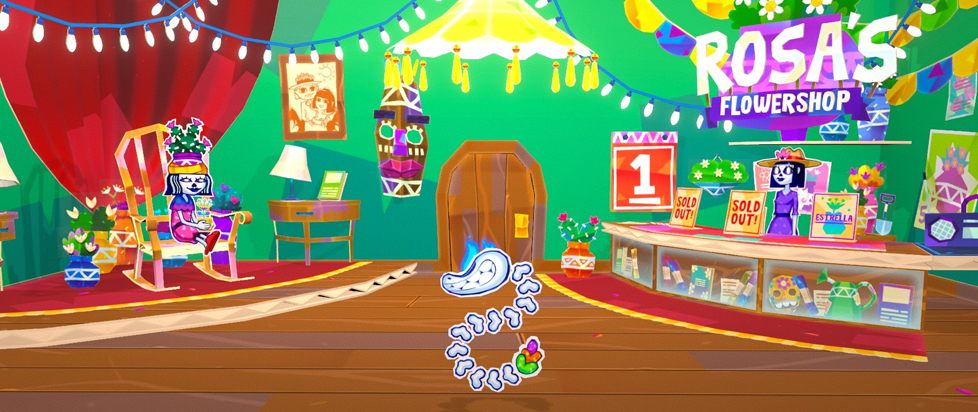
Well, no, he has an individual name – Kulebra – and he’s the protagonist the player takes control of, not an opponent to wreck. In Kulebra and the Souls of Limbo by Galla Games, the eponymous Kulebra is a snake who wakes up in the titular Limbo with no real clue about his past. Despite his amnesia, he winds up helping his fellow residents in Limbo try to resolve their emotional issues to escape the supernatural realm’s time loops – chronological tangles that seem tailored to their tumultuous state of mind. (Think The Forgotten City plus Steven Universe.) But the circularity of time also has an interesting hold on him as a snake, conjuring up images of the Ouroboros – the snake eating its own tail, the symbol of eternally cyclical time in Egyptian lore. (My first encounter with this symbol was emblazoned on Homunculi in Hiromu Arakawa’s Fullmetal Alchemist.) As likely another layer of time, the Ouroboros also symbolizes destruction and rebirth, which can potentially tie into this game’s vision of Limbo. The destruction of the mortal shell, the chance for metaphorical rebirth of the psyche.
And apparently, there might also be some natural inspiration for all that mythology. Turns out, there are some real snakes that dabble in literally eating their own tail, such as the rat snake. Fortunately for Kulebra, he wasn’t that type of snake before Limbo. “Our dear protagonist was a rattlesnake in life,” says Paulo and Pavel Lara, the developer-brother duo behind the title and the founders of Galla Games. It ends up clear in the character’s design with the colorful rattle at the end of his tail, hinting at the specificity of his mortal life before, the care his creators put into crafting him. In fact, outside of the game’s in-universe story, a dev blog on Steam discusses how Kulebra (or “Culebra” then) was first designed as a living snake in an earlier game, an endless scroller for mobile. But the tail proved to be a problem.
“Due to technical limitations, we couldn’t display a continuous snake tail, so we had to split it into sections,” the Laras explained. The segmentation of the snake into parts was a constraint that sparked new ideas. “We landed on a skeleton look as the best, given this limitation.”
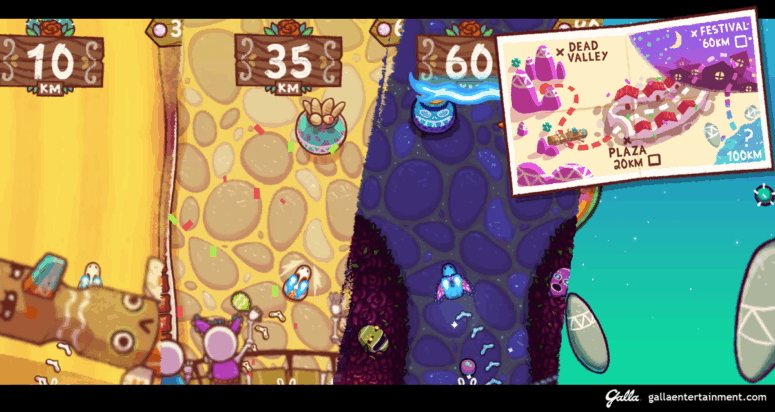
Kulebra’s earlier iteration for mobile as an endless scroller.
That constraint also led to the Laras deciding to set the whole game in their version of Limbo, to align with the style of their skeletal character. “And thankfully the theme matched fairly well with the next iteration for Kulebra that we had in mind.”
But an endless scroller for mobile before – oddly enough, arguably again playing with the symbol of circular time with the Ouroboros. Perhaps a picture of the Ouroboros in cultural layers now, from far-reaching myth to games digitized into pockets, showing the elasticity of imagination and art and play.
“The snake protagonist came from our mobile game’s main gameplay loop: You would have to zigzag across obstacles, but could never go fully straight,” the Laras shared. “We found a snake would be a natural fit for this gameplay style.”
The snake may just be a naturally looping creature, in shape and sheer vibes.

While transitioning from mobile to multiple consoles and PC, Kulebra didn’t just change one letter of his name. (The developers said “Culebra” is a colloquial way of saying “snake” in Spanish, but a copyright dispute necessitated the slight name change.) According to the Laras, he also underwent subtle visual changes, like curving the head to resemble a “Diablo Cojuelo”-like shape. “The Diablo Cojuelo is a character from the Dominican carnival. Kulebra’s overall shape takes a few notes from its design,” the Laras said. “[His] design shares some features from Dominican and Mexican culture, although very subtle. Things like the shape of his head, and the colorful tail are fairly light nods to these two cultures.”
The Laras added that the subtle visual changes also included bigger and flatter teeth, a Sonic-style roll for acceleration, and using the “Egyptian walk” as Kulebra’s main way of traversing –looking like a nearly profile view on screen and while mostly upright (see ancient Egyptian mural art). “I noticed that the S-posture of Kulebra was very appealing for the type of character, and helped a lot with reading his silhouette, especially compared to crawling [and] sneaking around, creating a very iconic look for the character. So, we stuck with it as idle and walking animations.”
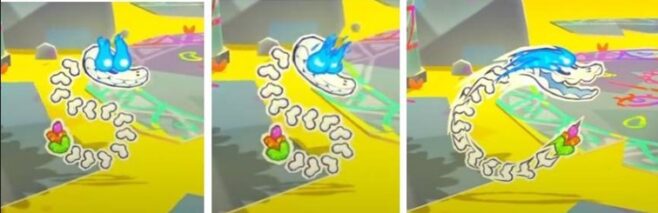

A sequential breakdown of Kulebra’s roll. Galla Games said they focused on creating “snappy animations for the characters.”
But the impact of Kulebra’s design on gameplay movement went beyond figuring out regular traversal for a video game snake. For the Laras, the roll for speeding up travel was the most significant quirk of the snake’s iconic and distinctive legless appearance. “[We] think rolling makes for a more interesting mechanic than just running – it makes moving around fun by adding a small layer of skill,” the Laras explained. “If you can avoid obstacles, you’ll be able to keep up your speed for longer. It took a bit of trial and error to get it to feel right, but I think the end result makes for a better experience!”
While the devs remarked that this sort of movement isn’t very realistic, it sounds perfect for a skeletal snake contending with time loops and the lingering emotional problems of souls in a vibrantly painted Limbo. Exploring alternate bodies and how they can move differently is part of the appeal of nonhuman characters. The Laras’ imaginative detail in embodying how a snake can accelerate (or “go fast” like a certain hedgehog) in a fantastical realm even ends up touching on actual folklore, though they said that wasn’t originally intended. “[There’s] an Australian tale of a creature referred to as ‘The Hoop Snake,’ which is a snake that bites its tail to traverse faster around the ground. Just like Kulebra’s roll ability,” the developers shared. “That is a total coincidence that showed up in the game. Nevertheless, we made a little reference to it in the game!”
It feels like a mythical Ouroboros on the move. It’s a concept and an image that apparently loops back around, in myth and folklore and tall tales. Human thought was put into picturing the physical possibility of snakes contorting themselves into something as geometric as a circle. And then to go from game dev and find this already echoed in mythology, connecting back to the history of humans and the snakes they observed years before, imagining their limbless curving body as a line, and bending that line into a circle, a hoop, a symbol. Is the snake devouring its tail to maintain the circularity of time, flowing from destruction to rebirth? Or is the snake only biting its tail to move even more quickly, turn itself into a wheel that rolls ever forward? Both?
Other than that, the Laras explained that the skills of the legless Kulebra don’t actually diverge too much from a character with limbs. “Ironically, despite the limitations, I think the snake design gave us more tools rather than removing them.”
But were there ever any concerns over possible limits in audience reception? Again, snakes can unfortunately still be viewed with exclusively negative connotations. The Laras said that in their first iteration, that possibility hadn’t even crossed their minds. By the time of their second game, Kulebra and the Souls of Limbo, they were more aware of it. But the character had grown on them, and they welcomed how unusual their protagonist was despite a possibly negative reputation for a whole species.
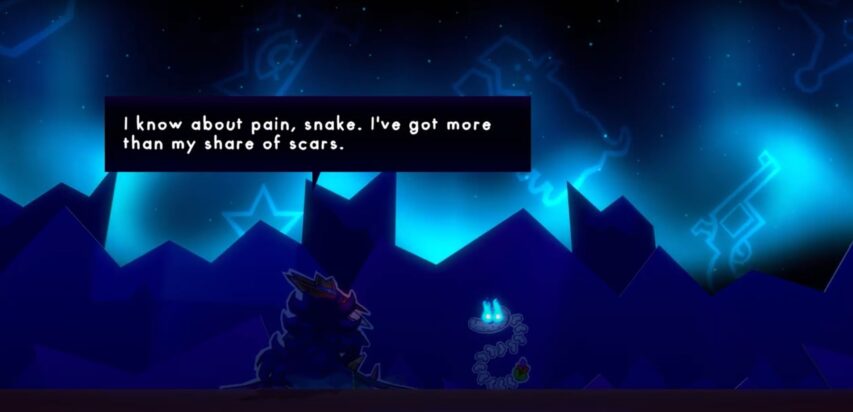
Then again, Kulebra isn’t the lone friendly snake character in media – there’s the coral snake Noodle that players controlled in Snake Pass, Viper from the Kung Fu Panda movies, and any snake Pokémon a trainer recruits. The number of benign snakes in fiction is steadily growing. And with empathy highlighted as a major theme in Kulebra and the Souls of Limbo, exploring that theme through a misunderstood animal like a snake can add an interesting weight and warmth to it.
“[The] element of the snake plays a substantial role in how Kulebra’s path forms, and his past shapes his perspective towards empathy through introspective analogies that open a little crack into Kulebra’s feelings and motivations from his perspective as a snake,” the Laras said. They’ve grown to appreciate making their hero a snake. “[We] think it is a nice way to make Kulebra stand out, especially with that big bright smile that he always carries.”
———
Alyssa Wejebe is a writer and editor specializing in the wide world of arts and entertainment. Her work has included proofreading manga, editing light novels, and writing pop culture journalism. You can find her on Bluesky and Mastodon under @alyssawejebe.