The Age of High Adventure: Conan on the Tabletop
You feel compelled to support great writing…

I see board games in the store and they always look so cool and then I buy them and bring them home, I’m so excited to open them, and then I play them, like, twice… This column is dedicated to the love of games for those of us whose eyes may be bigger than our stomachs when it comes to playing, and the joy that we can all take from games, even if we don’t play them very often.
———
Despite the ubiquity of fantasy properties in the tabletop roleplaying, board game, and wargaming arenas, and the massive and longstanding popularity of Robert E. Howard’s Conan, the latter has made surprisingly few inroads into the former.
While it may no longer be the case, for a long time, Conan was probably the second most recognizable fantasy property around, following the works of J. R. R. Tolkien. By comparison, however, Tolkien’s Lord of the Rings has reached the tabletop in an unsurprisingly large number of forms, with board games alone dating back at least as far as 1978 and continuing in dizzying numbers to this day. And that’s not to mention the numerous ways in which Tolkien’s work has influenced the worlds of tabletop roleplaying and miniature wargaming, both officially and otherwise.
Conan may have a similarly significant unofficial presence in roleplaying games – it’s hard not to see influences of stories like “The Tower of the Elephant” and “Rogues in the House” in the most basic elements of games like Dungeons & Dragons – but licensed adaptations of the Cimmerian are fewer and farther between.
As far as I’m aware, the earliest instances of Conan (and his occasional cast of supporting characters) making their way onto the tabletop coincide with the release of John Milius’ 1982 film adaptation, starring Arnold Schwarzenegger. There was apparently a planned “adventure wargame” meant to be released the same year as the film, developed by Simulations Publications, Inc.
Oddly enough, this game (which, as near as I can tell, was never published) would not actually allow players to directly play as Conan. Instead, according to designer’s notes published on BoardGameGeek.com, “Conan is for 2 to 4 players with each of the contestants representing one of the major factions of Hyborea (Conan’s fantasy world). Each faction has agents at their disposal with which they attempt to thwart their enemies’ plans while enlisting the aid of our fearless hero, Conan. There are five types of agents: Wizards, Warriors, Courtesans, Assassins, and Thieves […] Control of Conan is gained by sending agents after Conan and either seducing him (Courtesan), befriending him (Warrior), or hypnotizing him (Wizard).”
The success of the film also spawned a handful of early RPG supplements designed to bring Conan and his world onto the tabletop. For a full-throated Conan board game, however, we would have to wait until the 21st century. When it did come out in 2009, Age of Conan: The Strategy Board Game had a playstyle that, frankly, sounds a lot like an updated version of that early “adventure wargame,” with players taking control not of Conan directly, but of one of four factions within Hyborea, who attempt to thwart one another and manipulate Conan’s adventures into aiding their goals.
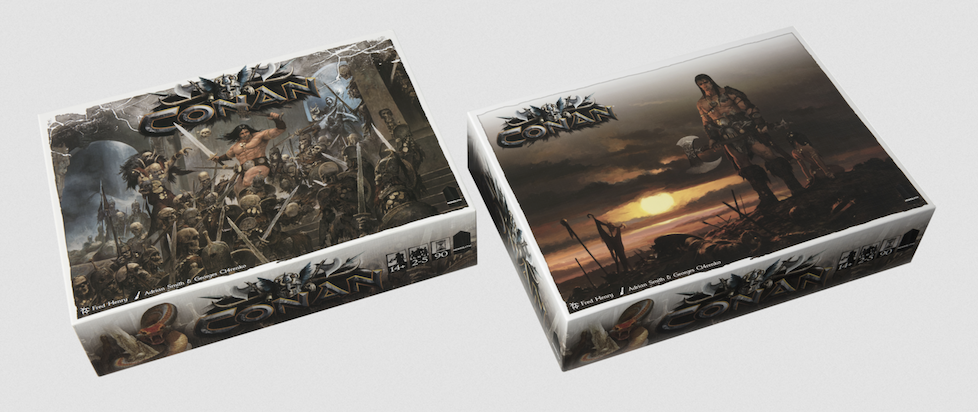
Despite a few odds and ends, including card games from 2001 and 2006, those who wanted to actually play as Robert E. Howard’s famous barbarian in a board game may have had to wait until 2016 to get the chance. That’s when the game that we’re ostensibly here to discuss was released by Monolith Board Games. Simply called Conan, it pits “1-4 players taking on the roles of the legendary Conan and his comrades in arms” against an “Overlord – a player controlling hordes of savage tribes, bandits, and undead slaves.”
This sort of asymmetric approach should be extremely familiar by now to longtime readers, and is probably the dominant form of the dungeon crawl board game, dating back (in one form or another) as far as HeroQuest and continuing through one of the form’s most iconic exemplars, Descent.
With the 2018 release of Conan: The Monolith Sourcebook and the 2021 release of Conan the Conqueror, the game added solo/co-op rules, to allow 1-4 players to play alone against the board, rather than requiring one player to act as Overlord and control the various monsters, brigands, and other villains of the game.
Funded via Kickstarter – as were so many of these games – there are countless Kickstarter exclusives and various expansions available for Conan, but the base game comes complete with the ability to play as our eponymous reaver, as well as several companions drawn from assorted Conan stories. It’s also got a boatload of enemies, all represented by plastic miniatures, including pirates, picts, a giant snake (what would a Conan game be without a giant snake), and some named characters from various tales, including the ape-man from “Rogues in the House.”
Perhaps the most immediate and obvious difference between Conan and other games of its type is that its various scenarios are not played out across small dungeon tiles, but larger boards representing battlefields, villages, castles, and the decks of ships, thereby giving a game of Conan something of the feel of a tabletop skirmish game, even if the mechanics more closely resemble classic dungeon delvers such as Descent.
I’ve only dug into the core game and not any of the numerous expansions, which also means that I’ve never played it in its solo or co-op modes. I can’t say much about how Conan plays, but I’ll quote the publisher’s website in saying that the game has been “unanimously praised for its brilliant and faithful reproduction of the Hyborian Age.” It’s obvious that the game has its fans, as new expansions are still being added via periodic successful Kickstarters.
Is that a testimony to the game itself, the overall popularity of these sorts of products, or simply an unfilled niche for people who want to bring one of fantasy’s most recognizable characters to the tabletop?
———
Orrin Grey is a writer, editor, game designer, and amateur film scholar who loves to write about monsters, movies, and monster movies. He’s the author of several spooky books, including How to See Ghosts & Other Figments. You can find him online at orringrey.com.