Teenage Angst At The End of the World
You feel compelled to support great writing…

If you’re like me, you are probably sitting on a heap of painful or cringe-worthy memories from your teenage years. Something stupid that you said or did which twinges in the back of your brain every now and again, despite how far away you are from said event in time and space. Our teenage years are, in a large part, defined by puberty and all the accompanying physical and mental changes that accompany it. To grossly oversimplify: you are a mess of emotions and hormones during this time.
Imagine, instead of being a rejection from a crush being “the end of the world”, you were faced with the literal end of the world? There’s a lot of fiction out there which deals with how we as a civilization would deal with an apocalyptic event, but only a handful really grapple with the emotional toll of the situation on a deeply personal level, and fewer still are interested in exploring this in characters that aren’t fully grown adults.
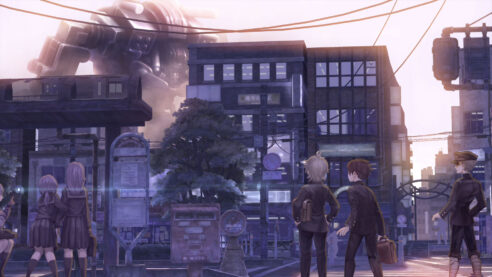
Two recent games have chosen to tackle this idea head-on in quite different ways – 1000xRESIST and 13 Sentinels: Aegis Rim. Neither game wastes any time bringing their teenage protagonists to the forefront, with early chapters in both establishing high school settings where the characters undertake typical teenage activities like attending a dance or getting ice cream on the way home.
Knowing an apocalyptic fate awaits our protagonists, this setting lulls us into a false sense of security. But equally – and crucially for the games’ eventual narrative impact – it also allows us to get into characters’ headspaces right before the upheaval their lives face. Their problems seem almost laughably small compared to what we know is coming, yet feel overwhelmingly large in the moment.
From these insignificant schoolyard troubles, the trajectories of both games diverge, providing a stark contrast in the protagonists’ reactions to the subsequent events and the games’ overall message.
13 Sentinels draws inspiration from the mecha-anime stories of the 1980s and 1990s, alongside the romantic elements of shoujo manga, all within a sci-fi setting. As you play through the various storylines of the 13 different protagonists there is a lot of time and attention given to the relationships between characters. They fight, they fall in love and ultimately they all come together to fight the invasions of the aliens (referred to as the Deimos) at the end of the game. It’s by no means a happy affair. Certain characters go through physical and psychological torture, but there is an air of optimism which permeates the story. The characters overcome their own emotional burdens over the course of the game to rise to the challenge and come out victorious. Developer Vanillaware uses the events of the game to, in part, show the characters maturing – something which is reflected in the game’s ending where our protagonists lead a more idyllic life as adults.
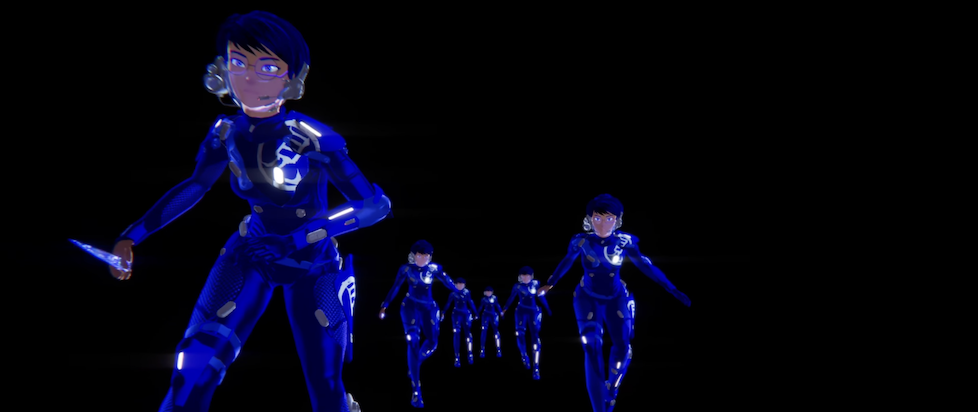
Contrast this with 1000xRESIST, a game which starts at the very real 2019-2020 Hong Kong protests. Although not the playable character, Iris is very much the focus of this story. She is shaped by the intergenerational trauma resulting from her domineering mother who herself carries the emotional weight of fleeing Hong Kong during the protests. Iris’ petulant behaviour is shown to us through flashbacks where we see her interactions with her parents as well as fellow immigrant Jiao whom she ostracises in response to the increasing anti-Chinese sentiment in 2046. It’s these experiences that shape her bleak world view, diametrically opposed to the optimism of 13 Sentinel’s classmates, and her despondency causes her to act with reckless abandon when she proves to be the only one immune to the disease brought upon by the game’s own alien invasion (this time named the Occupants).
The result of this dejected worldview is the civilization of her clones that worship her as a god – a reflection of her desire to be loved and adored in the way she felt never received from her own mother. Iris’ own immaturity is demonstrated through the early years of her clone civilization where she struggles to act as a mother to the first clones and, in particular, Youngest, at whom she lashes out. There’s a prevailing sense that Iris never fully develops and she is stuck as a young adult without anyone else around.
1000xRESIST has a lot to say on a lot of different ideas (something it handles with near unfathomable aplomb) but I think the choice to frame all of it through the eyes of a teenager is possibly one of the most important decisions made by developer Sunset Visitor. Themes of trauma, resistance and governance all have a sense of heightened stakes when your viewpoint is that of someone who is not emotionally prepared to confront them.
I often think of the classic trope of going back to my teenage self at telling them everything will work out in the end. Sometimes events in life may seem truly apocalyptic but you have the strength to overcome these challenges and come out the other side a little smarter and a little stronger. Equally, however, it’s important to acknowledge how these events shape you as you reach adulthood and experiences of trauma and anguish can leave mental scars.
Both 13 Sentinels and 1000xRESIST received a great deal of acclaim for their writing and narratives. Although they come to differing conclusions on their exploration of their common themes, they both offer nuanced perspectives on the personal burden of facing the end of the world. One where the characters’ personal struggles and emotional growth are just as vital as the external threats.
———
Harshit Kanchi is an accountant by day and an even bigger nerd by night. When he isn’t training for a marathon, playing pool or roleplaying as a frog in D&D he writes on his personal blog which you can read on Substack.