Let’s Do It Again, But This Time Better
This column is a reprint from Unwinnable Monthly #185. If you like what you see, grab the magazine for less than ten dollars, or subscribe and get all future magazines for half price.
———
What’s left when we’ve moved on.
———
Recently I watched a video of someone playing Triple Triad, the card minigame in Final Fantasy VIII. It didn’t seem like much fun. When you lose in Triple Triad, your opponent takes your best card, and the CPU seemed random from a difficulty perspective. Yet, Triple Triad has survived in Final Fantasy XIV, and is also the ancestor of Queen’s Blood, the thing I heard the single most praise for in reviews of Final Fantasy 7 Rebirth. More than the characters, more than the graphics, people were sinking time into Queen’s Blood. This is also true with Final Fantasy VIII, whose Junction System gameplay is talked about as just too weird to deal with. In both cases, at least some players are skipping through the story so they can hang out and play cards.
The Final Fantasy 7 Remake trilogy came to life in a post-FFXII world, the point when the games started experimenting with open worlds. Kaile Hulner’s essay series Children of Lightning argues the Remake trilogy borrows from XIII’s combat and is tonally inspired by it. In Rebirth I also see Final Fantasy XV everywhere I turn in the open world and Cloud’s basic attacks also feel as weightless as Noctis’ do. These critically deflated games return in Rebirth’s more polished and thought-out form. It’s as if the 7R team looked at each other and thought, this time we have the time and money to do it right.
But did they? Opinion is split. I heard so much criticism of Rebirth in the past year, evenly spread between three aspects: the open world, the minigames and the story. All of these point to an issue at the heart of this criticism: game too big.
Rebirth and Remake both traffic in accumulation in order to square up with the past. Both are reinterpreting the original Final Fantasy VII, but making it much longer. In doing so, they’re re-doing the story to reference itself repeating. And as I mentioned, they’re reworking elements of XIII, XV, VII and X’s combat and upgrade systems.
But Rebirth reinterprets something else: the RPG as it stands in the 2020s, after open-world Ubisoft games, collect-a-thons, gacha, MMOs, turn-based RPG reactionism and everything else that’s buffeted the genre for the last ten plus years. Unfortunately, it often gets caught in the web of all those influences. It does a lot of things worse than your standard open-world RPG. But I think that’s because it has so much character that the game’s essence chafes against the model it’s been shoved into. And the best place to see this is in the minigames.
The middle part of FFVII is silly. A few serious things happen, three especially serious things, but almost everything else is either getting from point A to point B, or minigames. This doesn’t come across as tonally discordant, or the fact that it doesn’t matters less, because OG FFVII is less closely tied to reality than its remakes. Not only are its characters abstract, its story and translation are dreamlike. Even when the plot makes sense (which is not guaranteed) you have to give it room for it to work its magic. In other words, the experience of being a little confused by the plot is, or can be, made less of a problem, or even an aesthetic bonus, by the art style and the characters’ personalities being similarly removed from straight-up reality.
Rebirth gives away both of these abstractions, making its characters more consistent and fleshed out and making its art style much more realistic. It’s a beautiful game, although playing it on Steam Deck there’s a lot of pop in so I unintentionally got a more similar experience to the original: assets would appear rectangular and bulgy, more similar to their polygonal ancestors until you walk up close and a hexagonal shape recomposes itself into a beach inflatable. I actually love that. It replaces some of the mystery and character of the original, which Rebirth lacks not because of any directional issues (except in the open worlds, which definitely look barren) but because of the transition from ’90s graphics to 2024. Without the old art style, some of the outlandish things that happen seem more out-of-place than they would in the sideways-world of FFVII, where being interrupted to get a dolphin to jump over industrial equipment and then giving a child CPR is just a Tuesday.
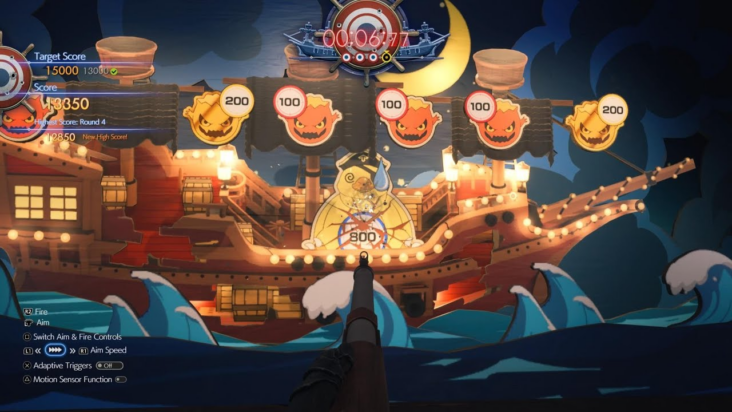
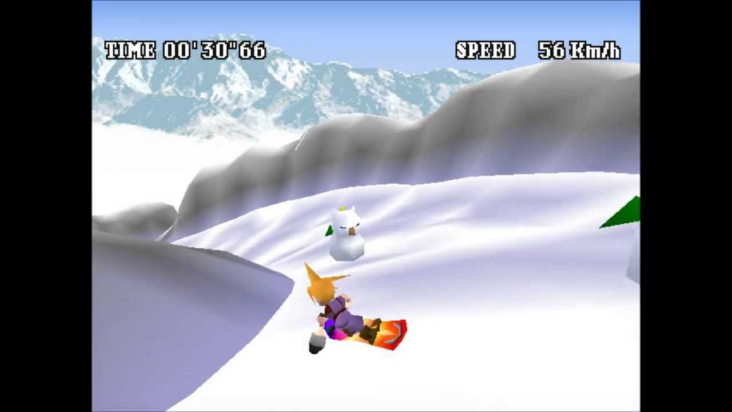
The minigames in Rebirth lean into the absurdity of VII’s lineage. The ones that only show up once, like the dolphin race or the parade, are generally weaker but have the advantage of not giving you time to get tired of them: they appear and then they’re over. It reminds me of how Mario Wonder reviewed a few years ago: each level was a new idea, you completed it, and then you never saw it again. These minigames are plot moments made playable, there’s a reason they’re here. Perhaps not all these plot moments needed to be played. Barrett shooting a box to make Yuffie un-motion sick, for example. But they’re more fun than QTEs, at least. The repeatable minigames have another issue: you are encouraged to do them over and over to get the best prize. They’re often more enjoyable and polished than the one-off ones. But do anything long enough and it will start to get annoying. Even Queen’s Blood gets frustrating when you don’t have the right deck to beat someone and so you have to retry the match 15 times.
Still, the minigames aren’t ubiquitous enough to deserve the amount of negativity they got. They fix a lot of the monotony of the open world, but they’re criticized just as much (or more). Maybe we’re all conditioned to deal with big empty open worlds even in single-player games, and they don’t register as anything other than neutral. Equally likely is that the minigames provoke a reaction: they’re memorable. Even having played this recently, I can barely remember the first two zones at all. But I remember the frog jumping minigame. This is Yelp rules: you remember what made an extreme impression on you.
I recently watched this video on MMOs, and one of my takeaways was that games are scared to leave players hanging. In MMOs, as soon as a player runs out of things to do, they stop paying the subscription fee. You already paid your $70 for Rebirth by the time you start it up. It’s been marinating in the open-world cultural sauce of the 2010s for as long as anyone, however. Its worst decisions make its world big and empty, and fixing that by adding more stuff to it is a risky, and sometimes bad, idea. Yet the way Rebirth’s minigames disrupt the open-world parts by being surprising, janky and often full of character moments is still charming to me more often than not.
Can the Remake trilogy, vastly expanded as it is, be a “good” remake of FFVII? I won’t know for sure until it’s finished. But its minigames show a loyalty to the original that I find sweet. A baffling, hard, thematically inappropriate choice that sucks you in despite yourself: what’s more Final Fantasy than that?
———
Emily Price is a freelance writer, digital editor, and PhD candidate in literature based in Brooklyn, New York. You can find her on Bluesky.

Sign up for the forthcoming weekly Unwinnable digest!