Paranormacrisis
You feel compelled to support great writing…

This column is a reprint from Unwinnable Monthly #199. If you like what you see, grab the magazine for less than ten dollars, or subscribe and get all future magazines for half price.
———
Analyzing the digital and analog feedback loop.
———
When I said I wanted to see more Weird games, I hadn’t meant to focus on a title as literal as Paranormasight: The Seven Mysteries of Honjo but playing this cosmic horror visual novel reminded me that how weirdness manifests is not fixed to specific genres or mechanics. To be clear, I know cosmic horror is the exemplar genre of Weird and the New Weird even, but for Paranormasight it’s less about the genre it evokes and more about how that evocation is persuasive.
At once, weirdness is often orbiting specific tones or modes that amplify the player’s sense of dread or awe. The 360-degree turns a player can make within Paranormasight’s traditionally illustrated 2D environments are key to instilling suspense into every narrative beat of the game’s anxious heart. But these revolutions are also key to signifying to the player the nature of that suspense, one of existing in a state of permacrisis. You are probably instinctually familiar with the term even if you aren’t using it verbally, but permacrisis was chosen as the word of the year in 2022 when many catastrophes were intensifying a global “sense of impending doom” and long-term insecurity. The simple definition of “an extended period of instability and insecurity” speaks to the underlying cause of the more complex state of hypervigilance we find ourselves in four years after the term’s popularization.
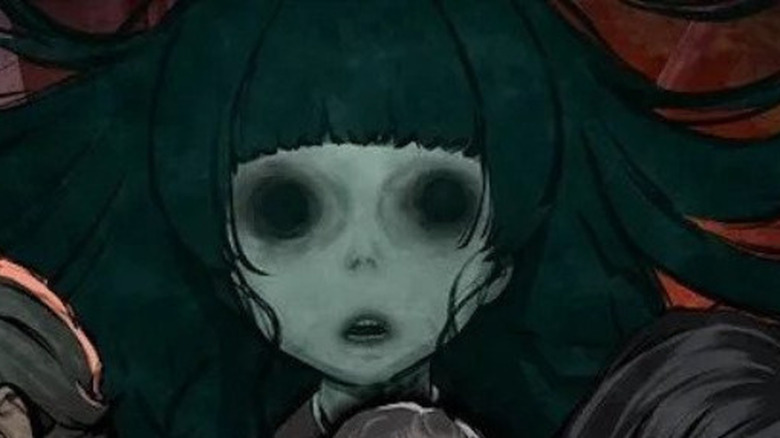
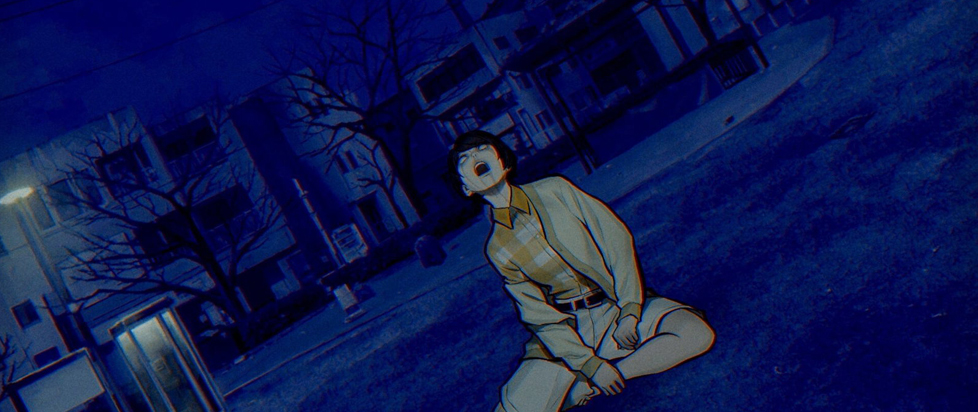
Paranormasight is a New Weird game, set in Japan during the 1980s, which happens to be when New Weird emerged as a genre concerned with the anxieties of urban society. It’s also, deliberately in my opinion, the nascent era of found-footage horror. The game’s prologue goes out of its way to foreground for players the technological locus of the ’80s too – the CRT TV set – to the point of pedantry, I should add. Or at least for those of us from the 19th century. But the Storyteller isn’t the only one to harp on about what a TV set meant in the ’80s either, even characters who avoid watching TV, like grief-stricken mother Harue Shigima, comment on how information is disseminated in an overwhelming fashion by news reports and incessant special programs: “It feels as if all the information in the world gets passed through that little black box.” She also mentions when you first click on the TV in her mansion’s reception room that when the family first acquired the set, they viewed it as a marvel of technology that has since fallen into disuse as the family is fractured from the death of Harue’s son, Shuichi, and the relentless work schedules of Harue’s father and husband. Both are higher ups in the police force and dealing with the shame of failing to save Shuichi from a ransom. There’s also a CRT filter you can toggle on and off to immerse yourself in the headache-inducing ambience of ’80s TV, rendering the game into a found-footage special itself. The game is very deliberate about how experiencing the paranormal is all about belief and perception, how individuals open themselves up to experiences of the extrasensory world.
In an interview with Takanori Ishiyama, the writer and director of Paranormasight’s two entries, “The Seven Mysteries of Honjo” and its spiritual follow-up “The Mermaid’s Curse,” he cited Death Note’s worldbuilding as useful for balancing Paranormasight’s supernatural curses with real-world problem-solving techniques like deduction for its more true crime moments. “[L]ogical mysteries and puzzle-solving are still possible as long as the rules and conditions are clearly defined” Ishiyama explains, sounding like an effective Keeper for a campaign of Call of Cthulhu.
That same interview also mentions something interesting about the camera work between Paranormasight’s two episodes didn’t change. Neither did the character art style which emphasized brush work. “I believe the strength of 2D illustrated characters, as opposed to 3D polygon models, lies in their ability to convey expressions through brushwork, so I did make a conscious effort to use dynamic camera work that featured frequent close-ups of the characters faces.” In addition to this design principle, the game excludes voice acting on purpose for a tighter control on fine details throughout the narrative’s textual elements. There’s a very Kojima-esque stunt involving the game’s audio settings during the early encounters with antagonists of the game that acts almost as a proof of concept in this regard. The reveal of this is so cool that I don’t want to spoil the exact moment this is introduced and a lot of the mystique is achieved by the deep confusion the player will likely experience.
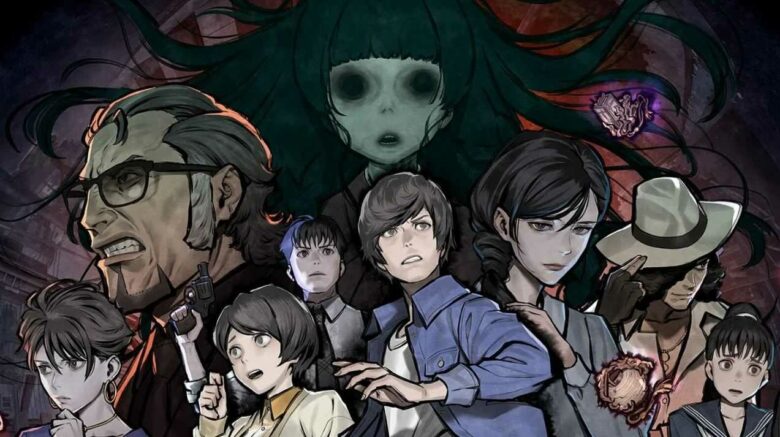
The camera work in The Seven Mysteries of Honjo is what I want to single out because it’s not just about the aesthetics of the New Weird, it’s the central mechanic that interpolates the player between the micro POVs of the individual characters and the limited omniscient one of the Storyteller, who can see the macro perspective of the narrative organized via a slowly unfolding timeline. The player is a semi-separate entity from the members of the game’s cast. The Storyteller refers to the player by the username associated with your saved file or by a chosen name. Similar to Uchikoshi’s treatment of the player in AI: The Somnium Files – Nirvana Initiative (a.k.a. AI:NI for short), the player in The Seven Mysteries of Honjo is a sort of ineffable force, felt but not seen throughout the text. There is a fourth wall break exception in one scene of AI:NI with Mama speaking directly to the player travelling between various points of the event timeline, but in Paranormasight the most recognition I’ve had by characters dealing with the seven curses is wonder that something intervened to save them or reunite them with characters they needed information from at just the right time of a certain day. This ineffability is related to the sort of telesthesia I looked at in older games grappling with how our sociality has rapidly shifted and adapted with our technological developments in mass media, for better and for worse.
Despite being capable of a sort of divine or supernatural intervention for the cast, the player via the 360-degree camera must remain paranoid of their surroundings and the positions of more hostile characters and vengeful spirits in the plot. You are also afforded increasing amounts of info in your glossary or “Files” as it’s referred to in the game’s terminology (which also gives your role a sort of X-Files framing of surveillance). But you often become aware of these files’ details at the same time as the characters do. In Paranormasight private information is power and characters like the eccentric independent investigator Richter Kai impress upon others the need to keep as much personal information safe as possible during the uncertainty of the crisis of Honjo being infested with curses.
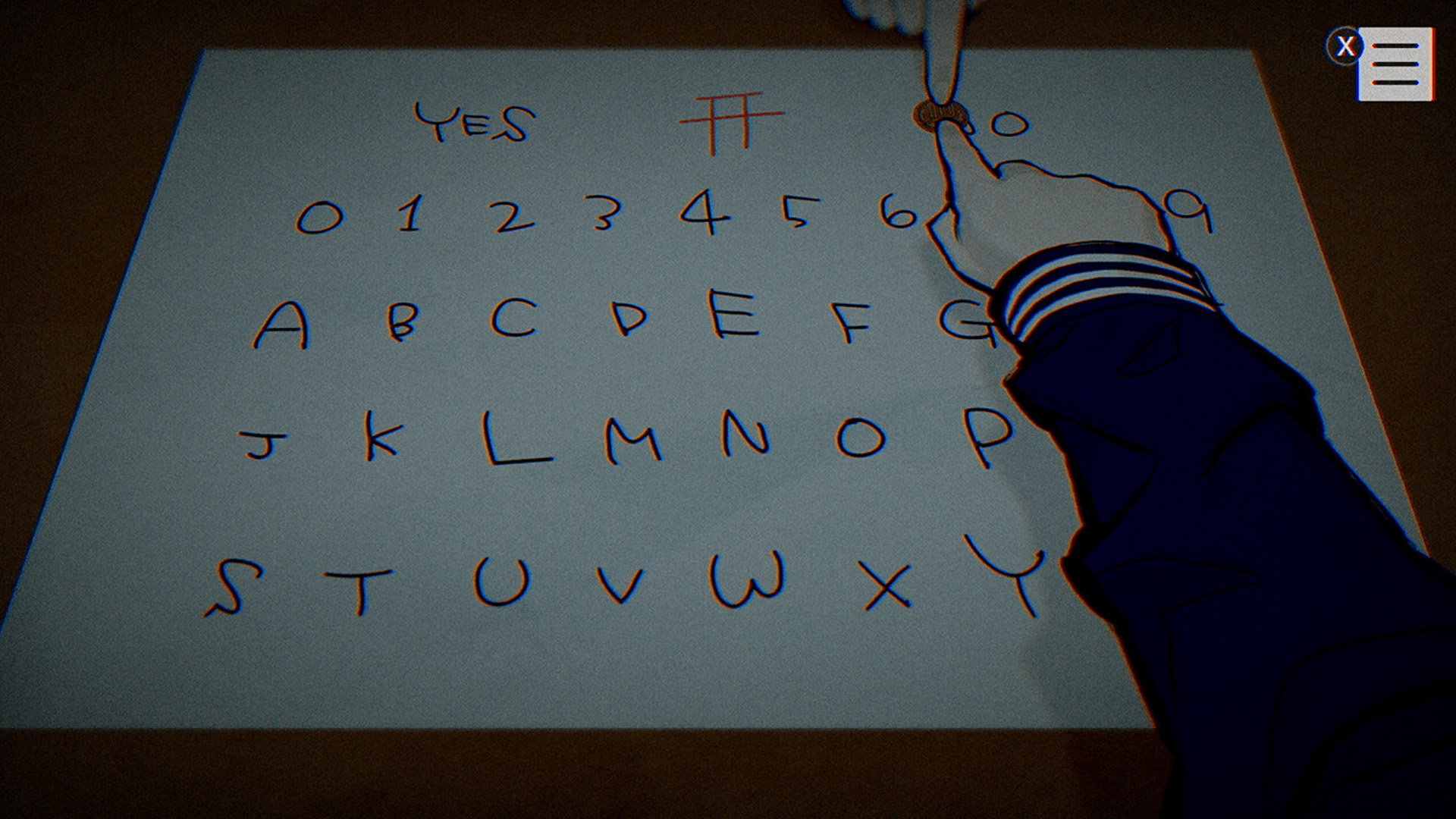
The most effective way I’ve come to characterize the Weirdness of the camera work in Paranormasight is through the lens of permacrisis. Being in permacrisis is as much physical as it is psychological. As is discussed in an interview with debut author Tara Menon whose novel Under Water explores ecological permacrisis and how we’re collectively impacted by climate change, existing in this state of endless uncertainty is not really about impending doom (as the initial Collins dictionary definition describes). Rather, it’s closer to the Cambridge dictionary’s definition of the term, which characterizes the uncertainty as ongoing “suffering”. Menon’s novel is in some ways a response to arguments made in Amitav Ghosh’s influential work The Great Derangement regarding how climate change is irrevocably changing storytelling. By telling Under Water’s story via the climate catastrophes of two different decades, the main character Marissa and her friend Arielle are persistently haunted by the “slow violence” Menon references of South African professor Rob Nixon’s work on the environmentalism of the poor. Menon’s explanation of permacrisis is that disasters have already happened and will continue happening as we reckon with the way forward collectively, while analyzing our systemic eco-violence with hindsight.
The permacrisis experienced in Paranormasight is akin to Menon’s, because it’s slow violence of past sufferings related to the seven curses of Honjo, causing uncertainty in the present which is also haunted by the psychological wounds of post-war era Japan. Honjo used to be an abundant agricultural area in feudal times when the curses were first inflicted upon the area. Those curses revolved around the belief that resurrecting dead loved ones or oneself is possible if you reap enough “soul dregs” from others. These curses entangle with the degradation of Honjo’s current environment from industrialization and a serial killing case that is as much about resurrecting the past as it is about post-war legacies of despondence and financial insecurities amongst the working classes.
Each of the characters in The Seven Mysteries of Honjo have a personal crisis that gets enfolded in the malaise of Honjo’s permacrisis. Everyone, including the player, must look back and forth constantly between the suffering of the past and how it translates into the present. The camera work of the game and its interactive timeline makes you perform hypervigilance as you seek a way to muddle through the murkiness of permacrisis. The only way you progress in Paranormasight is by understanding that you only have your perspective and the way to find more stability is by helping people share their unique perspectives and perceptions of the permacrisis with each other. Those who doggedly pursue their singular perspective, like Shogo Okiie, are truly doomed because they discount the perspectives and by extension the humanity of others’ positions. Although perhaps that’s unfair, since Shogo is also being influenced by the grudge of the curse he harbors. All the curse bearers gain their curse because they desire to resurrect someone after all. It may be more accurate to say that those who are too haunted by permacrisis are made desperate, which makes them isolated and, ultimately, more vulnerable.
———
Phoenix Simms is an Atlantic Canadian cryptid who is a freelance writer and the co-editor of The Imaginary Engine Review a.k.a. TIER. You can lure her out of hibernation during the winter with rare SFF novels, ergonomic stationery, or if all else fails, gourmet cupcakes. Or you can just geek out with her where skies are blue.