Memory Games
Visit the MIT Press shop
This column is a reprint from Unwinnable Monthly #197. If you like what you see, grab the magazine for less than ten dollars, or subscribe and get all future magazines for half price.
———
Interfacing in the millennium.
———
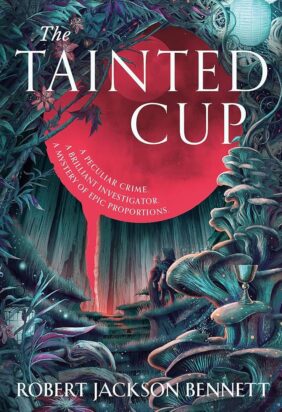
So, here’s the thing. I went into Robert Jackson Bennett’s The Tainted Cup thinking I was going to get a nice little fantasy Sherlock Holmes pastiche. It does do that a little bit. What it does more of, though, is a less nice (belabored) not very little (dense, confusing) Nero Wolfe pastiche. All my apologies to Robert Jackson Bennett: he did not know how badly that fact was going to doom it for me. But I made it through and, as one does, came out with thoughts.
In the Nero Wolfe novels – of which there were 33 books published over 40 years — the eponymous detective is a homebody and an eccentric whose pleasures in life are food, orchids and books. He rarely leaves his house, conducting his detective business chiefly within the walls of his New York brownstone; this lifestyle is enabled by Archie Goodwin, his man-about-town and narrator of the novels, who does the legwork of information gathering and gallivanting about before bringing his finds back to Wolfe to solve. They’re cheeky and charming; I highly recommend them; let’s move on.
On paper, the primary relationship of The Tainted Cup is extremely similar to that of Wolfe and Archie. The narrator of the book, Dinios Kol, is tasked with wandering the cities and investigating crime scenes in order to bring clues back to his boss, Ana Dolabra, who does the real deducing. Ana, like Wolfe, is a housebound eccentric, and so Din consequently steps into the role of Archie, both as narrator and as the active partner in a deductive relationship.
This doesn’t work for a couple of reasons. The Wolfe novels are written in a very thick character voice, which gives a level of vividness to Archie’s narration that Din doesn’t really approach. Ana’s eccentric detective business takes place in the middle of a convoluted military-bureaucratic hierarchy, so her and Din’s responsibilities and permissions are often obscured by secondary universe lore. I never felt that Ana’s personality got much past “manic pixie dream detective,” or that Din’s got past “guy who doesn’t know what’s going on.” My biggest peeve with The Tainted Cup‘s take on this relationship, though, is with Din’s memory – or lack thereof. Let me explain.
It is a very important part of the Nero Wolfe books that Archie has an incredible memory. They wouldn’t work without it: Archie’s memory is the reason he’s able to report to Wolfe, in detail, about things that Wolfe has not seen, heard or experienced. Wolfe’s deductive capacity rests, in no significant part, on the accuracy of this memory, and of Archie’s willingness to employ it. It’s a trained skill, one that is exceptional but not impossible, and it’s key to his character and his relationship with Wolfe.
In The Tainted Cup, however, there is an in-universe justification of Din’s memory: he’s an engraver, a magically altered person with the capacity to remember and recite, in detail, everything they have seen or experienced, during a trancelike state that they trigger with scented vials. His engraver’s memory is infallible, and though there are small hiccups because of his hidden dyslexia, he is mostly able to provide Ana with the exact detail of his experiences for her to sort through. His memory is unconscious, borderline involuntary and machinelike. Honestly, it’s really not his at all.
This stressed me out. I had never even thought about the narrative implications of Archie’s memory until I saw such a vastly different take on it, one that I found for multiple reasons much less effective.
One, the mere fact of Archie’s memory does a lot of work to inform his character. It’s a complex skill trained over time, with lots of room for error, that he uses consistently, accurately and easily: therefore it establishes him as a committed individual that takes his job seriously and has for a long time. This aspect of his character intentionally contrasts with his narration, which is snarky and irreverent, and his outward personality, which is cocky and pointedly careless. It grounds him and gives his interactions with the world more weight, as long-term readers get used to the fact that what may seem like a pointless detour on Archie’s part is instead grist that he’ll bring back to Wolfe’s mill. It also gives him that hint of protagonist shine to match Wolfe’s impressive deductive skills, keeping him one step ahead of the characters around him and keeping him interesting to the reader.
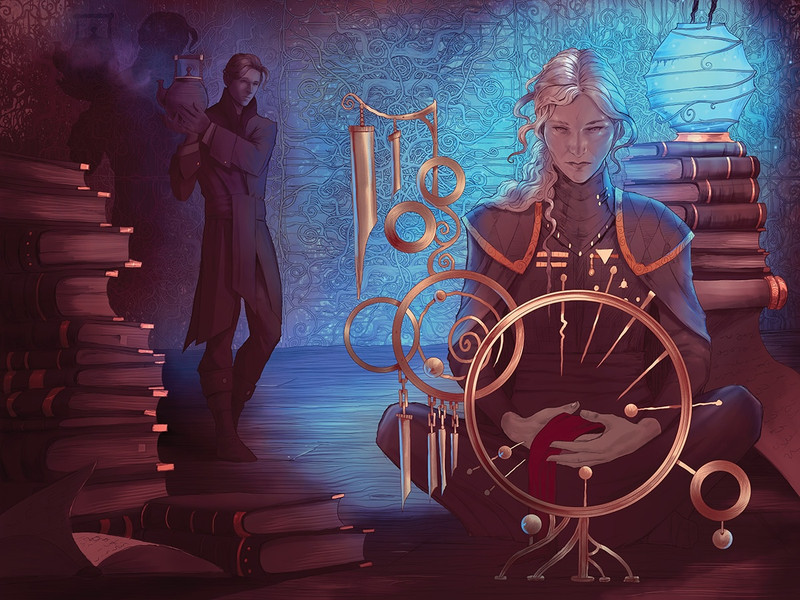
Two, Archie’s memory is a key tenet of his relationship with Wolfe. Wolfe’s trust in Archie is absolute, to the point that his perception of the events of the world outside his home is filtered almost entirely through Archie’s eyes. Wolfe as a character can’t exist, in all his solitary eccentricity, without Archie to bring the world to him. It is not only that Wolfe trusts Archie’s memory, but that the trust of his memory is never even brought into question. The relationship between their characters would be entirely different without Wolfe’s faith in Archie and understanding of his skill. (Also, the basic premise of the books wouldn’t work.)
So, then what’s the point of Din’s altered memory in The Tainted Cup, besides as a plot device to allow Ana to stay safely at home? It says nothing about his character, his motives or ambitions or capacities, as there are many engravers in the world that all function in basically the same way as him. It doesn’t impact his relationship with Ana, besides making him useful — there is no need for trust from her side, as the engraver trance does not seem to allow for lying, and from his side, he’s participating in his recollection of events in a way that is basically involuntary. And there’s no real reason for Ana’s engraver to be Din, despite the story insisting on pretending that he’s something special, because all engravers do the same exact thing. I would actually argue that the engraver concept undermines Din’s ability to come across as a character equal to Ana, as the entire idea means that the character never needs to acquire any actual talents.
Anyway, I’ll stop being a hater. The shallowness of Din’s role in The Tainted Cup served mostly to make me realize that I take for granted the elegance of character in what I think of as my goofy comfort mystery series, and that I find it jarring when books (or movies, or games, or any other sort of narrative media) don’t feel like they’ve thought all the way through the roles of their characters. Especially in a mystery, characters are developed by their functional interactions with the world. When those interactions feel unintentional or pointless, it undermines those characters. I think there’s a version of The Tainted Cup that worked, but unfortunately, as it stands, Din felt undermined.
———
Maddi Chilton is an internet artifact from St. Louis, Missouri. Follow her on Bluesky.