Being a Samurai is a Thankless Task: Eiichi Kudo’s Samurai Revolution Trilogy
Visit the MIT Press shop
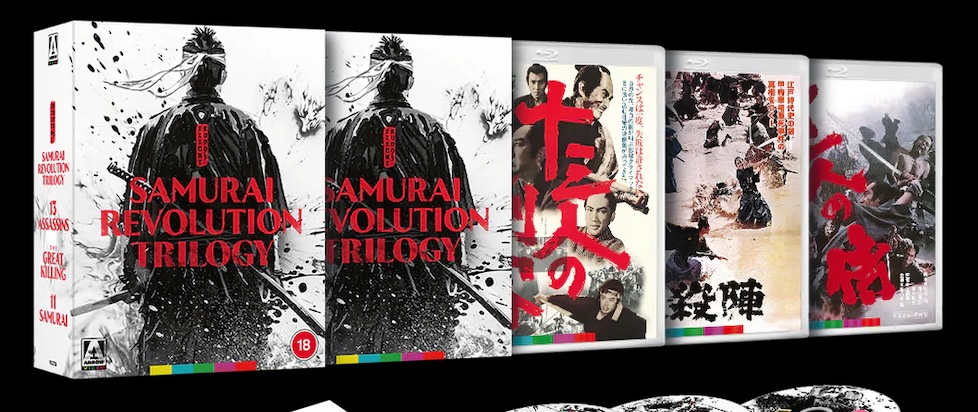
IMDb credits Eiichi Kudo with directing something like seventy projects, most of which are what’s known as jidaigeki films – Japanese period dramas, mostly set during that country’s Tokugawa Era, which ran from 1600 until 1868. Outside Japan, we tend to think of these types of films as “samurai movies.”
Of these, three of the most famous, at least here in the States, are the ones contained in this new Blu-ray set from Arrow. Only retroactively considered a trilogy, these three films, released between 1963 and 1967, came at a time when the jidaigeki genre was in decline.
Like the Hollywood western, samurai films had once dominated Japanese cinema. By the 1960s, however, they were being replaced in popularity, just as the western had fallen out of favor with American audiences.
As such, these three films number among the post-war samurai movies which Alain Silver cites in his 1977 study The Samurai Film as “dark, nihilistic motion pictures which re-paint Japan’s past in blacker hues,” often focused on the “ultimate impotence of […] violence.” That is certainly the case with the flicks contained in this loose “trilogy,” pictures where violence is often the only solution – but never a good one.
“My understanding is a man’s life weighs more than anything and is irreplaceable.” – 13 Assassins (1963)
I have seen only a tiny fraction of the more than one hundred movies directed by prolific Japanese auteur Takashi Miike but, of those, 13 Assassins (2010) is almost certainly my favorite. I was not aware until well after I watched it that it was a remake of this influential 1963 jidaigeki. Even then, I couldn’t have guessed how close to a beat-for-beat remake it really is.
Miike even casts actors who mostly look like the ensemble in the original film, making it an uncanny experience to pay a visit to this black-and-white flick after watching Miike’s version more than a few times. There are differences, of course. Miike’s 13 Assassins runs about twenty minutes longer and, as you might expect, is a whole lot bloodier and occasionally more absurd. But really, all the beats are here.
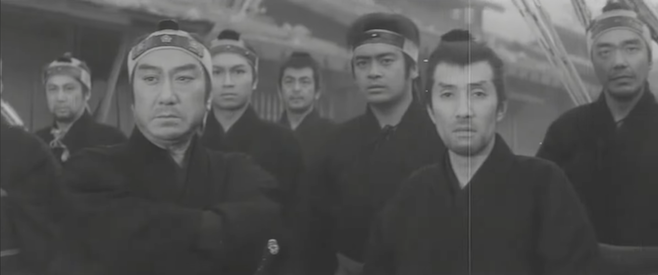
What impressed me most about Miike’s version is the way it manipulates the audience’s investment in its inevitable violence. It sells us first on the necessity and desperation of its central mission, convinces us of the worthiness and judiciousness of our protagonist, and communicates in no uncertain terms that its brutal and sadistic villain must die.
It builds in aching increments to the final confrontation, in which an entire mountain town is turned into a deathtrap for the daimyo and his retainers (200 in Miike’s version, 52 here). When the violence finally erupts, it is welcome, celebratory – at least at first. Then it begins to drag out, until it, too, becomes almost unbearable, so that when the final blow comes, there is no triumph in it.
Does Kudo’s original do the same thing? Perhaps not to the same extent as Miike’s – who, after all, had this to build off of – but it comes surprisingly close.
“Before throwing your life away, think about what it could be used for.” – The Great Killing (1964)
Any deficit in grueling violence that may have existed in Eiichi Kudo’s 13 Assassins is more than made up for in its immediate follow-up. The plot of The Great Killing is similar to that of its predecessor, only this time, the mission has already failed before it even begins; the conspirators rounded up, killed, and tortured, until only a few haunted, hunted individuals remain.
There is no honor or glory in the violence here. There is barely even victory and, when it does come, it comes only at the last possible moment, and at the most terrible cost. And the people who made it possible have already died believing that they failed.
Filmed via a combination of chaotic hand-held shots and long takes where the combatants are so far away and so jammed together that they become functionally anonymous, the violence in The Great Killing is always a jittery miasma of mud and blood and desperation.
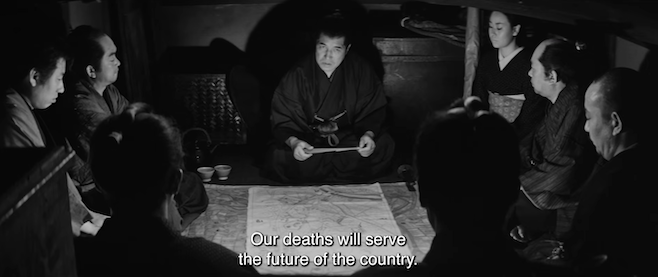
Even our conspirator protagonists are shown in a far from flattering light. Rather than the principled samurai of 13 Assassins, the would-be revolutionaries who remain in The Great Killing are mostly a gaggle of cowards, rapists, lunatics, and wastrels. Broken men (and one woman) who know that they are doomed even before they begin, and yet go on anyway.
It’s a harrowing film that ends on a bleak note, but what might be its most haunting moment comes before the violent climax. Perhaps the best of the conspirators is a cheerful family man. We have met his wife and passel of children – and we see them meet their grim fates at his hand before their father goes off to meet his own. It may be the starkest reminder in the entire series that these individuals have no future, even if they succeed. There is no happy ending waiting for them; only death, or something to which death would be preferable.
“Nothing will ever change as long as the rich and powerful exist.” – 11 Samurai (1967)
The bloodshed is at least incrementally more heroic in Eiichi Kudo’s 11 Samurai, the last and most elegiac film in this unofficial trilogy. The stakes are similar, however, and the outlook for our heroes is no more rosy.
When a cruel lord murders the head of another clan, he not only gets off scot-free because of his relationship to the shogun, the incident is actually blamed on the slain man and his clan is threatened with dissolution. Naturally, several of the samurai of that clan aren’t inclined to take this lying down, and a conspiracy is hatched to, you guessed it, ambush the megalomaniacal lord and take his life.
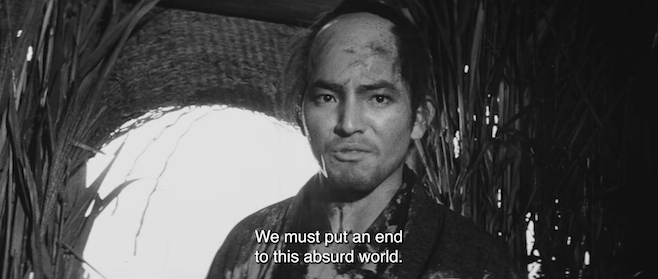
An interview on the Arrow Blu-ray set argues that this film is a way of saying goodbye to an era of jidaigeki. Whether that’s true or not, 11 Samurai is definitely more melancholy than the brutal films which preceded it, even while it is also probably the goriest of the three.
It also makes clear, perhaps more so than any other movie here, that the death of one man, while necessary, will not actually solve the problem. The real problem is not that the cruelty of one man could upend or destroy lives with impunity – it is the system that allows such men to exist and wield power, that insulates them from consequences.
Killing one man may strike a weakening blow to this system, but it will not bring it down. Still, it’s all that our protagonists can do, and even that will cost them everything. “Let’s spit our hatred on the government!” one samurai says, before the film’s bloody denouement. Sometimes, that’s all that’s left.
———
Orrin Grey is a writer, editor, game designer, and amateur film scholar who loves to write about monsters, movies, and monster movies. He’s the author of several spooky books, including How to See Ghosts & Other Figments. You can find him online at orringrey.com.