You Must Learn to Like Men: Why Red Sonja (1985) Is the Way It Is
Visit the MIT Press shop

“If you only yield to a conqueror, then prepare to be conquered, little Sonja.”
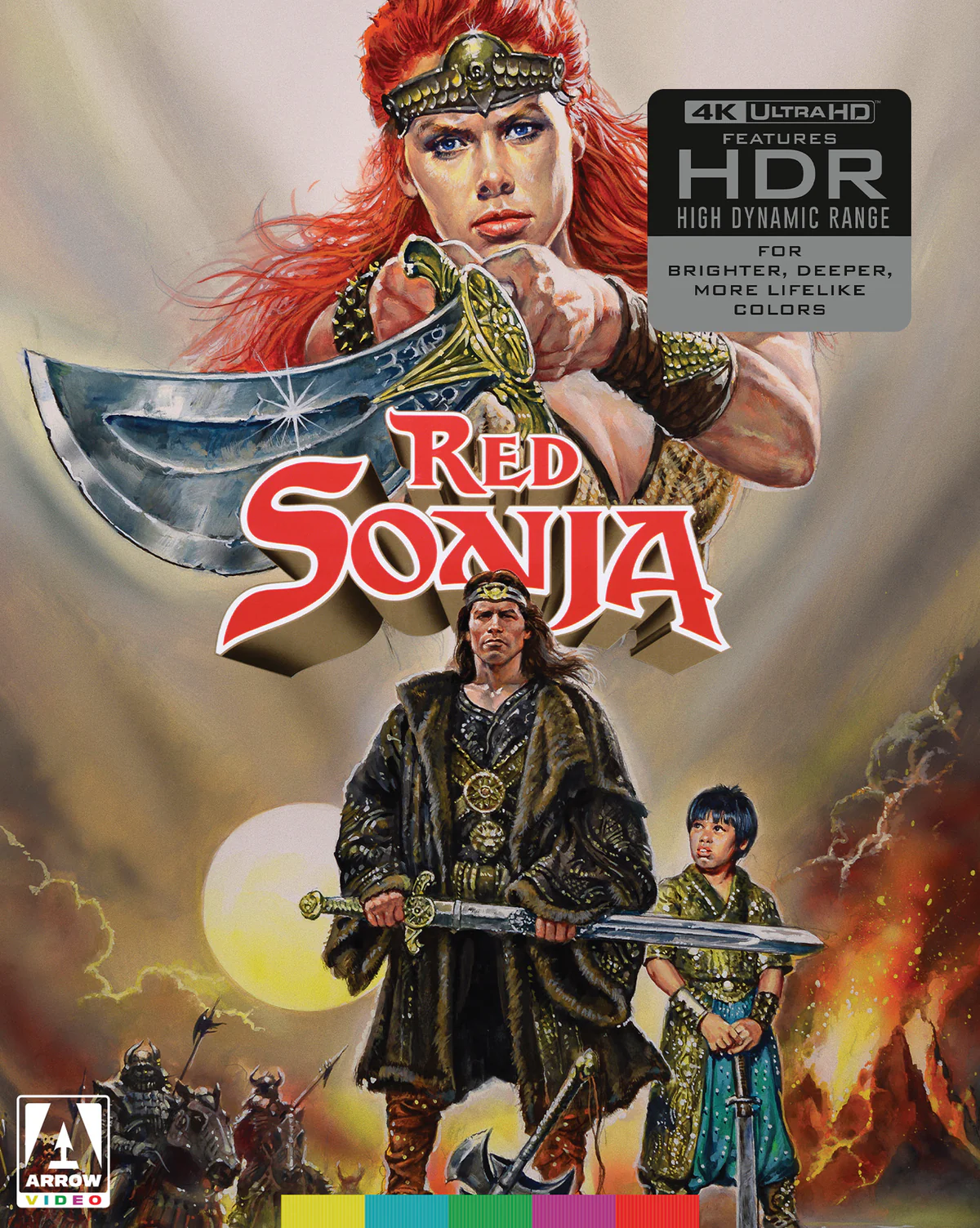
Somewhere, possibly buried amid the various special features on the new 4K from Arrow Video, there is the story of how Red Sonja came to be what it is. Though ostensibly adapted from the Robert E. Howard character Red Sonya of Rogatino, whose only appearance is in the 1934 historical fiction short story “The Shadow of the Vulture,” our cinematic Red Sonja actually owes her origins to the Marvel Comics character created by Roy Thomas and Barry Windsor-Smith, whose chainmail bikini is more famous than most human characters ever will be.
The script for Conan the Destroyer is credited to Stanley Mann, whose other films include Firestarter, Omen II, and The Collector, among others. The story, however, came partly from Roy Thomas, the co-creator of Red Sonja. Which makes it particularly strange that the 1985 Red Sonja film is not, in fact, a direct sequel to either of the previous Conan pictures, and while Arnold Schwarzenegger is back, he’s not playing Conan this time, but rather a character named Kalidor, who is basically Conan with the serial numbers filed off.
The explanation probably lies with who held the rights to Conan at the time. While all three films were produced by Dino De Laurentiis, both Conan films came out through Universal Pictures, who still held the film rights to the character in 1985. Red Sonja, on the other hand, was released through MGM – meaning that Laurentiis didn’t have access to the character rights for Conan, and had to make this a Sharp Hand Joe equivalent.
Though it can’t use the name, however, Red Sonja still links itself to Robert E. Howard, and states that it takes place in the same fictional Hyborian Age as Conan’s exploits. It also shares plenty of offscreen DNA with Conan the Destroyer, besides the return of Arnold Schwarzenegger.
Also here is Sandahl Bergman, who played Valeria in Conan the Barbarian. Allegedly, Bergman was originally offered the role of Sonja, but turned it down to play the evil Queen Gedren instead – a role which she, admittedly, seems to have a lot of fun with.
Instead, Sonja is played by a newcomer, Danish model turned actress Brigitte Nielsen in her first role. The same year that she played Red Sonja, Nielsen married Sylvester Stallone and subsequently acted with him in both Rocky IV and Cobra, not to mention playing the leggy villainess in Beverly Hills Cop II. In 1991, she very nearly essayed the title role in a planned She-Hulk film that never materialized.
Behind the camera, Red Sonja is directed by Richard Fleischer, who also helmed Conan the Destroyer. My instinct would be to say that this is an ill omen for the movie, given that I didn’t care much for Conan the Destroyer, but in-between when I last saw that picture and when I watched this one, I saw Fleischer’s 1968 film The Boston Strangler, which is honestly a masterclass, so I’m tempted to lay the blame elsewhere.
For that, perhaps, I should look to the script. One half of the credited writing team was Clive Exton, whose filmography includes 10 Rillington Place, Doomwatch, and The House in Nightmare Park. I haven’t seen most of his pictures, but that seems sound enough.
The other half of the team may be more instructive, however. George MacDonald Fraser is one of the writers credited with the 1983 James Bond picture Octopussy, as well as the only credited writer on the absurdist 1973 version of The Three Musketeers, which has the tagline, “One for all and all for fun!” I’ve never actually seen the ’73 Three Musketeers, but someone on Letterboxd called it “Pirates of the Caribbean if everyone acted like Johnny Depp.”
All this plus a PG-13 rating (the rating having been introduced the previous year, just too late for Conan the Destroyer to take advantage) may go at least some distance toward explaining why Red Sonja is the way it is.
Like that film, there are plenty of attempts at broad humor here that seldom work, many of them provided by a very young Ernie Reyes Jr. (at the time, he would have been around twelve or thirteen), five years before Teenage Mutant Ninja Turtles. There is perhaps some irony that the diminutive Reyes is probably the most credible fighter in the cast.
The bigger problem, though, belongs to Sonja herself. Nielsen was nominated for both Worst Actress and Worst New Star at the 6th Golden Raspberry Awards that year and, indeed, she delivers most of her lines as though she is saying them phonetically. In an archival interview included in Arrow’s 4K, assistant director Michael Ferry describes Nielsen’s Red Sonja as “like the physical embodiment of a character.”
If Nielsen’s performance is partly at fault, however, it may be more damning how often Sonja gets sidelined in her own movie. “Kalidor’s part was that of a supporting role,” Ferry says, describing Schwarzenegger’s character. “Then, his presence grew stronger.”
Perhaps it was a desire to highlight a more bankable star in Schwarzenegger – who, after all, receives equal billing and a bigger portrait on the film’s poster – but while Nielsen’s Sonja seems perfectly capable of taking care of herself, she is nonetheless constantly being rescued by Schwarzenegger’s Kalidor. It doesn’t help that people around her are basically always telling her the equivalent of that she should smile more.
“Hatred of men in a lovely young woman,” laments the master who instructed her in sword fighting, immediately after declaring her the best he’s ever trained, “it could be your downfall.”
Unlike Conan, Sonja doesn’t even get to be a great warrior on her own merits. Her fairy godmother instead does that for her, one of many facts that goes largely unmentioned later in the picture.
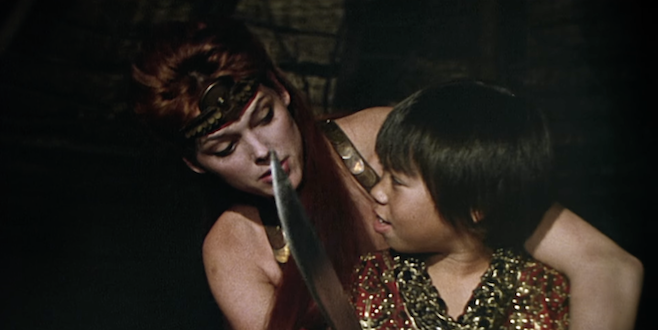
Just as surely as the film seems somewhat schizophrenically divided between Sonja and Kalidor, it also seems pulled in two directions by its story. Before the credits even roll, Sonja is given a homophobic rape backstory in which she rejects the lesbian advances of the evil queen and is then gang raped by the queen’s soldiers – all of this delivered like a “last time, on Red Sonja” episode synopsis.
There’s basically no reason for any of it, however, as the queen gives plenty of other cause for Sonja to come hunting her down when she absconds with a magic artifact that will destroy the world in thirteen days, and kills a woman who is apparently Sonja’s sister in the process. It feels very much like two different plots that got haphazardly tied together, and like almost everything else about the movie, the two never sit comfortably side-by-side.
Some things work, though. The score is by Ennio Morricone, and while it’s not up to the standards of the legendary Basil Poledouris score from Conan the Barbarian, it’s still good. Better are the many matte paintings, models, costumes, and sets. “The set decorator was Danilo Donati,” recalls Ferry, “also set decorator for Fellini, and everything went over the top.”
As he’s saying that, the featurette on the Arrow 4K shows a room filled with hundreds of candles. It’s just one of the many times the sets in Red Sonja go way harder than they need to. See also the evil queen’s throne room, which includes innumerable gilded skeletons, and a giant pet spider that inexplicably purrs, shown in only one scene. (One has to wonder if this provided partial inspiration for Baron Harkonnen’s weird pet spider in Denis Villeneuve’s Dune.)
“We knew that we were not shooting a great movie,” Ferry says, “but everything that Donati said or did was a work of art.” Red Sonja certainly is not a great movie, but thanks to the work of Donati and the various other matte painters, sculptors, model builders, and so on, it sometimes looks like one.
———
Orrin Grey is a writer, editor, game designer, and amateur film scholar who loves to write about monsters, movies, and monster movies. He’s the author of several spooky books, including How to See Ghosts & Other Figments. You can find him online at orringrey.com.