Zarvot, Intimacy, & The Limits of Politeness
Visit the MIT Press shop
Individualization and atomization abound. The feeling of community, belonging, and solidarity with would-be strangers has been replaced with paranoiac isolation, especially for those terminally online. Even amongst friends, encounters are often confined to a vacant notion of civility – the rehearsal of a script. Theatrical reproduction supersedes the compulsion to repeat that which grounds the bonds of friendship.
Communication is always mediated through a failure, an excess or lack which disturbs our message and clouds our meaning(s). So how do we respond when a struggling friend says “don’t worry about me”? Should we simply tolerate their vaulted insecurity, fearing the rupture of our fragile relationship if they view our interventions as too insistent? At what point, then, does keeping a “respectful” distance transform into implicit consent for the ideology of personal responsibility so that we shoulder our problems alone? What room is there for courage and solidarity, which involves internalizing responsibility for the struggles of others, to support those who cannot advocate for themselves?
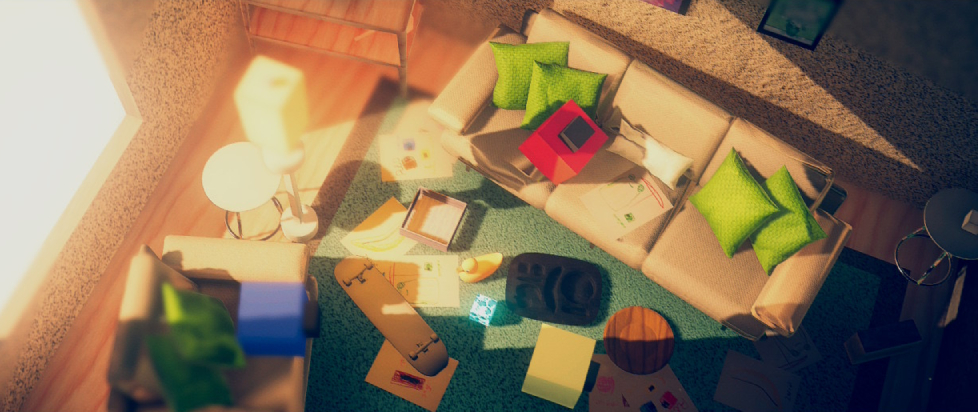
Sam Eng’s Zarvot is ostensibly a game about cubes. It is also a game whose seduction engenders our reception to its deeply personal, surreal story of life in a modern city. The experiences exhibited in Zarvot are human in that they allude to meaning and translation. And yet the game resists full comprehension or programmatic universalization. Its strength is its singularity – its irreducibility is at the heart of its seductive power.
Sublime Aberrations
This world of cubes is resolutely distinct. Eng produces three-dimensional dioramas that establish and surround the linear hallways of playable space, ranging from abstract, minimalist representations of concepts to dense and detailed metropolitan spaces filled with mossy bark strangled by concrete and glass. There is love here, of both nature in its “pure” form – messy, layered, spontaneous, and of urbanity – structured, polished, sterile. The exaggerated use of lighting and depth of field produces a dynamic reactivity in atmosphere and tone. Speech bubbles cast shadows on characters and vibrate subtly, as if humming along to their own beat. North Tox Docks evolves from a wood textured boardwalk with rays of neon light blooming from its borders to a winding voxelated pier as you weave between shipping containers surrounded by crystalline glaciers and shimmering particles.
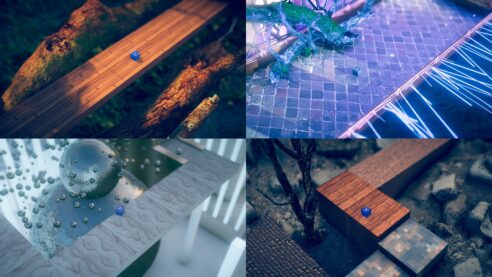
The atmosphere of each place is defined by the interplay between the rich soundtrack and these multiform visuals. Ripe Taffy by John Fio accompanies the luxuriously adorned main menu, marble slabs layered on a desk surrounded by models of the objects you encounter throughout the story, like a well-used toy box bursting with the possibilities it contains. Happun Forest greets you with the percussive propulsion of Voxelfall by Lazerwolph. While gnarled synths and guitars pass the melody back and forth, warped and twisted trees emerge from the swampy, glistening mineral residue of the surface below. Wizard Farm’s instrumentation in My Head is Disappearing drives you forward with the echoes of chimes and bass, while you navigate your way through a torrent of rain as the screen is covered with moisture like the windshield of a car.
Every element of the game’s aesthetic presentation contributes to its overwhelming allure. Zarvot draws the player in with its sheen; its flashy, thumping style inundates you with the desire to be in close proximity to its singular vision. We as the player are drawn to it, just as Zarvot’s enemies are magnetically pulled toward your character. As in relations between people, there’s an anxiety underpinning this desire – of wanting to embrace, to feel another, while knowing that reciprocity is not guaranteed. This mirrors the degree of risk involved in artistic expression. There is a fine line between pouring too much of yourself into your process, and the ability to deliver a work that feels laden with meaning: personal and intimate, aloof and seductive.
Conflict & The Prospect of Vulnerability
The opening track, Scenes from a Midnight Movie, from Blood Cultures’ debut album ends with a voicemail being left to a friend: “Just called to wish you Happy Birthday”. This nominal “presence-present” grounds the plot in Eng’s Zarvot. Charcoal and Mustard, the cubes which make up two-thirds of a trio of temperaments, are on a quest to finish a birthday gift for their friend Red. After a skateboarding accident which spoils their efforts, the two cubes show up to Red’s empty-handed. Appreciative of their silly remedial gesture, Red admits how isolated they’ve been feeling lately. Responding earnestly, Charcoal insists on providing them with whatever support they need. It is at this stage where the gap between Charcoal’s cordial yet naive nature and Red’s shame and insecurity reaches its apex. Adamant, Charcoal and Mustard obsess over what item or thing could resolve and reassure Red, forgetting the element of being-with that forms the basis of connection. And so begins Mustard and Charcoal’s misguided adventures to recreate their gift-assemblage in hopes of bringing light into their friend’s life.
When Zarvot was originally published in October 2018, I was between hospitalizations for my mental health. I felt, as Red does, unable to articulate the type of support I hoped for from my friends for fear of being seen as an unnecessary appendage – not worth the weight I was afraid to ask them for help to carry. They were good friends who remained present in my life even if I was unwilling to rely on them as much as I needed. Charcoal and Mustard do the same for Red, continually checking in with them at the end of each chapter, even when they are locked out and ignored. At several points, they encounter Red sealed in a jar, unable to recognize how this reflects Red’s tendency to bottle up their emotions and disconnect from the world.

The events of the game culminate in a dream-like sequence where Charcoal, after fighting through waves of billowing red shadows, confronts Red in an explosive duel. In the aftermath, Red is able to admit the severity of the insecurity which has been weighing them down. In their self-imposed isolation began spiralling fantasies of being unwanted or undeserving of companionship. Red recognizes their need for proactive and explicit invitations rather than open-ended inclusion – an honest vulnerability from Charcoal that was missing prior to this encounter.
Therein lies the limitation of politeness: the usual liberal supportive script fails at the point where someone who is struggling cannot advocate for what they need. There is a messy balance to be found between expressing openness and engendering the conditions which allow people to seek help. Vulnerability and courage is required on both sides. I am lucky that my friends stuck around long enough for me to feel safe expressing myself, and, in turn, I try my best to recognize when they are leaving something unsaid. Being assertive, willing to push and inquire deeper into complicated situations is quite like the danger of exposing oneself through their art. And yet we owe those struggling to do what we can to create relationships and spaces where intimacy and honesty is the rule rather than the exception.
Since first playing Zarvot in 2018, I have played many games I’d call masterpieces. And yet this weird, absurd, stylish, raw-yet-refined experience by Sam Eng has remained one of my favorites. Eng’s next game has already impacted me – I’m now a frequent listener of Blood Cultures thanks to their collaboration. But beyond what I expect to be a stellar soundtrack, I also can’t wait to see the ways that Skate Story builds on the novel and resonant Zarvot: A Game About Cubes.
———
Christopher Spina lives in Toronto with his partner and their cat. When he’s not grumbling about capitalism to any and everyone who will listen, you can find him attempting to combat the endless waves of eSlop through curating games and writing short-form reviews here.