1997 – 2020
Visit the MIT Press shop
This column is a reprint from Unwinnable Monthly #198. If you like what you see, grab the magazine for less than ten dollars, or subscribe and get all future magazines for half price.
———
Kcab ti nur.
———
Greetings time travelers, this month we find ourselves lost in the mire of myth and mako, and lost between the timelines in the world of Final Fantasy VII and its remake. Hold on to your hats as we explore rupture, explosions and the worlds they bring into being.
THE BOMB + FINAL FANTASY 7
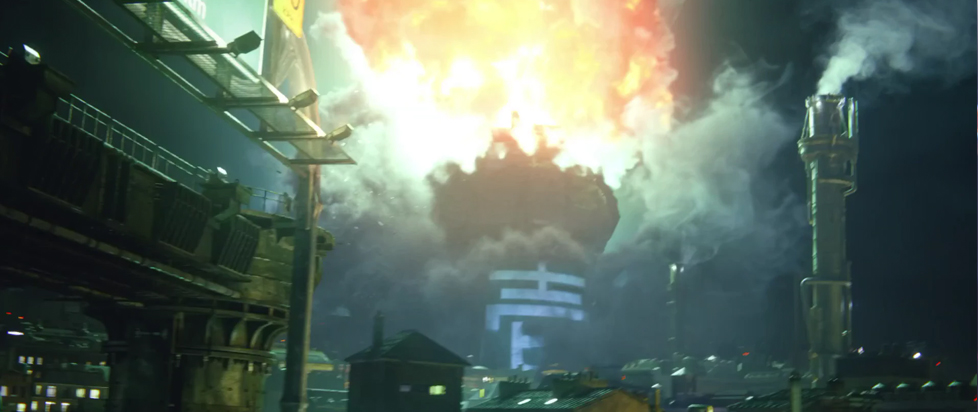
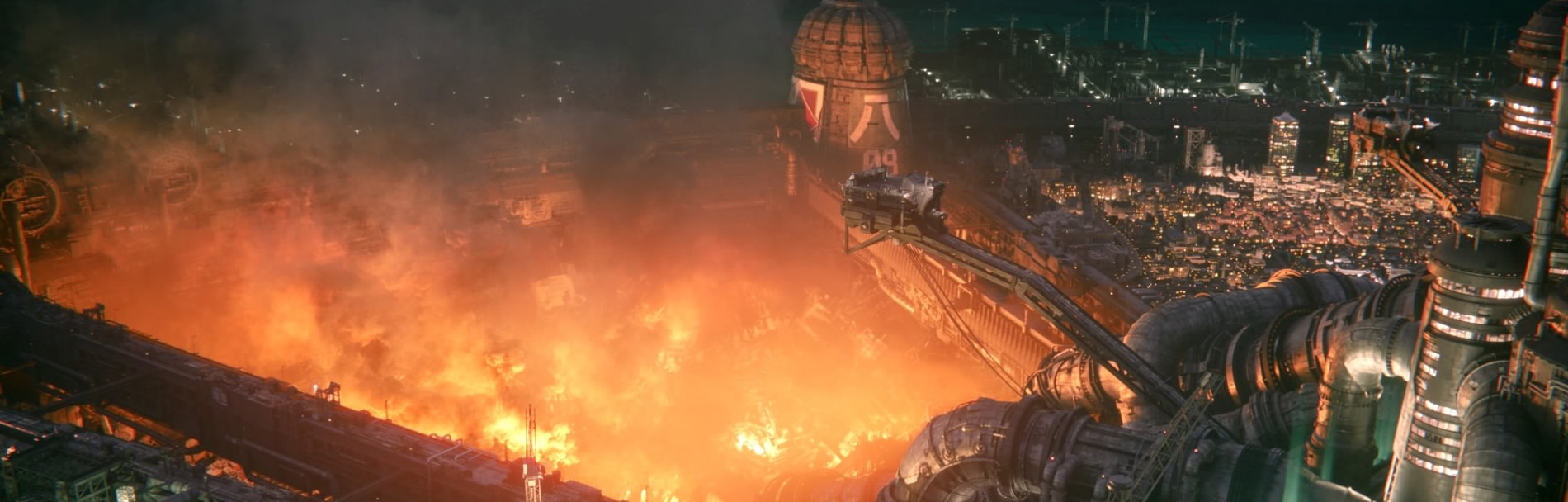
Perhaps the second-most distinctive image of Final Fantasy VII is the end of its prologue, where the bomb of rag-tag eco-terrorists AVALANCHE destroys a reactor which is being used by mega-corporation Shinra to drain the life energy of the planet. One of the quiet changes between the original game and the remake was the shift in intention behind the bombing that the game’s prologue focuses on. The bombing is cataclysmic in scale in both versions, but the remake puts extra time into emphasizing that Jesse didn’t intend for the bomb to be as destructive as it was. There were also some suggestions that Shinra made the damage worse to further implicate Avalanche.
From what I could find in English-language media there wasn’t an explanation for this change in emphasis, and it doesn’t quite add to either the multiversal time chicanery, or tap into the hauntology of the game. If I was being cynical I’d say it was the kind of softening that almost inevitably happens when you want to make something on this scale – especially in a modern context. Despite this arguable dulling of the messiness of Avalanche’s actions, the bomb itself is a powerful image.
A political bomb is not just about fear, or shutting something specific down. After all, you can’t really predict the journey shrapnel and chemical reactions will take even if you can try and mitigate some risks. It’s about heightening a contradiction, forcing a wheel to spin with the belief that it’s inevitable a better world will come or you can force that into existence. Sometimes that belief comes from the divine, sometimes it’s from historical materialism, sometimes it’s just overwhelming power. Whichever way it goes, the process is fairly parallel. Of course, the substance is very different between different political bombings and the worlds they seek to bring into being. In the of-course hypothetical world where violent men with god complexes ran companies that sought to drain the lifeblood of the planet itself – maybe I’d reach for something louder than a placard.
THE BOMB + THE GAMES INDUSTRY
This is the basis of the contemporary tech industry, to “Move fast, break things!”, except the “things” are usually workers or the environment. It’s an approach adopted by the executives running the games industry as well.
FFVII and its remake series are both scale escalations. With the 1997 game being the first in the series to use 3D computer graphics, it represented a significant jump in technical scale. In some ways it’s only natural that the remake also presents something of a shift as well. However, while the shift from the turn-based model to mostly real-time action RPG is a significant one, it also came along with a lot of bloat and the contemporary insistence that all games produced by major publishers must be increasingly large. There’s the assumption that this increase in scale will also result in an increase in profit, but as FFVII Rebirth proved that doesn’t actually reflect reality. Square Enix president Takashi Kiryu said in a briefing to shareholders that: ‘In the HD Games sub-segment, we released multiple new titles, including major titles such as Final Fantasy XVI and Final Fantasy VII Rebirth, but profits unfortunately did not meet our expectations.’
However, the response to the reality that infinite growth has its limits is rarely to scale down, or reconsider, or pause. Instead, the answer is mass layoffs and attempts to plunge headfirst into new technologies like generative AI that have destructive environmental effects – with Sony recently acquiring AI gaming startup Cinemersive Labs, and Microsoft pivoting its entire behemoth towards generative AI. In a document released in 2025 entitled “Progress Report on the Medium-Term Business Plan,” Square Enix laid out a goal aiming to “Automate 70% of QA and debugging tasks in game development by the end of 2027” – which would seem to imply mass QA layoffs. In other words, the belief is that these major companies can simply blow their structures up and the divine power of capital/technology will make sure the numbers continue to go up.
THE BOMB + DISASTER CAPITALISM
Our contemporary corporations and wealth funds and shadow banks understand the power of an explosion all too well. Disaster capitalism is a concept coined by Naomi Klein describing a dynamic where political actors and corporations use disasters as a platform to institute policies and ideas they wanted to implement anyway. The most obvious example of this in the recent-ish past being how corporations used the health risks created by the Covid-19 pandemic to push for automation and a decrease in human customer-facing services, which continues through to the present day even when those same corporations don’t acknowledge Covid-19 anymore.
Perhaps more cynical than just the vulture behavior is that disaster capitalism also creates a perverse incentive to create or accelerate the disasters which they use as a launching platform. Many of the economic forces involved in genocide in Gaza and the Congo, or in international law-violating wars of aggression understand this keenly. It’s much easier to force desperate people into extractive economic relationships when you’ve fundamentally destabilized their society. This only gets exacerbated in grotesque ways with prediction markers like Kalshi where people bet on when and how the next war crime will be committed.
That’s a bomb. Whether it’s an actual bomb or haphazard economic policies, or state forces laying siege to cities domestically, the approach runs in parallel. Everything is based on the belief that if you simply destroy and burn then things will change in your favor. Perhaps it’s the divine, but more often the real belief is just based on raw power, the ability to exercise violence on a massive scale until you get your way.
AFTER THE BLAST
The one thing that I can agree with these executives on is that these industries cannot continue to operate how they have done for the last few decades. It is clear that a change will come, whether or not it is accelerated via detonation. The question is really just whether what comes after this change is just or something worse. The answer to that in terms of the world at large is maybe too much for the end of this column, but insofar as the games industry goes there are clearly starting points.
The union movement within the industry continues to grow globally to counteract the damage, with the Game Workers’ coalition challenging Rockstar on its working conditions and their firing of union organizers. Additionally, some of the most influential (and financially successful) games of the last decade like Stardew Valley have come from outside of these growth-obsessed behemoths. Movements like No Games for Genocide have developers pledging to not take funding from Microsoft until they end their complicity in apartheid. There is a future of art in this space, beyond cycles of extraction and exploitation and implosion, let’s hope this moment of rupture can be seized to take us there.
———
Oluwatayo Adewole is a spectre whispering hauntological secrets and begging Square Enix to let Barrett’s scalp have a break from the chemical relaxers.