Tom Morello Knows Final Fantasy Is Political
Visit the MIT Press shop
This column is a reprint from Unwinnable Monthly #198. If you like what you see, grab the magazine for less than ten dollars, or subscribe and get all future magazines for half price.
———
Ruminations on the power of the riff.
———
This is not a profound statement nor an original thought. I’m uncertain whether this is a direct quote of anyone specific, or merely common knowledge that gets passed around in writerly and artistic social circles. I would not be surprised if another writer references this exact same sentiment in this very issue of Unwinnable. The argument is that all art engages with politics because creative work is inseparable from its social and political environment.
Spelling out this concept may be stating the obvious, yet it’s worth establishing a shared understanding of what it means for art to be political, because the core concept offers useful framing for understanding why we would dedicate an entire issue to the politics of Final Fantasy. Despite most entries in the series being centered around tangentially political themes, they are not often discussed in the media through an explicitly political lens. Thus, it wouldn’t be surprising if this choice in theme confuses anyone or comes across merely as a joke.
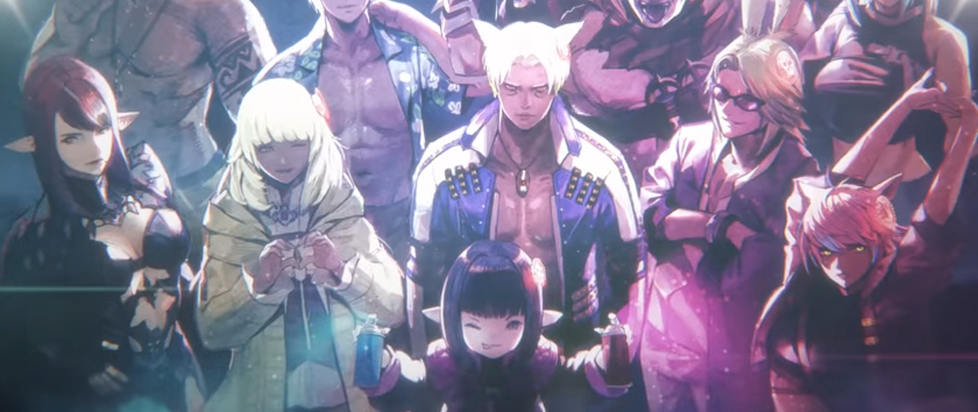
As a case in point, look at the response to the recent collaboration between Rage Against the Machine guitarist Tom Morello, Beartooth vocalist Caleb Schomo and Final Fantasy XIV composer Masayoshi Soken for the in-game track “Everything Burns.” A lengthy thread about the song on r/ffxivdiscussion opens with one commenter saying, “tom morello is afraid of giant respawning snake monsters and I for one agree with him.” Conversely, most comments on the official YouTube video (which has more than one million views) focus either on its sheer improbability of existing or how much it rips when it’s blasting in the game.
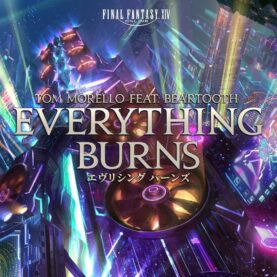
In other words, most of the discourse has revolved around gently mocking the absurdity of Morello, whose name is synonymous with serious progressive activism, writing a song for a videogame that isn’t widely perceived as being political in any sense that matters in the real world. And on the surface, it does seem like an odd pairing. In an interview with Eurogamer, Morello says, “For me, ‘Everything Burns’ is both a reflection of the world that we’re seeing and a warning, irrespective of anyone touching a controller, or a computer, or playing a game. This is a song that has a life – a very vibrant life – within the game. And my hope is that it has a very meaningful and vibrant life outside of the game as well.”
Outside of the context in the game, most players probably wouldn’t interpret “Everything Burns” as overtly political; it isn’t exactly “Bulls on Parade” or “Killing in the Name.” Yet it does deliver a message of standing up for yourself in the face of overwhelming odds, and even if Morello might have oversold the profoundness of its message, it’s hard to argue that the sentiment of his interpretation of the track isn’t broadly relatable. It may be boss battle background music, written quickly to serve a somewhat utilitarian purpose, but it does have some deeper meaning for those who care to extract it (and that meaning fits the game better than most give it credit for).
Indeed, within the context of the game, Final Fantasy XIV is not subtle with its handling of political subject matter. The aforementioned piece from Eurogamer notes numerous themes – colonialism, nationalism, class warfare – that are central to Final Fantasy XIV’s plot. It is not merely adjacent to loose political themes; politics are core to its narrative. The game may not have an explicit political agenda it’s trying to advance, but those are explicitly political themes, and they do align with the sorts of very real things Morello and the rest of Rage Against the Machine have been railing against since the early 1990s.
If there’s a parallel between Final Fantasy and Rage Against the Machine, it may be that the political content of their messaging is often misunderstood. Even though most people familiar with the latter understand their music is explicitly and radically political, that understanding is far from universal. 2012 Republican candidate for Vice President Paul Ryan learned the hard way that he was, in fact, part of the machine being raged against after he said in public that they were one of his favorite bands. This was a public display of ignorance on a level that even The Atlantic couldn’t rationalize.
Art is political and criticism serves in part to extract meaning from art. Yet when you tell a normal person that you’re writing about the intersection of politics and Final Fantasy, the reaction you’re likely to get is that this connection is anything but obvious. The moral of this story is core to what I understand this publication’s mission to be, to allow space for its writers, and for those reading this work, to look deeper at the art and media we love. If there is any question why we would spill so much digital ink over the topic of politics in Final Fantasy, then, a better question might be why we’d choose to write about anything else?
———
Ben Sailer is a writer and critic who has been freezing in Fargo, ND for more than two decades. You can follow him on Bluesky.