The Paragade Paradox
Visit the MIT Press shop
If there’s one thing I’m happy we left behind in the seventh generation of videogames, it’s the strict binary morality systems. It felt, for a bit, like every RPG and narrative game had these kinds of toothless moral quandary to come across as a more elevated, more contemplative art form. Do you want to help a town of people… or do you want to murder them for no reason? Do you want to play a game about characters growing and becoming better people, or do you want to derail the whole plot in favor of the antisocial euphoria of cruelty for its own sake. For a lot of games from that era, it really is this binary.
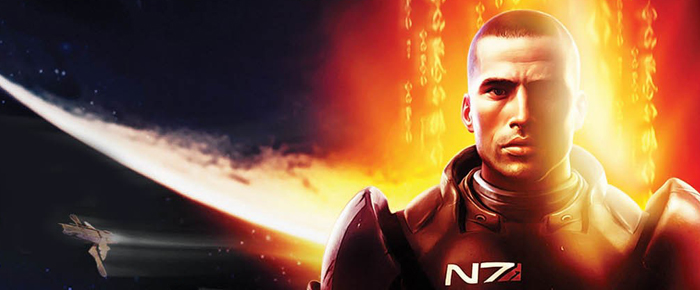
It’s been more than a decade since I developed my obsession with the Mass Effect trilogy, and I’ve played all three games enough to have taken almost all of the choices offered up, whether aesthetic or game-changing, and I’m stunned by the way that the games try to force Shepard down one of the lanes on offer. She (and I’m using she because I think Hale’s Shepard is a better, more interesting, slightly more fragile character than Meer’s) is either a Christ-in-the-making who never succumbs to the stress of a situation, or the baddest cop in the entire galaxy who is only good in comparison to the big genocide machines.
A lot of the major narrative choices, split between Paragon and Renegade, inhabit this same hollow binary – Shepard can either keep a promise and do the right thing, or do none of that big-hearted shit in favor of just getting things the hard way. There’s an interesting dichotomy at the bottom of this, because the space opera of Mass Effect wants to embody the world of necessary evils: Sure, Jane Shepard can do the right thing, but should she when the galaxy is at stake, and the more ruthless option is far more pragmatic?
In reality, the Renegade options are more often than not comically awful – at least, the big ones. I can’t have the complex discussions over motivation and background with most players because they’re so outwardly rancid. In other games, such as Fallout: New Vegas, which also uses a somewhat archaic karma system but thankfully places it on the back foot, I can still debate endlessly the four main paths and appreciate the different viewpoints of other players even when I disagree with their preferred direction.
It’s a bit obvious to me that the writers centrally wrote for a paragon/selfless Shepard, and then wrote the renegade options as a bit of an afterthought. And this is fine! It’s fulfilling to be a hero, and the type of science fiction that Mass Effect is emulating is very much about people overcoming the odds to make things right. But a character who is never challenged, who never lapses, becomes saccharine quickly.
Jane Shepard is not entirely a blank slate, either: the player does get to choose both Shepard’s background and her existing reputation, which unlocks a sidequest or two in each direction. This gives us the impression of a Shepard who can be a bit more fluid. For example, I always choose for Shepard to be an orphan who slummed on the city streets of Earth, who joined the Alliance to escape the endless cycle of meaningless violence. I also make her ruthless, a woman dubbed the “Butcher of Torfan” for her willingness to do what had to be done to end a conflict.
Both of these choices predispose a Renegade variation of Shepard, and yet I still choose the majority of the blue (good) options offered to me. Despite the selection that is always available to me, the games do largely want the player to pick a direction and stick with it. There are mechanical limitations for this: Each time a player picks an option in one of their directions, a point system ticks upwards. At the end of Mass Effect 2, for example, there are two instances of party members getting into conflicts that require a very high score in either direction to settle. If you cannot do this – if Shepard has not been the goodest girl or the gnarliest girl, you permanently lose the loyalty of the party member whose side you do not take. In my first playthrough of that game, despite completing every mission and securing every party member’s loyalty, I lost Miranda Lawson and Tali’Zorah in the Suicide Mission.
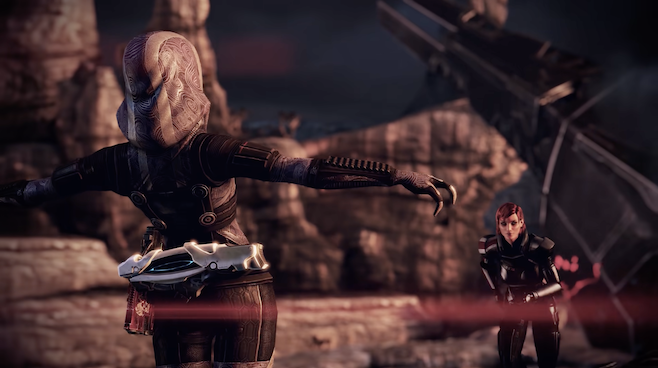
The game punished me for having a Shepard who was willing to be more fluid, who could be both kind and ruthless as the situation necessitated.
Mass Effect 2 also introduces “Interrupts” into the series, which work as follows: during a cutscene or exchange, Shepard can essentially receive an impulse to act in a certain way while another character is speaking or acting. These too are either paragon or renegade. These are wonderful for Shepard’s characterization as her own character. We can see her impulses beneath, even if we do not act on them. Sometimes, though, there’s something to be lost in not taking them. Knowing that a battle is inevitable, Shepard takes the first shot while the lead goon of the latest group monologues. If she doesn’t take that action, he gets the first shot when the cutscene ends. One of my other favorites is Shepard using a repair tool to kill a criminal mercenary building a gunship, quietly insisting that he “stop working so hard” before zapping him. Ruthless? Definitely. Within the realm of a pragmatic hero? Absolutely.
The binary nature and the meters that must be filled to open more activities create a paradox between offering the choices to the player and the consequences of fluidity. A “paragade” Shepard (which is what my preferred style is called) may have less agency to act later in the game than one who adheres strictly to one side. In my earliest playthroughs, I hesitated to take an interrupt or a response that fits my characterization of Shepard out of a fear of locking myself out of a future action. The systems encouraged me to play a less interesting character.
Having played through the series too many times to count, I’ve gotten into the habit of arranging my play in this certain way: Shepard starts Mass Effect with the aforementioned background, but I choose almost entirely Paragon options. She’s been ruthless, she’s capable of cruelty, but the Shepard we meet is one who is trying to adhere to her own better nature. She holds her tongue, she plays diplomatically.
Then Shepard dies in Mass Effect 2’s introduction, and upon her return the lack of positive change sours that mood. Having to work with Cerberus – a human supremacist organization – fractures things further. The realization that the weight of the galaxy is entirely upon her makes her more ruthless, less hinged. She’s more willing to kill and strike first because every moment matters. Her dialogue becomes more bitter. I start choosing more cynical dialogue options. In a few loyalty missions, I take the red option: Garrus Vakarian was betrayed by a man he trusted. Who am I to tell him that he must forgive? The Quarian Flotilla condemns Tali’Zorah for the sins of her father? They’re morons, they’re insipid fools, and Shepard is going to bark at them until they realize just how stupid they are.
Mass Effect 3 brings the Reapers, and the refusal of the galaxy to stop playing politics in the face of annihilation pulls away more and more of what Jane Shepard wants herself to be. By this point, I’m choosing as many acerbic options as I can get away with. She’s not trying to be better, any more, she’s just trying to survive. When that final choice comes around, all that matters is killing the Reapers. The other choices are namby-pamby bullshit.
I still end up choosing the monumental paragon choices, because their renegade alternatives are far more dissatisfying and less in character. Jane Shepard, even at her worst, is going to do the right thing. She’s just not going to be nice about it.
I remember some marketing around Mass Effect 3 that invited players to compare and contrast their Shepards, but the games are engineered such that there should only be two. The choices she makes are often binary (or there is an ideal third option – but that too is still framed as either a Blue or Red ideal, you choose) and yet there’s so much wiggle room for an interesting character that the games seem uneasy to permit in full.
The irony that my favorite protagonist’s personality, development, conflicts, and ideals are something that I’ve brute forced within the game is not lost on me.
———
J.M. Henson is a freelance critic/author who haunts the Blue Ridge Mountains and is in turn haunted by most things out of their control. Follow on Bluesky.