Gaming to Remember
Visit the MIT Press shop
As a child of the ‘90s, videogames always felt like a race against the clock. I fell in love with roleplaying games for the narratives, but I only had so much time to get through them before they had to be returned to our local rental store. Doing so was always a gamble. Sure, I might be able to rent the thing again later, but my save file was stored on the physical copy of the game. All evidence of my progress could be lost if someone deleted my file. As a result, I played for long hours each day, trying to experience as much of the story as I could before it might be lost.
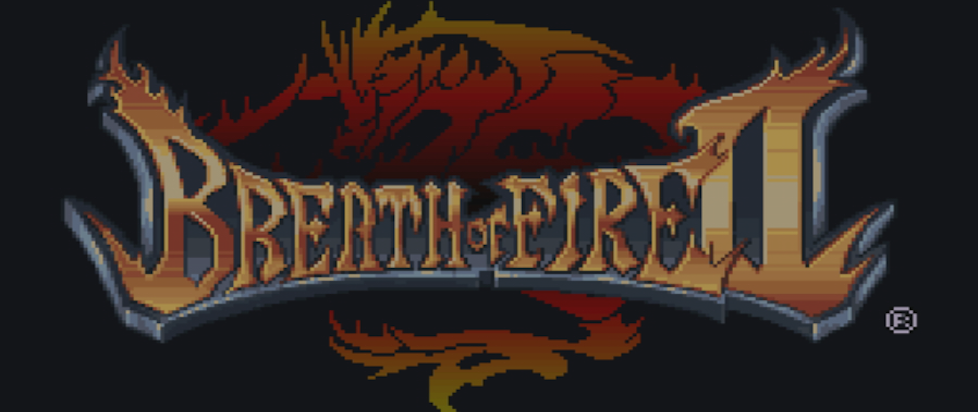
On one trip to the store, I came across Breath of Fire II. The opening of the game still takes my breath away. In it, you join your father and sister to visit a long-sleeping dragon who mysteriously appeared to defend your town the same night that your mother disappeared. The game invites you to hang back alone and close your eyes to hear the dragon’s voice (later revealed to be your transformed mother). After falling asleep, you wake up to find that what remains of your family has disappeared and all of the NPCs you talked with mere moments ago act as though they have never met you. This act of forgetting renders the main character an orphan, leads to a life of suffering, and serves as a central mystery that drives the plot forward. Later in the narrative, it becomes clear that a demon named Aruhamel is responsible for erasing the memories of everyone in your hometown. Defeating the monster is required to advance the plot, but doing so is fairly easy. Aruhamel barely attacks, instead inflicting status effects on your party (like amnesia).
Replaying these games from my childhood has been a fascinating view into how things change with distance. Those sprawling dungeons that seemed to take hours as a child turn out to be just a few rooms, easily navigated by an adult. An unstructured plot that leads you to wander a world map turns out to be bread crumbed pretty significantly if you talk to the right NPC1. The dialogue that I found captivating as a child can feel hamfisted with the benefit of years2. Most saliently, I am no longer worried about how quickly I will need to return a game to the store, but I do think about time and memory more than ever.
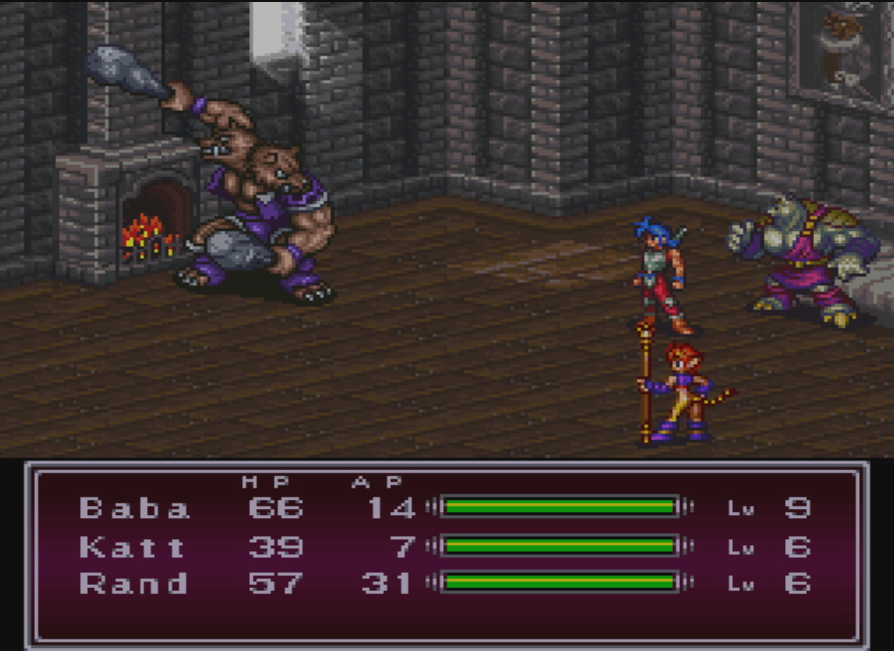
In some localizations, Aruhamel is rendered as Alzheimer. While I played Breath of Fire II as a child, my parents were in the midst of the same fight. My great aunt suffered from advanced Alzheimer’s disease around the same period, and my parents provided care for her over a number of years. The disease is devastating. Watching someone you love slowly forget pieces of themselves feels like a million small battles, most of which you lose, fought each day. As a child, my parents largely spared my siblings and me from this caregiving. But it was impossible not to see and feel the effects on them each time we returned from a family visit.
It’s become an Internet joke that Japanese RPGs escalate quickly, asking you to attend class on Monday and fight God on Friday. But this narrative arc also elevates these human concerns, recognizing the stakes for those dealing with such issues. Embedding everyday trauma in a game also makes it manageable. Alzheimer’s and dementia are no longer incurable illnesses. The right item can lead you to their cause. The right battle can prevent memory loss and restore the narrative. Such wish fulfillment might be a fantasy, but it also can be powerful for the dreamer. It’s no accident that the item you use in Breath of Fire II to find the memory-eating demon involves an item called a therapy pillow. Very on the nose.
Retro gaming can feel like an exercise in nostalgia, a longing for a past media experience that wastes valuable time in the present. I now have children of my own, rapidly developing their own interests and imaginations. As I age, I often wonder how much memory loss is inherited and what memories will last, for me and for them. Revisiting older games has become a way to recover memories and stories from my own life to share with them. Once, games like Breath of Fire II helped me to make sense of and manage life events that were too big and confusing for my age. So, too, might they do the same for my kids one day.
———
1 “I hear that everyone in the town due west has wings! No reason!”
2 “We are here to defend the sorceress from attackers! You seem fine though.”
———
Brandon Walsh is a teacher and writer who holds a PhD in literature and lives in Virginia. You can find more of his work at Backlog, on walshbr.com, or on bluesky.