Something to Touch
Visit the MIT Press shop
 This is a reprint of the feature essay from Issue #95 of Exploits, our collaborative cultural diary in magazine form. If you like what you see, buy it now for $2, or subscribe to never miss an issue (note: Exploits is always free for subscribers of Unwinnable Monthly).
———
Were it not for the intervening screen, I could take that withered hand in my own. There’s no tennis ball on a stick, nor an actor covered in motion capture dots – Gorcha, the vampiric antagonist of 2023 French film The Vourdalak, is present in all his inhuman proportions. The skeletal body with sunken cheeks and bulging eyes, reduced to a pile of rags in his son’s arms, is a puppet.
The puppet lays bare the truth Gorcha’s son refuses to see: this object is no longer his father, but a corpse. Its stiff movements and the unreality of its visage enhance its impact, especially in contrast to the live performers alongside it. More reminiscent of something made for the stage, its design is simple; it lacks the animatronic bells and whistles commonly seen on film sets. The point is not realism, but presence and sensation. When that hand, with its skin flaking away, is pressed against the bangles adorning doomed daughter Sdenka’s wrist, its immediacy demands attention.
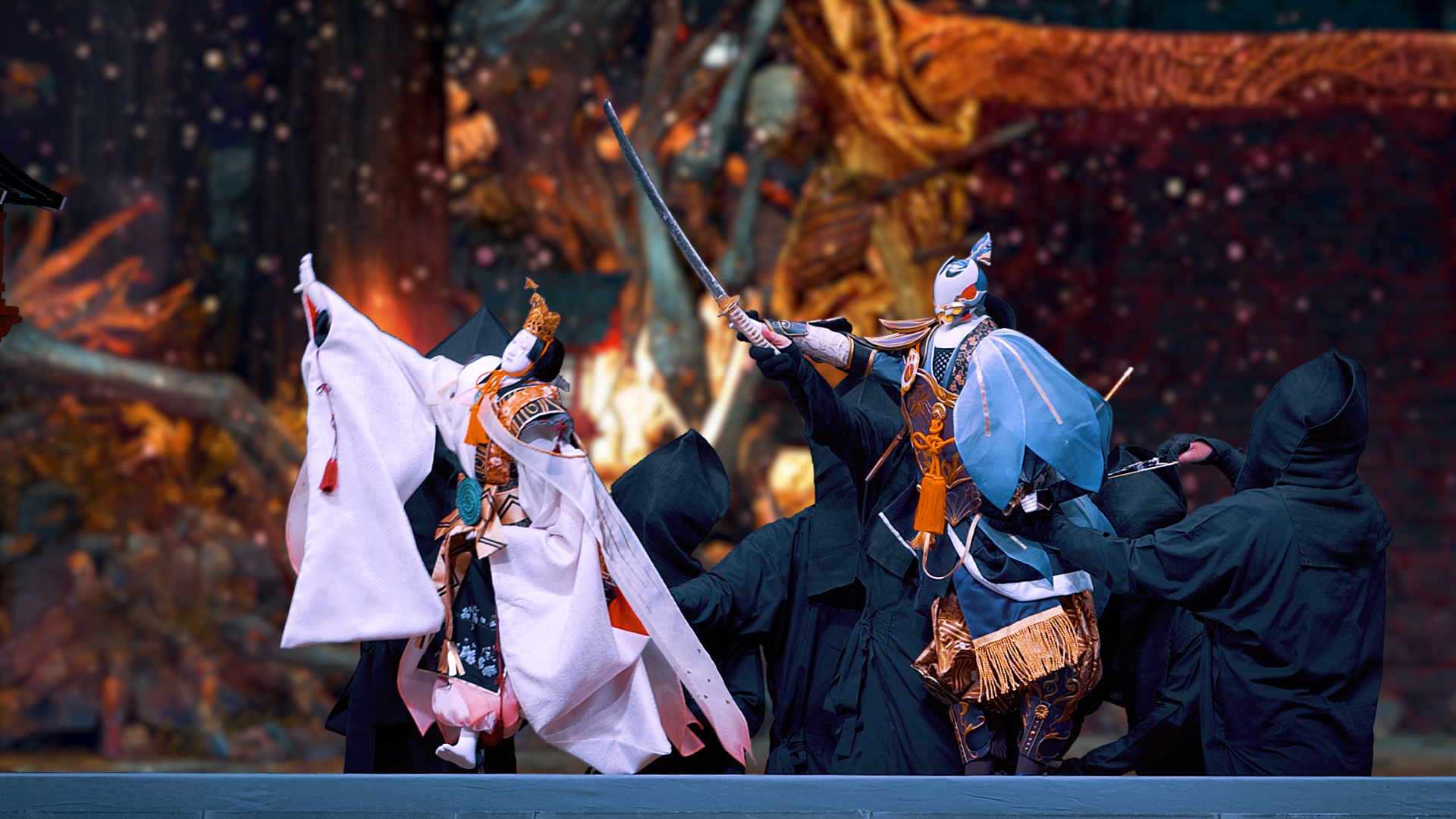
Where The Vourdalak leans into artifice to emphasize the wrongness of its titular vampire, Kunitsu-Gami: Path of the Goddess uses puppetry – and more – to marry the physical with the digital. Shortly before the action strategy game’s release, Capcom published a filmed bunraku play that introduces Kunitsu-Gami’s fantastical setting. In “Ceremony of the Deity: The Maiden’s Destiny,” protagonists Soh and Yoshiro take the form of traditional puppets, each operated by three black-clad performers from Japan’s National Bunraku Theatre. Like the characters in the game, the puppets perform a kagura dance that purifies the enemy Seethe, cleansing Mt. Kafuku and its residents of defilement.
The physicality demonstrated in “Ceremony of the Deity” extends to Kunitsu-Gami itself. Accompanied by NPC villagers, Soh and Yoshiro navigate a series of digitized dioramas constructed from scans of handcrafted miniatures that were stitched together with computer graphics. The roof of the shrine, a location central to the plot, is made of used coffee grounds. On the other side of the coin is destruction: fireworks, flames and exploding miniatures were filmed and integrated into the game’s visual effects. The same process was applied to Kunitsu-Gami’s costumes, which were worn by human models when scanned, capturing the fabrics’ weave and drape. Likewise, a selection of Japanese desserts was also digitized. The seasonal sweets, among them minazuki and sakura mochi, were handmade by artisans from 220-year-old confectionery Tsuruya Yoshinobu.
The final product is not imbued with a sense of realism so much as texture. Though overlaid with a coating of digital sheen, the objects populating the game cohere to form a world that is palpable.
Lips peeled back, Gorcha’s bloodstained grimace does not look “true to life” (or death, for that matter). But if I were near, those teeth could close around my fingers. When I puppeteer Soh, using a controller as an intermediary, I am at the same level of remove as I would be with a game wholly rendered digitally. But somewhere out there, hands once traced along the grooves of molded cobblestones flecked with moss, and felt the warp and weft of woven sleeves.
That’s enough for me.