When A Series Just Isn’t Into Itself Anymore
Visit the MIT Press shop
Stories are inherently iterative, malleable, and messy, no matter the medium they’re presented in. Experimentation is a good thing, and I typically defend games that take wild swings – The Bureau: XCOM Declassified, Resident Evil: Revelations 2, and so on. It’s even what prompted me to write in Exploits about how, despite being tied to a monolithic name and corporate greed, there’s still an oddly alt-flavored heartbeat struggling beneath all the gruff military jargon in Call of Duty these days.
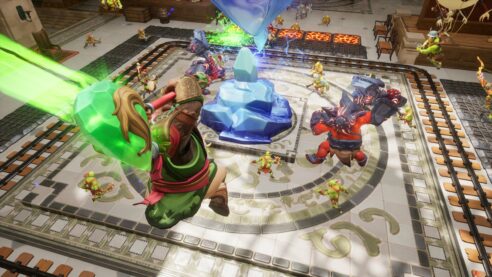
Yet I finally had to eat my words when it came to the latest iteration in one of my favorite series, Orcs Must Die!. It’s a hybrid shooter/tower-defense series with a rocky history. The first two games are certified classics, but then things got weird. There was a MOBA entry that nobody wanted. The fourth game had too many gimmicks and balancing issues. And this latest swing is all the more confusing: Orcs Must Die! Deathtrap, a four player rogue-lite co-op shooter that actively fights its own core ideals.
The point of these games is to feel clever – like solving a puzzle, you can subvert a map into the perfect killbox against your opponents. There was some work getting to that point and experimentation on the player’s part, but nothing like Deathtrap puts you through, it’s mostly excessive grinding for meager state boosts. The levels are so wide open most traps aren’t practical – made worse due to them cutting and nerfing several traps and weapons. The rogue-lite nature means players can’t just kick back with their preferred map for an hour. It’s all so strangely hostile.
Here’s the thing though – it’s not hard to surmise why this happened. Robot Entertainment have been iterating on this series for well over a decade now. I was a teenager when the first game dropped. So I can understand being tired of making more of the exact same game, especially after your first spin-off doesn’t land well at all. Yet right now, it’s their only real ongoing franchise, and we’re at a point where taking risks in entertainment is more terrifying than ever. From a studio management perspective, I can understand the calculus of sticking to a brand name people know, even if it adds up to a contradictory game. I just also don’t see the point of a half-measure like this. If you’re going to pivot, you have to commit.
Let’s go back to that MOBA spin-off for an example. When Orcs Must Die! tried to copy the League of Legends formula, traps were relegated to a secondary element for dealing with mobs, and that… was it. It was a garden variety MOBA, indistinguishable from the rest of the genre. Other than an over-the-shoulder camera, nothing said “this is an Orcs Must Die! game” other than arguably the aesthetic. It’s why, even when they pivoted the game to be a PvE experience, it just didn’t click.
By contrast, when Titanfall released a free to play strategy game on tablets, it worked well because they leaned into what made Titanfall special. Units were agile as they traverse around each location. The very namesake of the series was used as an explanation for deploying units anywhere on the map at any given time. The different roles of the infantry, support units, and Titans allowed for an array of tactical options. The game already being built around tight encounters of 6v6 battles meant that the scope of fights worked well. Yes, it was chasing after that Clash Royale money, but it had the right flourishes to warrant its own cult following. So if you’re going to swing for something new, really swing for it, and make it stand out because of your IP’s strengths.
We even see this twice in a row with Titanfall given the ongoing success of Apex Legends. Despite getting rid of the titular Titans, and for a while not even having a character with similar movement options to that of a Pilot, Apex Legends retains what made the core experience fun. It’s those frantically fast encounters between a handful of players with simple to learn, hard to master tricks across flexible maps that encourage creative thinking. You feel like Spider-Man with a gun. It’s incredible.
And for contrast, think back to the turn of the millennium with Team Sonic’s many, many ill-fated spin-offs and soft-reboots. Sonic Adventure tried to make the story the emphasis. Then Shadow the Hedgehog added swearing, guns, and branching narrative with moral choices – all in a platformer. Sonic (2006) is a ball of yikes too difficult to sum up in a single sentence. Then they made him a werewolf. Then they had him fight alongside King Arthur and a version of Merlin that was a young elf girl for some reason? They had BioWare make a full-scale Sonic-focused turn-based RPG for DS. And no I’m not making any of these up. None of these twists and turns had anything to do with just moving really fast while making precise jumps in a cartoon world.
Yet when they made a Sonic game about racing in vehicles that transform and navigate the environment in unique ways, it was a hit that led to a sub-series that is still going to this day. Go figure.
So do I think Orcs Must Die! could work as a four-player horde mode game where the emphasis is on the players rather than the traps? Sure, if it’s still about finding creative ways to subvert enemy encounters to your own ends, ideally with unique combinations of abilities. With the right character builds, smaller scale maps, and enemy design adjustments, Deathtrap could’ve worked brilliantly. It could’ve been Mass Effect 3’s multiplayer, but medieval.
Or if they wanted to keep the building element, there’s other ways to do that. They could’ve done the Fortnite thing and leaned into buildable structures – those were already partially explored in a more prefab style in the last game. They could’ve pivoted hard into just PvE combat with traps being pre-installed in levels, maybe with some branching upgrades for characters or the traps for some variety. There are ways this could’ve worked. If anything, the strangest aspect is the stubborn insistence on limiting how many barricades players can place.
In prior games, barricades were a high-skill investment to get more out of maps, not a necessity. They cost a lot, but they could crucially delay enemies. Deathtrap makes them free because you have to use them due to how wide every map is. Except you could only place 16 of them, until a fan outcry. Now you can place 22, with the cost of 5,000 rune coins (essentially 12%-25% of the currency earned per-wave) to get one more per-wave for the rest of your current run. And players had to beg for this. I was there, in the comments section, watching fans try to explain how it was nigh-impossible to play Deathtrap like prior entries, and be told no, they just didn’t understand.
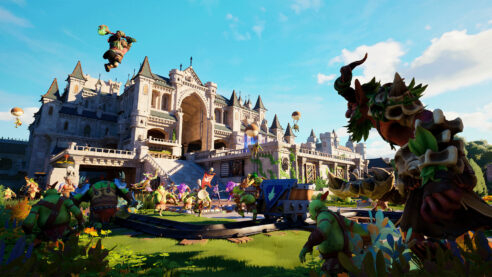
Modders have had to step in to make the functionality at least available to anyone playing on PC. And thank goodness they are, because it’s the one thing that at least gives the game a fighting chance. It wasn’t until I installed mods that I realized how much of my chagrin while playing was simply because of the barricade limit. There are some absolutely outstanding trap opportunities that could be harnessed by players… but they never will, because it’s objectively a bad idea to prioritize one set of enemy spawns over a more practical defense. In a game made to be about variety, it’s actually stifling your creativity. It’s the opposite of what these games are all about, a quagmire too many games have fallen into over the years.
And I’m not saying that sticking to a series’ tenets will always lead to success. Remothered: Broken Porcelain doubled down on everything the first Remothered did… and it did not work out well commercially or critically, despite the first game’s success. Much as it vexed me when Shigero Miyamoto was revealed to be passing on any new F-Zero games unless a new innovation hit him, and Gabe Newell expressing similar sentiments towards Half-Life 3, the alternative isn’t ideal either. Battlefield 2042 was and still is an absolute mess of contradicting design choices after the shaken confidence over Battlefield V’s ambitions, struggling to find a creative way forward. I can’t even predict what Halo is going to look like in the next few years after three hard pivots in a row.
So it begs the question – when is it time to try something radically different, or just start new? There’s no one-size-fits-all answer, sadly. Sometimes the exact moment everyone assumes an IP is dead, it revives again. Just look at Siren: Blood Curse, Resident Evil 7: Biohazard, or Deus Ex: Human Revolution. Sometimes a little time on ice is just what a series needs to find its way. Yet there are times when enough is enough. I’m still making my peace with the fact Sony seems to outright despise the Resistance, inFamous, and Killzone games that first drew me to the PlayStation 3 all those years ago. Same goes for Halo, which I just have to headcanon as ending at Halo 4, because otherwise none if it makes sense anymore.
In a world where we’re seriously getting a semi-direct sequel to The Rise of Skywalker because Disney’s executives need more diamond studded swimming pools, there’s value in an ending. We can take a bow, accept the accolades, and start anew. It’s even something I’ve had to grapple with as a creator. When it comes to my new column for Unwinnable Monthly, I was tempted to pitch just reviving one of my old columns from my Escapist days. It’d be so easy to bring back Second Look or The Stuff of Legends. Except those had their time. They’re done. We all have to move forward, lest we become Brennan Lee Mulligan’s the Oreo CEO skit, weeping in despair at our own works. Better to find joy in what comes next.
———
Elijah Beahm is an author for Lost in Cult that Unwinnable graciously lets ramble about progressive religion and obscure media. When not consulting on indie games, he can be found on BlueSky and YouTube. He is still waiting for Dead Space 4.